 The Assay
Vic Doyle had stayed late to photograph the inside of a gorget. The condition report was finished, his tea was cold, and he had taken six photographs of the same mark without getting the light right.
He lowered the lamp until it was almost level with the bench. There. Both impressions, and the thin ridge between them.
From the front, the gorget of Duke Albrekt's garniture was a plain piece. Two overlapping plates for the throat, a roped edge, steel that had been blued once and was now more or less the colour of a pond in February. Tourists walked past it on their way to the helmet. Under this light he could see fine scratches along the roped edge, too shallow to feel through his gloves.
On the underside of the lower plate, the maker's mark was struck twice. Same punch. Two strikes, a hair apart, so that the little crowned hammer overlapped itself like a badly registered print. He had found it in the spring and he still came back to it. Somebody in a southern workshop in fifteen-eighty-something had hit the punch, not liked the depth, and hit it again. Then, presumably, sworn, because you cannot un-strike a mark and the Duke was paying by the piece.
The catalogue gave the Duke half a page. There was no name for the man who had made his armour. Vic tilted the plate a little further and took another photograph.
"You're humming," said Owen from the doorway.
"I'm not."
"You are. You hum when you've found something. When you swear it means you've dropped a thing, and I know what to do about a dropped thing. When you hum, I'm going to be told about a rivet."
Owen Marsh leaned on the frame with a thermos in one hand. He was fifty-four, the Arsenal's night guard, and his rounds went through the conservation workshop because it had the good kettle. Tonight he had his coat on over his uniform.
"Going somewhere?" Vic asked.
"When Martin gets here. I'm covering his early shift tomorrow, so he's taking the rest of tonight. Supper at my son's."
"It's nearly midnight."
"He's on late shifts. So's Ruth. They eat when they get home." Owen unscrewed the thermos lid. "She says she'll put mine in the oven, but that means my son will find it. How's it going?"
"It's a gorget," Vic said. "It's going the way gorgets go."
"Which is?"
"Slowly. Kettle's full."
Owen filled his thermos from the kettle, then made them both tea. Vic set the gorget back on the felt beside its neighbours and peeled off the cotton gloves. He ought to pack up. He moved the lamp to light the whole bench instead.
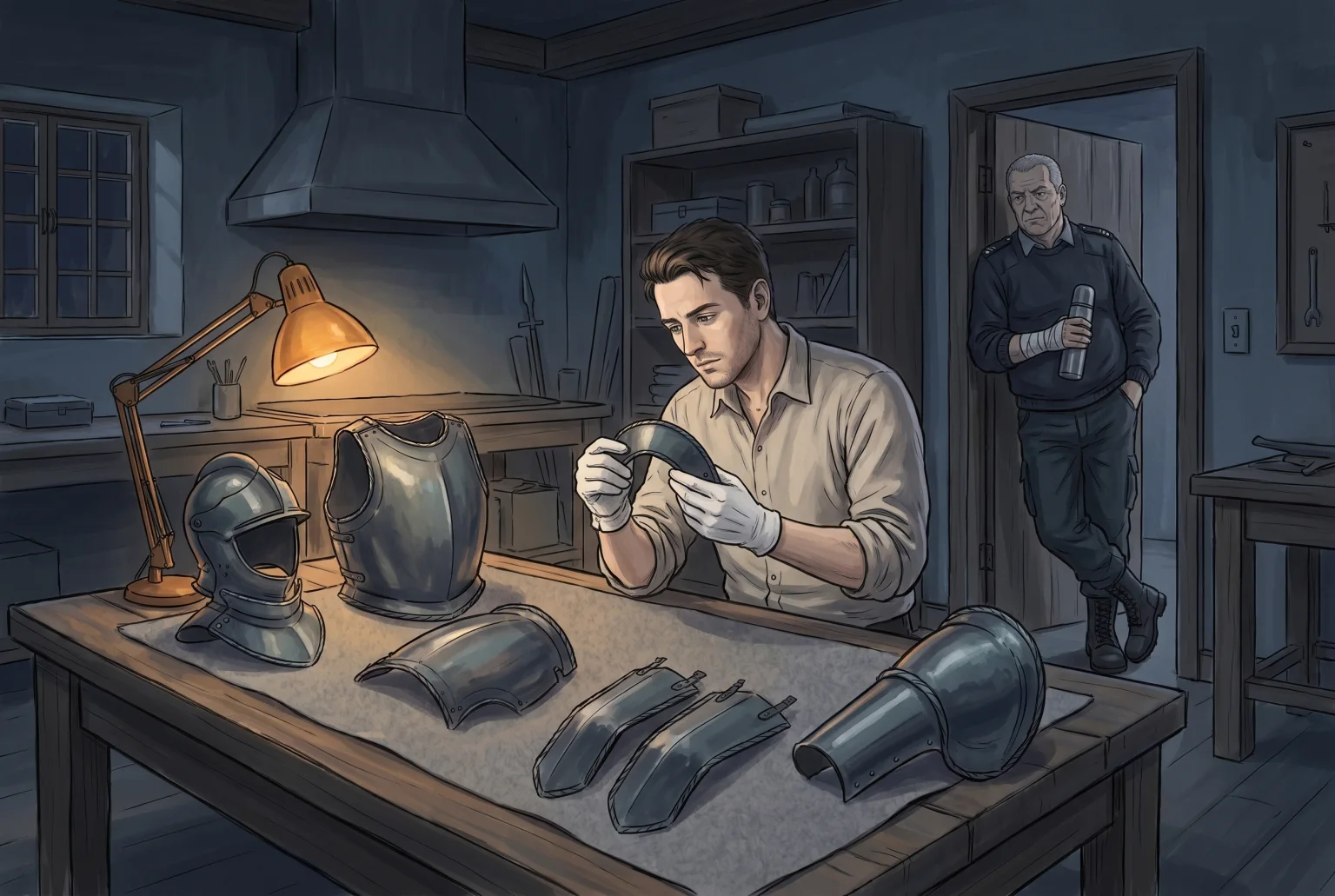
Seven pieces of the garniture of Duke Albrekt of Vendal lay on the grey felt in the order they would go onto a body. Close helmet, with its visor down. Gorget. Breastplate, backplate. Two tassets, the hanging plates that guarded the thighs. And at the end, taking up half the bench on its own, the grandguard: the reinforcing plate that bolted over the left shoulder for the tilt and turned a man on a horse into a wall with a lance behind it. Made in the south around fifteen eighty-one. The grandguard still fitted its stud on the breastplate; Vic had checked that afternoon.
A garniture was armour built as a set. Not a suit; a system. One core harness, and a run of exchange pieces you bolted on or took off depending on the day's work: fighting on foot, fighting on horseback, riding at the tilt, standing about at a coronation trying not to sweat. The best had thirty or forty pieces and came with a book saying which went with which. Every piece had been made to fit the others. Vic could spend a morning matching a row of holes on a loose plate to an engraving in an inventory, and forget to eat. Last Tuesday he had done exactly that. The sandwich was probably still in the staff fridge.
Most garnitures had come apart. Heirs sold pieces; dealers separated them again. A helmet acquired a new attribution, a reinforcing plate went into storage without a label, and a century later nobody thought to put them beside each other.
The inventory of sixteen twenty-two listed eleven pieces for Duke Albrekt's. The Arsenal had seven. Two more sat in a basement in the south museum, four hundred kilometres away, where they had sat for ninety years, not on display and not going anywhere. One had gone to a private buyer in nineteen twelve, who had been private about it, and that was the last anyone knew. The eleventh had not been seen since the inventory itself. Nobody knew what it had been. The clerk in sixteen twenty-two had written one piece more, for the arm, and supplied neither a drawing nor a measurement.
He had spent three years writing to the south about their two. He had been very, very polite, in three languages, on letterhead. In return he had got three years of a gentle southern no that never used the word.
"You've gone quiet instead," said Owen, and put a mug down by his elbow, on the one corner of the bench where mugs were permitted.
"Thinking about the south."
"Don't. It's bad for you. You get a look." Owen blew across the top of his tea. His phone buzzed; he glanced at it, typed with his thumb, then looked at the bench. His eye stopped on the helmet. "That one looks like it wants to say something."
"They all do. That's the problem with faces. You put a slot in a piece of steel and everybody's grandmother sees a—"
The lamp went out.
He waited for it to come back. It was reflex. The Arsenal was a seventeenth-century building on a twenty-first-century grid and the lights stumbled in high wind maybe twice a winter; the trick was to sit still for a second and a half until everything hummed back on, and then carry on with the evening. So he waited the second and a half. Nothing hummed. Under the bench, the humidity unit stopped. Out in the corridor, the green exit sign, which was wired specifically so as never to be off, was off.
His phone was face up on the bench, still lit, suddenly the brightest thing in the room.
"Breaker," said Owen.
"Exit sign's on its own battery."
Owen tried the switch beside the door. Vic could hear him moving in the corridor, opening the emergency-light cupboard. A click, then another.
"Nothing."
Vic picked up his phone. Before he could switch on the torch, pressure closed over his ears. He swallowed. It did not clear. He gripped the edge of the bench and swallowed again, harder.
And then there was writing in front of him.
It sat where his eyes were looking and came with them when they moved. He shut his eyes. The writing remained, crisp against the dark of his eyelids.
He opened his eyes. The line hung in front of the bench. Through it he could still see the felt and the seven dark shapes. He read it, and read it again. He waited for it to go away. Instead it did something worse, which was change.
He read down to the bottom, then went back to his name. Twenty-eight years. He could not think who would have that information and put it here, in his head.
He tried looking past the writing at the lamp. It faded. When he thought of his name it returned, with all nine numbers unchanged.
"Owen," he said.
"Yes."
"Are you seeing writing."
He heard Owen put his mug down.
"I'm seeing a list. It's got my name on it. Says I'm human. Says Raw."
"Mine too."
"Can you get rid of it?"
"Look at something else. It comes back if you think about it."
Vic turned the phone over in his hand. No signal, not even the one emergency bar you got in the lift. 23:41. The torch worked; a hard white circle appeared on the ceiling. He went to the window, which looked down over the plaza and the roofs to the harbour, and looked at his city.
Vendal was dark.
Not entirely. Headlights on the shore road, six or seven pairs, stopped and pointing at nothing. Across the plaza a pale square in an upstairs window, somebody's camping lantern. Toward the harbour a red smear low down that was probably a fire and probably a car. But the streetlights were gone, all of them, the whole orange net you never saw because it was always there. The tower on the hill with its red aircraft light was gone. And the sky over the water, which had been orange every night of his life, since he was a child looking out of a bedroom window three streets from here, was black and had stars in it. A great many stars. More than he had known there were.
A horn sounded from the shore road. It went on without a break. He waited for it to stop, but it was still sounding when Owen joined him.
"Grid's down across the city," he said. "Maybe further. I can't see the far shore."
"Phone?"
"Nothing. Torch works."
"Same." Owen held his phone against the window, then higher, above his head. He tried a call. Vic could hear the small failure tone.
"Your son?"
"Ruth. Dan won't have his charged." He tried again, then typed a message. The screen lit his face from below. "They're on the east side. Behind the ferry terminal."
Vic looked across the harbour. He knew the flats Owen meant; there was a bakery underneath them, with a yellow awning. He could not see the terminal, let alone the flats.
"Martin's not answering either," Owen said. "I'm going over."
"Now?"
"Yes, now."
Vic looked back at the bench. The seven pieces were bare outlines beyond the light from his phone.
The writing changed.
The pressure returned, hard enough to make him brace a hand against the window frame. New lines appeared across his view of the harbour.
Owen lowered the phone.
"Beasts," he said. "Does it mean loose?"
Vic waited for more writing. None came.
"We need to get downstairs," Owen said. "See what's in the hall. Then I'm taking the shore road."
The main stair to the entrance hall was at the far end of the armoury. So was the loading-bay stair; there was no way down that avoided the long room. Vic could picture its central cases and all the places between them he would not be able to see.
Owen set his tea down on the windowsill, squared to the edge.
"Have you got the key to the racks?"
"Most of the wall mounts aren't locked. Wait. I've got my sword."
His locker was at the far end of the workshop, past the fume hood. It took him three tries to open, because the combination was a thing his fingers did and his fingers were not quite his tonight. Inside: his cycling jacket, a spare shirt, the small first-aid pouch he carried on his bicycle, and a longsword in a wool bag.
The longsword was his, a modern reproduction made from measurements of a blade in the Arsenal's collection. That was why the museum let him keep it here. Six years of monthly cutting practice, and the grip had been rewrapped twice. A hundred and twenty centimetres, a fraction under a kilo and a half, balanced a hand's width above the cross. Everything it had ever cut was rolled straw mats and plastic water bottles.
He drew it and let the wool bag fall. Writing appeared along the blade.
"Nothing else." He turned it to see whether the other side said more. It did not.
"What does it say about mine?"
Owen had gone through into the armoury while Vic was fighting his locker. Now he came back into the torchlight with something long in both hands. The beam found the head of it, and Vic actually closed his eyes for a second.
It was a broad steel spike, a foot long, with a crescent blade on one side and a hooked fluke on the other, and two flat langets running down the shaft under the socket. He knew every millimetre of it. He had written the label.
"Owen. That's a sixteenth-century Swiss halberd."
"It was on the wall."
"The shaft is original. Four hundred and thirty years old. If you hit something with it, it'll break and I'll have to put that in the report." He heard himself, and did not stop. "Put it back. Please. Take the boar spear off the end rack instead, the one by the fire door. Nineteenth-century reproduction. Sound ash shaft. We used it for the handling session last month."
Owen looked at the halberd, then at the dark doorway.
"You could have said the bit about it breaking first."
He made the exchange. The spear was two metres of ash with a leaf-shaped head the length of a hand. A steel crossbar was riveted below the socket to keep a pierced animal from reaching the person holding it. Owen pressed the butt against the floor and put his shoulder into the shaft, testing it.
Vic went to the empty mount and checked the halberd. Owen had laid it across the hooks without fastening the retaining strap. He fastened it.
"Vic."
"Coming."
"Says Common," Owen reported. "And Raw. And sharp."
"That'll do."
"Says not attuned. Same as yours. What's attuned?"
"Don't know yet." Vic zipped the first-aid pouch into his jacket and put it on. He had done eleven months as a conscript, mostly stores and driving. He could remember the layout of the barracks medical room better than the field dressings they had practised with.
Owen was trying another call. It failed before Vic had got his second arm into the sleeve.
They needed their hands. Vic fetched the tape from the packing bench and fixed his phone to his jacket's breast pocket, torch facing forward. Owen tucked his into a radio loop and secured it with another strip. The beams tipped when they moved, but they could see the floor ahead.
"Don't get in front of the point," Owen said.
Vic nodded. His mouth was dry enough that he could feel his tongue sticking behind his teeth.
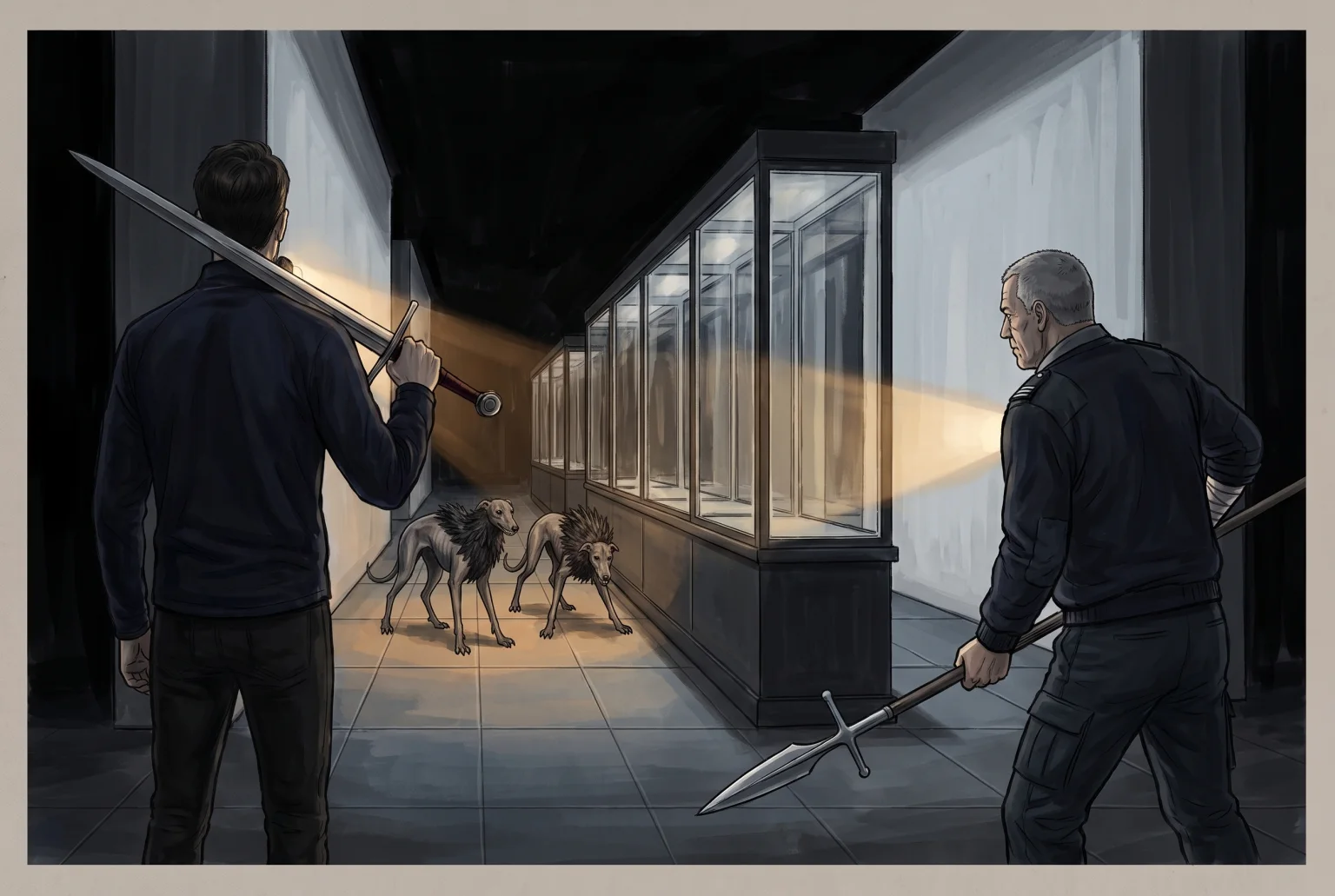
The armoury of the Vendal Arsenal was sixty metres long and had been built in sixteen forty to hold muskets for a regiment. Now it held glass: cases down both long walls and a spine of cases down the middle, and in them four centuries of other people's ways of killing each other, all clean, all labelled, all at the correct humidity. By day the room was tall and white and made people lower their voices without knowing why. By phone-torch it was a corridor of reflections. Every case gave back their two lights, twice, and the lights moved when they moved, so that walking down it felt like walking with a crowd.
They went down the left side, because the left side had the wall.
Vic carried the sword in both hands, hilt by his ear, point up and back over his shoulder. Tibbs called the guard from the roof. In the practice hall, Vic could hold it while Tibbs corrected someone else's feet. Here his shoulders began to ache within a dozen paces.
Owen walked beside him with the spear low. They stopped at each gap between cases. When Owen looked left, the light on his chest swung left too, taking half the next aisle out of sight. Vic kept his own body facing forward and turned only his head.
They were about halfway down, level with the Eastern Wars case, when writing covered the glass ahead.
"Where," said Owen, very low.
"It didn't say."
Then it did not need to. Something came out from behind the spine of cases twenty metres ahead, low and quick, and stopped in the two torch beams and looked at them.
It was the size of a large dog and it was not a dog. That was the only sentence his mind would produce for several seconds: not a dog, not a dog. The body was more or less right, long and lean and deep in the chest, tail down. The head was wrong. Too narrow, too long in the muzzle, and the ruff around its neck was not fur. As the thing lowered its head toward them the ruff stood up, in ranks, with a small dry sound, and Vic had spent enough Sundays watching the crows on the plaza to know exactly what that was. The eyes gave the torchlight nothing back.
A second one came round the other side of the spine and stopped beside it.
"Two," said Owen.
"I see them."
Vic tried to keep both animals in view. The one on the left moved behind a case; he turned towards the gap where he expected it to reappear.
"Back," Owen said.
Owen retreated along the aisle. Vic took one step to follow and his shoulder brushed an open display of cavalry swords, and a scabbard rattled against its neighbour. One of its suspension cords had slipped off the peg. He caught it with his left hand before it could fall, leaving the longsword wavering in his right.
"Leave it!"
The first hound came through the gap. Vic let the scabbard drop, got his hand back on the grip and cut too soon. The animal was still coming up under the edge.
The blade bit, and went in a finger's width, and stopped.
Bone stopping steel. He had read about it. He had not known it felt like hitting a kerbstone, that the shock went up both arms into his teeth, that the whole weight of the animal would come onto his hands and try to take the sword away from him. The hound was screaming, high and thin and tearing, not a dog's scream at all. It was thrashing, its jaws snapping a hand's breadth from his knee, and he could smell it: hot wet feathers and something under the feathers that was worse.
He pulled. The hound came with the sword, and its teeth caught the loose cloth at his knee. He stepped sideways to get away from the jaws. The blade twisted free; he nearly fell against the case behind him.
Owen shouted his name. Vic drove the point into the side of the hound's neck, missed the firm resistance he expected, and pushed until the cross met feathers. He could not tell how deep it had gone. He kept pushing.
It stopped screaming. It took a while to stop moving.
Owen had the other hound on the spear, but he was several paces back, on his own. The head had entered at the outside of its chest. The beast twisted towards him, wrenching the shaft sideways; one end of the crossbar caught against a case. Vic heard a sharp metallic crack.
The rivet had sheared. The bar tore loose and struck the glass. The hound dragged itself forward along the shaft. Owen backed into the wall. He tried to pull his forward hand away, but the jaws closed on his left forearm.
Vic got the sword free of the first hound and stumbled across the aisle. He could not swing without hitting Owen. He brought the point in low, under the second animal's jaw, and drove upwards. Owen yelled. For a moment Vic thought he had stabbed him.
The jaws opened. Owen tore his arm away and let go of the spear. The hound fell with both weapons still in it.
The armoury was very quiet.
Vic could hear his own breathing. The light taped to his chest ran up and down the glass. He bent over with his hands on his knees, then had to straighten to see beyond his feet.
He looked at that for a second. He did not know what a record was, or who was keeping it, and he found he did not want to know just now.
"Owen."
"I'm here." Owen was holding his left forearm in his right hand. Blood was running between his fingers. "It's got me."
"Sit down."
Owen lowered himself against a case.
"Not the glass," Vic said. Then he saw blood dripping from Owen's cuff onto the tiles. He knelt beside him and unzipped the pouch.
The little scissors would not cut the uniform sleeve. Owen undid the cuff with his teeth and Vic eased it back. Four punctures in a curve. He put a pad over them and pressed; Owen drew a breath through his nose and held it.
"Too hard?"
"Keep it there."
Vic had to hold the pressure with one hand while opening the bandage packet with the other. The first end escaped him and unrolled across the floor. He swore, put it aside and took out the spare. There was only one spare.
Owen looked past him at the scabbard lying in the aisle.
"I needed you beside me."
"I know."
"Do you?"
Vic kept his hand on the pad. His thumb had begun to cramp. He could not find anything to say that would not sound like an excuse, and Owen had turned his head towards the doors.
"It gave me a level," Owen said after a while. "Three points. Can I put them in Health?"
Vic called his own sheet back. The numbers overlapped the arm under his hand. He looked at Vitality and tried to ask it about bleeding.
"Vitality," he said. "But it doesn't say how fast."
"Would it close this?"
He tried to make the line tell him. It stayed as it was.
"I don't know."
Owen watched the pad. They held it there until Vic could lift the edge without fresh blood immediately filling the punctures. Then Vic wrapped the forearm. By the time he had secured it and checked Owen could move his fingers, his phone read 00:12.
"I'm keeping the points for now," Owen said. "If it starts again, we try."
Vic helped him stand. Owen took a moment before letting go of his shoulder.
Vic retrieved the sword and turned it in the torchlight. Blood down the blade to the cross, something darker gathered in the fuller, and a third of the way down from the point the edge had rolled: a bright little wave in the steel where it had met skull and lost. He ran his thumb along it, well back from the edge. He would need a stone to find out how much metal he had to lose to put it right. He wiped the blade on the dead hound's flank and asked the Assay to read it again. It still called the sword sharp. He turned the rolled edge towards the light, then wiped a clot out of the fuller with his sleeve.
He stood over the hound while Owen worked the spearhead out of the other body. Black feathers, the flat lightless black of a crow's wing, in a ruff from the skull down over the shoulders and along the spine, thinning to something like a greyhound's pelt on the flanks. A dog's teeth. Not a dog's feet: too long in the toe, with a spur at the back like a fighting cock's. One of the long toes contracted against the tile. Vic raised his sword and waited. It did not move again.
Owen picked up the crossbar from the floor. A bright crescent of metal remained where the rivet had broken. He put the loose bar in his coat pocket.
"That wasn't part of your handling session."
"No."
The end of the spear shaft was slippery. Owen wiped it on his coat, tried his grip and shifted his left hand further back.
"Thirty-eight," he said. "And they're not all in here."
He took his phone out of the loop and tried Ruth again. Vic stood facing down the room to give him light. The call failed. This time Owen waited with the phone against his ear for several seconds after the tone had stopped.
They went back to the workshop for more dressings. The wall cabinet there was stocked for cuts and burns. Owen shut the door and turned the key while Vic emptied its lower shelf into a canvas tool bag.
"Water too," Owen said.
Vic tried the tap. It ran, briefly brown, then clear. He filled two clean specimen bottles. Owen drank from his thermos and held out the lid. The tea was still hot enough to hurt Vic's mouth.
The garniture was where he had left it. Seven pieces on grey felt.
He moved the light across the bench, looking for a stopper for the second bottle. It caught the gorget's rim. Writing appeared before he had quite looked at the steel.
Made to be worn with the others. He looked from the gorget to the helmet. Seven of eleven. Dormant. Then the breastplate. The same count.
He put the uncapped bottle down beside his mug.
"Owen. What's a regalia."
"Crown jewels," said Owen. He was checking the workshop window catch. "Why?"
"It's calling the Duke's armour one."
Owen came over to the bench.
"Seven of eleven." Vic put out one finger and touched the gorget on the roped edge, where he had touched it a thousand times gloved and never once bare. Nothing happened. He had not really expected it to. The sword's read had told him nothing about its damaged edge. Here was a count he could check against the inventory. "It knows how many pieces there were. It knows how many I've got. It's counted them."
"Will it protect you?" Owen asked.
"The steel will. If it fits. I don't know about the rest."
"Do you know where the other four are?"
"Two in the south museum. One sold without a buyer's name. The last one's just a line in the inventory."
He wanted to put the pieces in order again and read each one. There might be more if he turned the gorget, or brought the grandguard up to the breastplate's stud. He reached for the grandguard.
Owen picked up the bag of dressings with his good hand.
"I'm leaving, Vic. You can lock up."
"Give me a minute."
"You've had it."
Vic stood with his hand on the reinforcing plate. Owen had the key out of the door already. He was going to walk back down that room alone.
"Wait. I'll come."
He capped the water bottle and put it in the bag. He left the armour on the bench. At the door he had to go back for his sword, which he had propped against a stool to free his hands. Owen waited with the spear across the doorway until he returned.
The entrance hall of the Vendal Arsenal had a ticket desk, a rack of leaflets in nine languages, a cloakroom with a little bell, a donations box shaped like a helmet that children put chewing gum in, and tall double doors onto the plaza. The doors were shut, with the night bar across them.
From the foot of the main stair, Vic could see across the hall to the cloakroom. He stopped on the last step.
The ticket desk was gone.
In its place stood something waist-high and a little longer than a man lying down. It looked like slate. The top was flat and the edges so square that Vic wanted to run a finger along one. He crouched to check how it had been fitted around the skirting.
A knife's width of darkness ran underneath it. It did not touch the tiles. He moved his light to the far end; the gap went all the way along.
Exchange placed, the announcement had said. Vic stood up. The slab was the height of a shop counter, with room behind it for someone to serve him.
There was nothing on the other side.
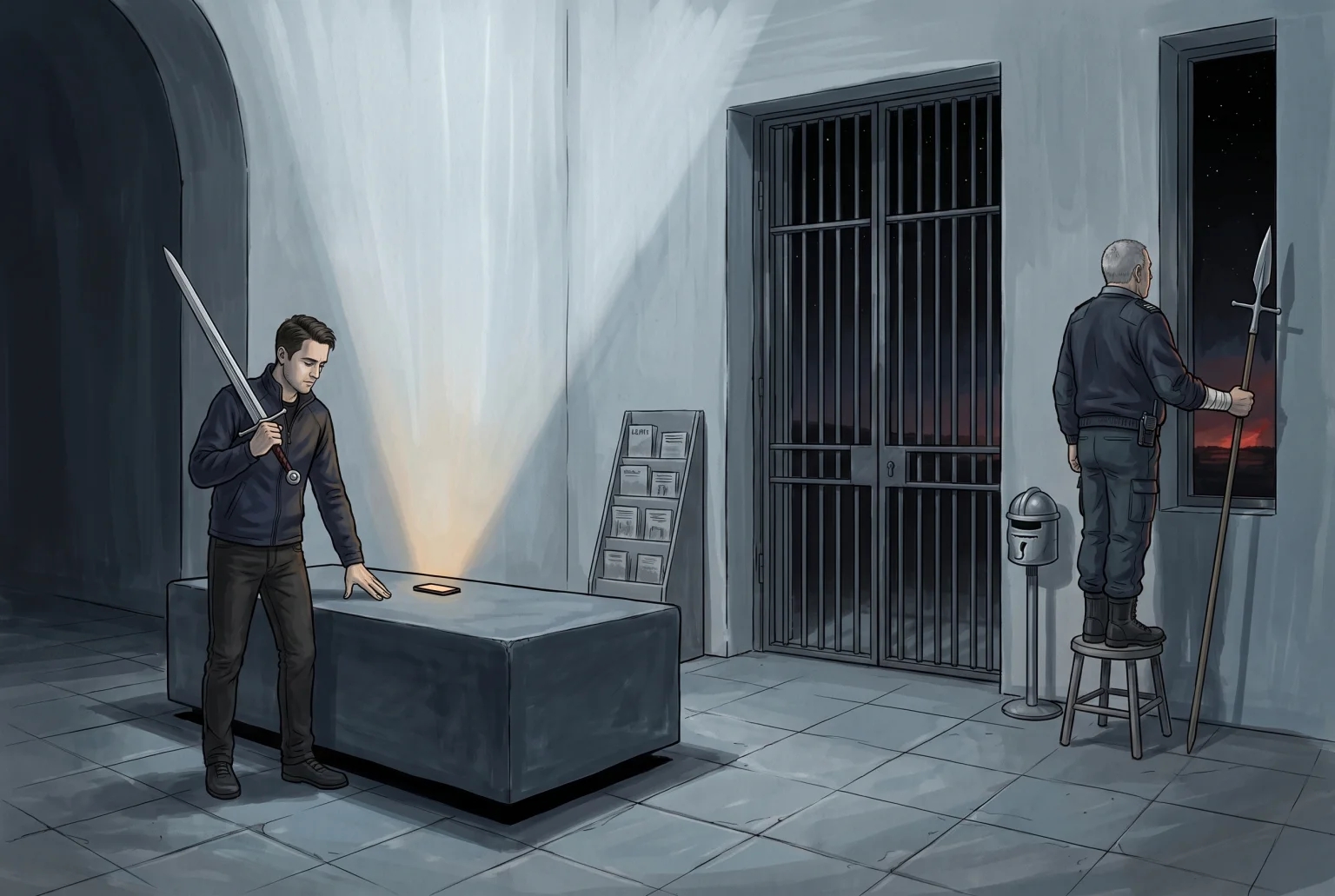
Owen went to the doors. He listened with his ear against the wood, then tried the street through the narrow side window. The glass was too high; he dragged his stool over and stood on it.
"Can't see anything moving."
Vic peeled the phone off his pocket and laid it on the counter, light towards the ceiling. Then he put his right hand on the surface, keeping the sword in his left.
It was cold. That was all. Cold the way stone is cold.
A list unfolded faster than he could read. He flinched and it stopped. Prices beside every entry. He found a Common spear at forty Marks, then a shield at the same price. His gaze went to Owen's left arm.
"It sells weapons," he said.
"Does it take money?"
"Marks. We haven't got any."
Owen got down from the stool. "What'll it give you for that?" He indicated the sword.
Vic looked at the blade. The smith's price had been six weeks of his salary. What would the Duke's armour be worth here? The list changed before he had asked aloud.
He took his hand off the slate. The offer stayed in view.
One thousand four hundred. He checked the spear price again. Thirty-five spears. Or shields, and people to carry them. His eye kept going back to the line above the premium: seven of eleven.
"Well?" said Owen.
"It's offering for the garniture."
"You haven't brought it down."
"No."
Vic read out the price. Owen looked towards the armoury door.
"Would selling break it up?"
"I don't know what selling does."
Vic put his hand back and tried to inspect the offer without accepting it. No explanation came. He drew his hand away again. The Exchange had priced the armour without his bringing it downstairs. It knew there were eleven pieces. It might know what the missing one was, while Vic was still working from a clerk's short entry.
"We could arm people with that," Owen said.
"I know."
"I'm not telling you to do it."
Vic looked at the forty beside the spear. He had thought of the armour as his a few minutes ago, upstairs. He had not thought about the museum trustees, or the city that paid him to look after it.
Owen tried his phone again. Vic watched the unsent messages accumulate beneath Ruth's name. He could read the last one over Owen's wrist: Stay inside. Coming round the shore.
Outside, across the plaza, something that was not a dog lifted its head and began to howl. It went on for a long time. And then, further off, down toward the harbour where the red smear had been, something answered it.
Owen put the phone away and went back to the window. Vic rested the sword point on the floor. His wrist hurt when he loosened his grip.
His phone read 00:41. He had spent an hour getting from the workshop to the front door.
"You?" he said.
"Three of them." Owen's eyes had gone to the middle distance, where the writing lived. He read for a moment in silence. "One's called Watchman."
Vic opened his own offers. Three names appeared. The third held him.
He read it with the sword point still resting on the tiles. Collector. He had put that word on forms when lending pieces from his small collection at home. Here it was being offered in the same place as Owen's Watchman.
"What is it?" Owen asked.
Vic told him. Owen glanced at the sword, then towards the workshop.
"Would that help you use the armour?"
"It might help me put it together."
The offer remained open. Three points in Perception for every level; he thought of the letters he had sent south, the photographs too poor to show the rivets. Then he tried to lift his sword and had to change hands.
"How much Strength?" Owen asked.
"None, unless I spend the free points."
Owen leaned the boar spear against the wall beside the door, then held out his good hand for the sword. Vic let him take it. With his empty hand he called back the price for the garniture and set it beside the Vocation offer. He read both again while Owen stood at the door.