Viewpoint: Vic
The last ordinary thing Vic Doyle did in England was refuse to stop work.
He had taken his glasses off to show he was finished for the day. Unfortunately, he could still see the crooked plate on Duke Albrekt’s armour.
Kate put a finger on the open glasses case.
‘You said that was the last thing.’
‘It was. This is something wrong with the last thing.’
She held out her hand. He folded the arms and shut the case before she could ask. After eight years of friendship, there were arguments they no longer needed to finish.
‘A very successful intervention,’ she said.
‘You haven’t documented it.’
‘I have a witness.’
Owen lifted his keys from the loading door. He had paused on his security round to hear the argument, leaning round the empty transport trolley Vic had left standing half through the doorway.
‘I’m willing to sign something if it gets the lights off.’
The galleries at the Arsenal in Portsmouth had been closed all afternoon, leaving Vic alone with the armour and no visitors asking whether he had tried polishing it. Dark steel rested on shaped supports under the work lamps, an etched border disappearing beneath the next plate. He had spent an agreeable hour following it into places nobody would see when the display was finished, finding where the cut changed and another hand might have taken over.
Kate glanced at his coat, still on its hook.
‘Did you get to Helen’s?’
‘The drawer needs a new runner.’
‘That wasn’t what I asked.’
His sister had invited him to eat when he came to mend their father’s tool chest. He had yet to make the runner, which had somehow become a reason not to answer her.
‘I’ll ring her,’ he said. ‘I did mean to be ready.’
‘I know. I’d still like an evening with you in it.’
He looked up. A curl had caught under the strap of her bag, the one with the pale streak she had had since she was twenty; she pulled it free without taking her eyes off him. He had been about to explain the fastening again.
‘The place with the aubergines?’
‘Yes.’
‘We always have the aubergines.’
‘I like the aubergines.’
‘Aubergines,’ he agreed, and covered the armour.
The transport trolley still stood half in and half out of the loading door, where he had left it: the kind used for moving display cases, a steel frame on four wheels that folded in the middle, with a padded bumper at one end. Its crossbar, the bar that stopped it folding, lay loose on the lower deck beside a black restraint strap. Vic ought to put it away. He reached for his coat instead.
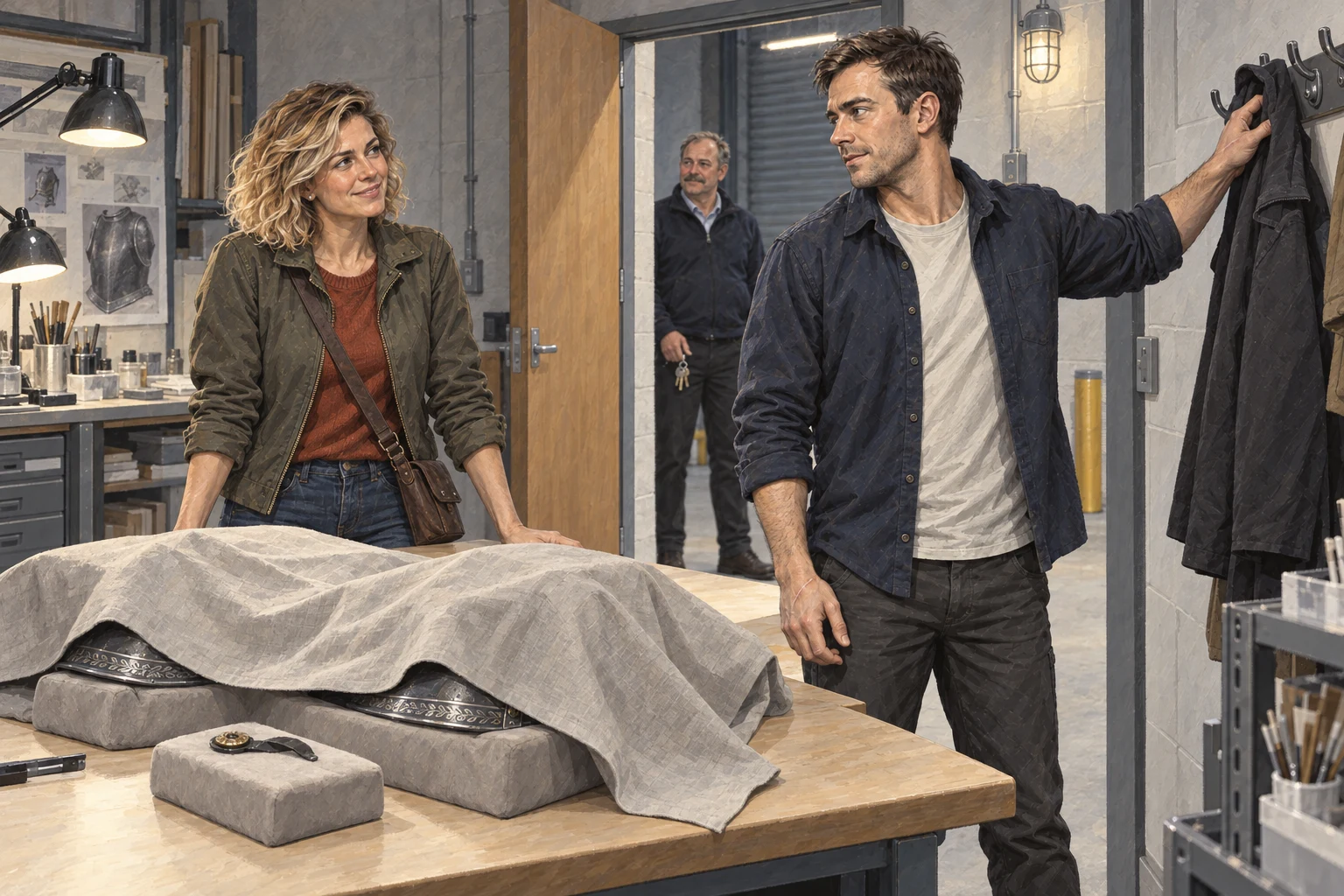
The work lamps went out.
Before the emergency lights came on, something struck the outer shutter with a rolling crash. The floor shifted beneath Vic’s boots. He caught a coat hook hard enough to hurt his palm, and from the galleries came the long scatter of breaking glass.
Owen was already at the loading door. ‘Stay here.’
Vic aimed his phone torch past him into the loading bay. At its far end the big steel shutter had jammed half open, and where the service lane should have been, pale rocks crowded the apron with water running between them.
‘You shut that,’ Vic said.
‘I know.’ Owen pressed the control. Nothing moved.
Something black came scrambling over the rocks and in under the shutter, and skidded across the wet bay towards the light: a lean animal the size of a large dog, with a thick ridge along its neck and a muzzle like a wedge. The rasp it made seemed to catch in Vic’s teeth.
Owen dragged at the door, but the trolley was in the way. The animal hit the trolley and drove it into the room, and the push handle crushed Owen’s left arm against the frame. He cried out.
Vic heaved the trolley off him. Kate pulled Owen clear. The animal’s head came over the padding and snapped at Vic’s hand; he snatched his fingers away. The ridge along its neck stood up stiff and black, like a fan of feathers.
‘The corridor,’ Kate said. ‘Come on.’
It would follow them anywhere in the building, unless it was shut out. And the only thing that could shut it out was the trolley.
‘The bar,’ Vic said.
Kate kicked it to him across the floor. Vic jammed the crossbar between the uprights and locked it.
The frame went rigid under his hands, the way a fastening goes home. Vic put his head down and ran at the animal like a man pushing a stalled car. The padded bumper caught it in the chest and carried it backwards across the bay, scrabbling, and slammed it out through the gap under the shutter, and the trolley jammed in the gap behind it like a cork in a bottle.
‘Strap!’
Kate was already there. She looped it through the iron ring by the shutter and round the trolley’s base and hauled it tight.
The animal hit the padding from outside. The trolley jerked against the strap and held.
They ran back across the bay. Owen had the loading door half shut with his good hand. Vic caught its edge as Kate slid inside, drove his shoulder into the timber, and the latch caught.
Owen turned the key.
For a few breaths Vic stayed pressed against the door. Out in the bay, claws dragged at the trolley’s padding, but the frame no longer moved. Kate touched his back.
‘Help me get him into the chair.’
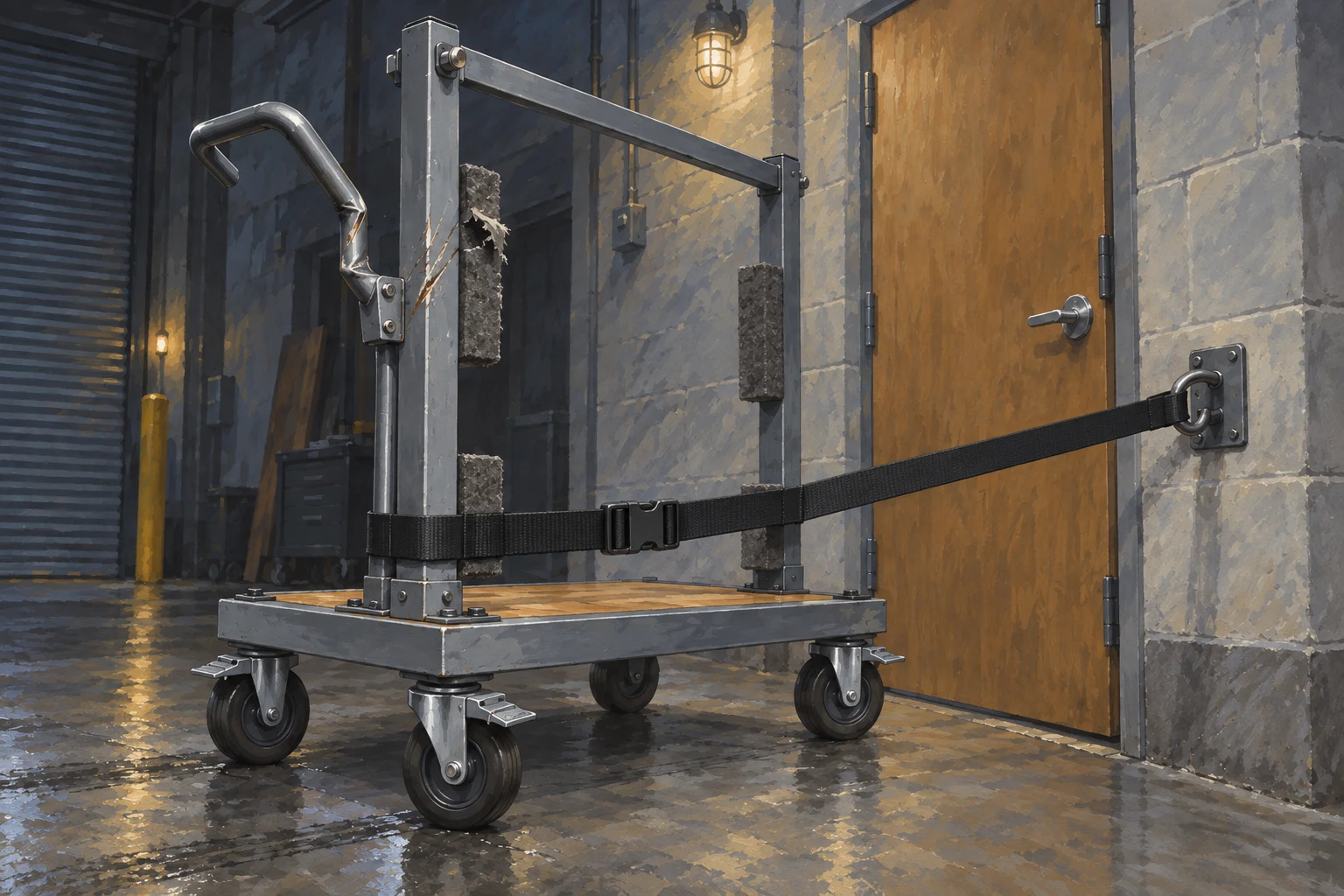
Owen sat supporting his left wrist in his right hand. He was grey around the mouth and breathed carefully whenever he had to shift his grip. Vic looked from him to the locked door. He had left the trolley across that doorway, with its crossbar loose on the deck.
He wanted to apologise, but that would require Owen to answer.
‘First-aid box,’ he said.
‘I’ve got it.’ Kate set it on the bench. ‘Ring for help.’
Vic tried the emergency number. An animal in the loading bay, a man with an injured arm; he could start with those. He waited until Kate looked up and he checked the screen.
No service.
‘Mine too,’ she said.
‘Radio’s dead,’ Owen said. ‘Went with the lights.’
There was nobody else on site. Vic took the end of the triangular bandage Kate held out, and Owen told them where to put it. They stopped when he asked, waiting until he could speak again. Kate tied the bandage, leaving his fingers visible, and he settled the weight into it a little at a time.
‘Better?’
‘A bit.’
Vic laid Owen’s coat over his shoulders and sat down himself. His legs had begun to shake. Kate settled on the floor beside the chair, and for a while they listened to the water through the walls.
‘Was that a dog?’ she asked.
‘It had feathers.’
‘Dogs don’t.’
‘No,’ he agreed. Neither of them offered another name for it.
An alarm sounded out towards the ferry terminal. Vic waited for sirens to follow. Even on a Sunday evening Portsmouth should have been louder than this. When the alarm stopped, he could still hear the irregular tapping of loose metal outside, and under it, once, the rasp from beyond the shutter.
Kate selected her brother’s name on her phone.
‘Martin’s going to be trying me.’
She stood by the window, cupping her free hand over her other ear. Vic watched her, waiting for the change in her face that would mean someone had answered.
‘It doesn’t even ring.’
She put the phone into her bag. Beyond the window there was only darkness.
Owen eased himself forwards in the chair, then settled back with his eyes shut.
‘We ought to look at the front. Give me a minute.’
‘We’ll go when you can,’ Kate said.
Vic fetched the first-aid box to take with them. The cover cloth had slipped off the breastplate when the floor moved, trapping an old fastening leather beneath its edge. He eased it free, and his fingertips met the steel.
He took his hand away. The words remained, as distinct as the label on the box, though nothing had appeared on the bench or across his vision. Even with his eyes shut he could read them.
‘What?’ Kate asked.
‘I’m seeing words.’
She rose. ‘Are you dizzy?’
‘“Record established.” Measured. Level one.’
Owen opened his eyes. ‘Measured?’
‘You too?’
‘I thought I was going to faint.’ He looked above his good hand. ‘It’s still there.’
Kate was silent for a few seconds.
‘I haven’t agreed to anything,’ she said.
Neither had Vic. He pointed above the breastplate, trying to show her where the words were, then dropped his hand.
‘Can you see mine?’
‘Only my own.’
When he looked harder at the line, it opened into a short, tidy account of the trolley: its frame braced, its movement restrained. The crossbar and Kate’s strap were in it. Nothing about the hours at the bench, or the animal, or Owen being hurt.
‘It knows what I did with the frame,’ he said. ‘Not why. Just what held.’
‘Measured,’ Owen said again, as if he could make the word give something back. ‘Like we’re being weighed.’
Vic had seen gold weighed and tested at the assay office on a visit years ago, a scrape of metal taken from a spoon, a mark struck into it afterwards to say what it really was. The words had that cold, careful feel.
‘Assayed,’ he said. ‘Tested for what we are. It feels like a hallmark.’
‘I didn’t ask to be hallmarked,’ Kate said.
‘Does it say anything useful?’ Owen asked.
Vic rested his fingers against the armour again.
He read it aloud. Three working pieces. For weeks he had been trying to establish which plates belonged together, following etched borders that agreed and fittings that did not. Now something had counted them, and called the set dormant, as though it had been asleep rather than broken.
‘Which bits?’ Kate asked.
No list appeared. His fingers returned to the old leather beneath the breastplate’s edge.
Vic read the offer to them. For one minute, it would help him hold the shapes of inspected parts together accurately enough to compare their working edges. He looked at the backplate, remembering how often he had turned between the two that afternoon.
‘Collector?’ Kate said. ‘You’ll have to get a bigger flat.’
Owen laughed, then stopped and held his arm. When Kate glanced at him, he waved his good hand.
‘Do you have to accept it?’ she asked Vic.
Defer remained as clear as Accept. Nothing counted down.
‘No. I can leave it open.’
Whatever had put those words into his head frightened him. But he knew these plates. If the comparison showed him something, he could put his finger on the edge and check it. He had been wanting a better look at that fastening all afternoon.
Vic accepted.
The offer closed. The comparison remained available, waiting for him to use it.
‘Can you manage there while I try this?’ he asked Owen.
‘I can manage sitting down.’
Kate took the front-door key from Owen’s right hand. ‘I’ll see whether we can get out at the front.’
She left the corridor door wide. Vic put on his glasses and folded back the cloth: breastplate and backplate on their shaped supports, the gorget beside them, and a fourth plate on its own pad, the one with the same etched border that he had never managed to place.
He spent one effort unit and began the minute’s examination. The shallow crescent above the fastening stayed exact in his mind as he turned to the backplate. Usually, some part of that first shape went soft and he had to look back. Now he could follow the corresponding edge without losing so much as the little nick in the crescent.
He tilted the backplate towards the emergency light. The polished patch followed the same curve, all the way to the nick. He could almost feel how the surfaces would move against each other. Weeks of shifting lamps and comparing photographs, and there it was.
‘Oh,’ he said.
Kate came back into the doorway. ‘What?’
‘Come and look.’
She leaned beside him. He showed her the crescent, then the little break in the other edge, moving his thumb so she could follow it.
‘Those fit?’
‘They worked together.’
‘And that one?’ She pointed to the plate with the same etched border.
He had time to compare its edge with the breastplate. The decoration continued perfectly, but the curve could never make the same contact. It was not one of the three. He moved it a hand’s breadth aside.
‘I’ve been trying to make that one belong all week.’
He was grinning. Kate looked from the separated plate to his face and smiled too. There was room beside the pair now, and he knew why it should be there.
The minute ended. He kept the result, but the exact feel of the moving surfaces was gone. He turned back to the breastplate, ordinary steel beneath his hand again, and touched the nick he had finally understood.
Dormant. If a set could sleep, perhaps it could wake. There were pieces here he could put together, and he meant to find out what they did when they worked again.
Behind him, Owen shifted in the chair.
Vic covered the armour. The matching pair stayed together beneath the cloth.
‘The front door opens,’ Kate said. ‘I haven’t gone out.’
He put his glasses away, fetched his coat and tucked the first-aid box under his arm. Owen took his time getting up. At the corridor he looked back towards the loading bay.
‘Don’t leave that trolley in service.’
‘I won’t.’
Vic wrote on a bench label: out of service, animal outside the shutter, keep locked. He hung it beside the door and went to help Kate with Owen.
Cold air swept across their feet as she opened the front door. Vic stepped onto the stone threshold, switched on his phone torch and lowered it towards the kerb.
The pavement ended in water.
He raised the beam, searching for the far side. A piece of timber drifted past a pale rock whose rounded top stood above the surface. Beyond it the water continued until the torch could show him nothing more.
He had crossed that road carrying coffee. Opposite stood a warehouse with a blue sign missing one letter; he knew where its entrance should be. He swept the light across the place again. There was no wall to catch it.
‘Vic?’
Kate was bringing Owen onto the step.
‘Don’t come further.’
They stopped beside him. Where streets should have led inland beneath the glow of homes and shops, a dark slope rose above the water. No hill belonged there. His phone light shook as he lifted it towards the outline, though it could not possibly reach that far.
‘Where’s the road?’ Owen asked.
Vic lowered his hand against the door.
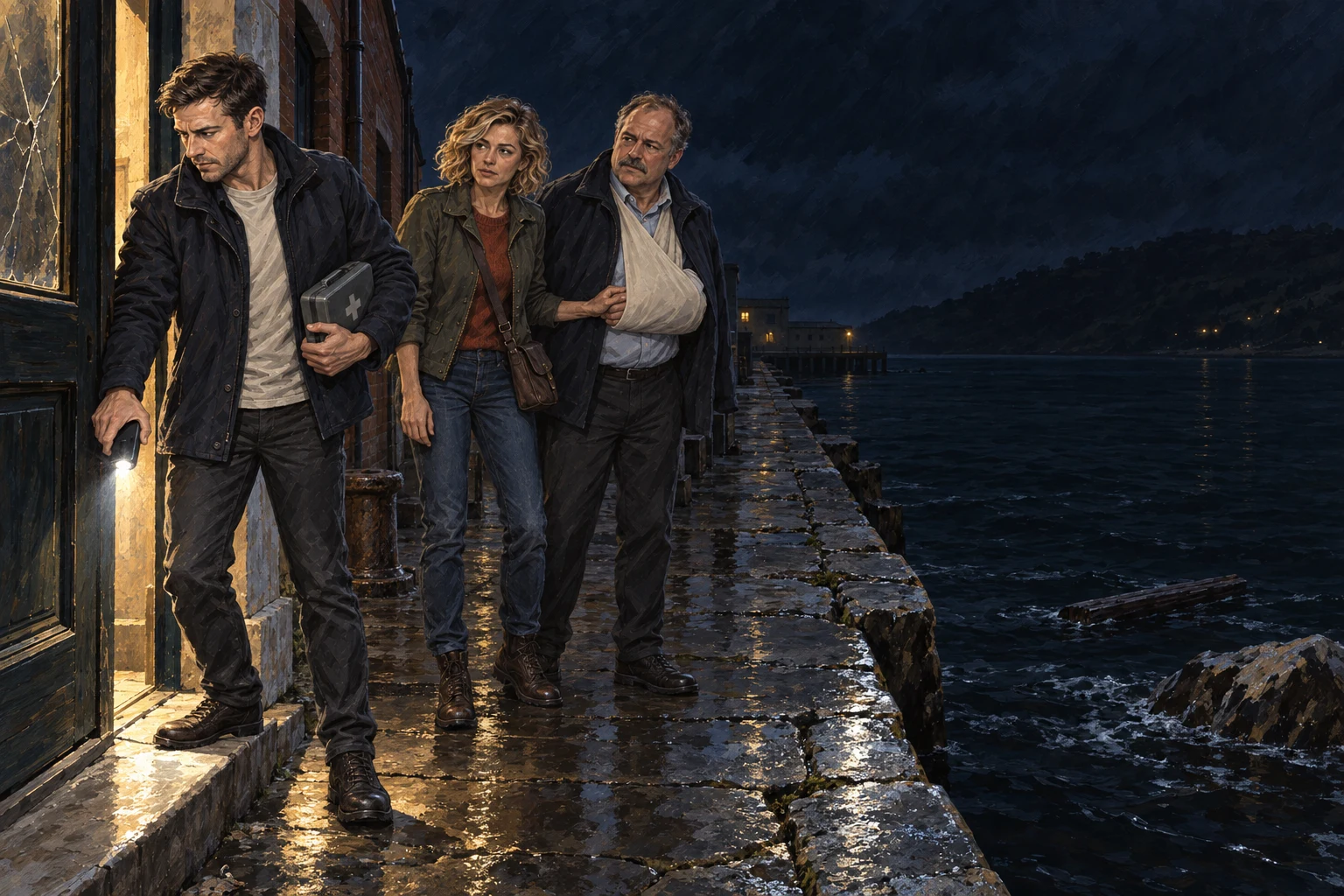
Kate drew Owen back from the edge by his good elbow. To their left a strip of paving ran along the building towards the apron, water lapping its outer edge. Beyond it, emergency lamps showed through the windows of the low ferry terminal. A smaller light moved behind one pane, disappeared, then crossed the next.
‘I’m going to that light,’ Kate said. ‘There might be people there. A phone that works.’
‘The apron goes that far,’ Owen said. ‘Or it used to.’
‘Can you walk?’ Kate asked.
‘Slowly.’
He was already leaning against the jamb. They needed to get him somewhere he could sit while someone who knew what they were doing looked at his arm.
Vic turned the phone towards himself. Helen’s last message was still there, asking whether he wanted her to leave the chest out. He had left it unanswered because he could always ring before he went.
All evening he had been able to imagine her in the kitchen, annoyed with him, with the drawer on the table where it got in his way. Now he looked across the water, trying to place that kitchen beyond the dark slope. He could not follow a single street towards it. He could not even point to a light and hope it was hers.
Kate’s hand settled on his sleeve. Owen waited against the jamb, his injured arm tucked close beneath the coat.
From somewhere behind the Arsenal, out among the rocks, came the rasp of the animal in the bay. A moment later, farther off along the dark shore, something answered it.
Owen looked at Vic. Nobody said anything.
‘The terminal,’ Vic said. ‘We’ll go together.’
Kate took Owen’s right side. Vic stepped onto the surviving pavement and held the beam low enough for all three to see. He started towards the light.


