Viewpoint: Vic
By the time Vic got Owen through the terminal door, he wanted someone else to decide what happened next. A woman brought a chair and knelt beside Owen once he was seated.
‘I’m Tess. I’m a paramedic. Tell me what happened.’
‘The trolley trapped him against the door. I’d left—’
‘I’ll ask you in a moment. Owen, did you hit your head?’
Vic put the first-aid box on the table and moved out of her light. His explanation about the loose crossbar would have to wait. Tess was asking Owen to move his fingers, watching each attempt without hurrying him.
The room smelled of wet coats and old coffee. People had pushed chairs together into places to lie down, leaving narrow gaps through which others stepped carefully with cups in their hands. A girl slept across two seats with her shoes on while her father checked a phone, lowered it and checked it again. Vic could see them reflected in the windows; beyond the glass, where the road had led down to the ferry ramp, water moved through the lights.
‘I think the forearm’s broken,’ Tess said. ‘I can give it better support, but I haven’t got the equipment to tell you exactly what’s happened inside.’
‘My flat’s behind the bakery.’
‘You’re staying here tonight. I want one patient where I left him when I come back.’
Kate tried the counter, then the office. She came back shaking her head. ‘They’ve been trying the ferries’ radios. Nothing’s getting through.’
After Tess had splinted the arm, Owen sat with his fingers visible beyond the support, leaning his head against the wall.
‘Priya will have been cleaning,’ he said. ‘She closes on Sundays. Gordon was home when I left. They’ll be looking at my window, wondering why it’s dark.’
Priya sold Vic his rolls; Gordon came into the Arsenal twice a week to take Owen to lunch and argue about films. Vic had never thought of either of them as people who might be frightened.
‘We’ll go and look in the morning,’ Vic said.
Two of the people sheltering here had already tried the alley behind the bakery and found a wall across it. Kate took a ferry leaflet from the rack by the door, to draw on.
They made places on the floor near Owen, spreading their coats beneath them. All round the room people were doing what Vic had done at the Arsenal: staring at a point in the air above their hands. Somebody near the counter said Measured as if it were a diagnosis.
‘It said Measured,’ Owen said from the chair. ‘I keep thinking: measured by what?’
‘And against what,’ Kate said.
‘I don’t like being marked when nobody told me there was a test.’
‘Mine calls Measured the tier,’ Vic said, finding the label in his own entry. ‘Then there’s a level underneath. I’m on one, whatever that means. A tier means there’s another one above it.’
‘One here too,’ Kate said. ‘No Vocation, though. You’ve got one already.’
‘Collector of Arms,’ Vic said as Tess came back with a blanket.
‘Does that give you anything that would help him?’ she asked.
‘It helps me compare fittings. I wish I had something for the arm.’
‘Then the splint stays.’ She tucked the blanket behind Owen’s shoulder. ‘Mine hasn’t offered to make me a better paramedic either.’
Owen had been reading something above his good hand. ‘Mine says twelve for strength,’ he said. ‘I’d like a second opinion.’
‘Use the other hand when you ask,’ Tess said.
By the time the lights in the room were turned down, Vic’s word had got round. He heard a man two rows over explain to his wife that it was an assay, like silver, and that they were being tested. Nobody laughed. Somebody else said the Assay, with a capital, and it stuck.
Kate pulled her coat over her knees, and her feet stuck out of the end. Vic gave her the edge of his and shifted closer. Someone went on walking between the windows long after he had closed his eyes.
He woke once in the small hours because the floor was humming.
It was very faint, a vibration more than a sound, coming up through the tiles into his shoulder. On the counter the cups had begun to tick against one another. Then it stopped, and the cups stopped, and the only sound was the sea.
The man who had been walking was standing at the window with his hands in his pockets. Vic got up, carefully, so as not to wake Kate, and went to stand beside him.
Out past the point, where the harbour opened to the sea, a low black headland lay against the paler dark. As Vic watched, its outline came apart. It doubled, two edges lying one over the other and not agreeing, like a photograph taken by somebody whose hand had moved. The two edges trembled. Then they closed up into one, and the headland was a headland again, and it was a different shape: lower at the seaward end, with a notch in it where there had been none.
‘Third time tonight,’ the man said, to nobody in particular. ‘It’s never the same shape after.’
Vic stood at the glass until his feet were cold. Nothing else moved. In the end he went back and lay down against Kate’s back, and did not sleep for a long time.
He woke twice to help Owen, and slept at last until the scrape of chairs woke him on Monday morning, the ninth of November, in a world that had not been told the date. Kate’s face was turned into the fold of his coat. For half an hour he lay watching daylight reach the counter, grateful that nobody needed him.
The alley was blocked just beyond the bollards, although Vic could see the bakery chimney above the pale wall that filled it. He recognised the missing corner of the pot. Yesterday he could have walked there without looking up. Now he was close enough to point to Owen’s building, with no idea how to reach its door.
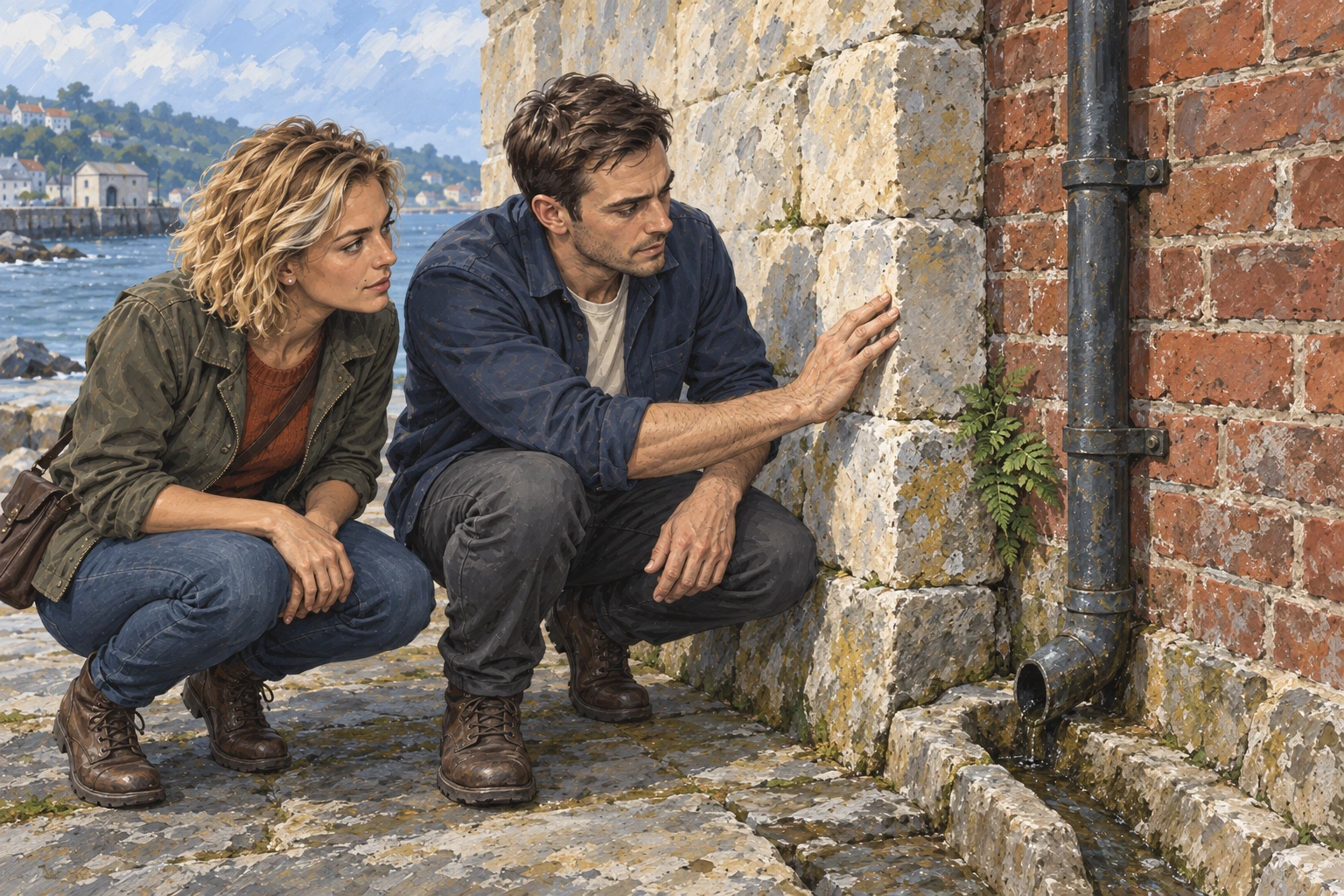
Kate climbed the slope beside the terminal and called him up to a narrow path along the back of the wall. He followed her along it to where the familiar red brick ended against pale stone, and something about the join made him stop.
A fern had been crushed between the walls, one green frond sprung free across the mouth of a drainpipe.
‘Where’s the broken part?’ Kate asked.
Vic brushed grit from the lowest course. Each wall had a finished corner and stood on its own base. Old rain stains ran down the brick face now pressed against it.
‘These were both ends,’ he said. ‘You can still see where the rain ran down ours.’
Kate crouched beside him. ‘Which one moved?’
All night Vic had pictured streets broken under rubble. These walls had stood separately, exposed to the weather, until something brought them together. He put a finger into the gap between their bases.
‘I don’t know.’
‘Or how much?’
He photographed the join. Helen would want to know why he was sending her a picture of a drain when she had asked a perfectly ordinary question about a drawer.
‘Helen’s kitchen might still be where it was,’ he said.
Kate looked at him before looking back at the walls. ‘It might.’
‘With the drawer on the floor.’
He had been afraid to imagine anything beyond that kitchen. Now he could picture her standing in it, annoyed with him, trying his phone.
‘Martin will keep ringing,’ Kate said. ‘He thinks the phone gets embarrassed eventually.’
‘Does it?’
‘Usually I answer.’
She put her hand on the brickwork beside his. It told him nothing certain about Helen or Martin, but when he looked up the path, it was the buildings beyond the join he was thinking about. He had spent enough of the morning looking for wreckage.
Kate stood and turned the leaflet over.
‘Let’s follow the backs. We keep trying to reach the shop front, and that’s the side we know is blocked.’
The path came out onto a gravel road above the shore, where they could see the bakery roof inland behind a buttress. Below the road, steps descended through a roofed landing to the water. An iron gate stood open partway down, and beyond it a rocky island filled the gap between two stretches of coast.
He had taken the island’s long low roof for a fold in the rock until sunlight reached its windows. A square tower stood at one end, with pale steps leading to the water. Someone had built rooms over there. He photographed them, though the building came out disappointingly small.
Kate was looking too. ‘Can you see anybody?’
He watched the black rectangles beneath the eaves a little longer before shaking his head. Kate touched his arm and pointed down towards the near landing.
‘There’s a light.’
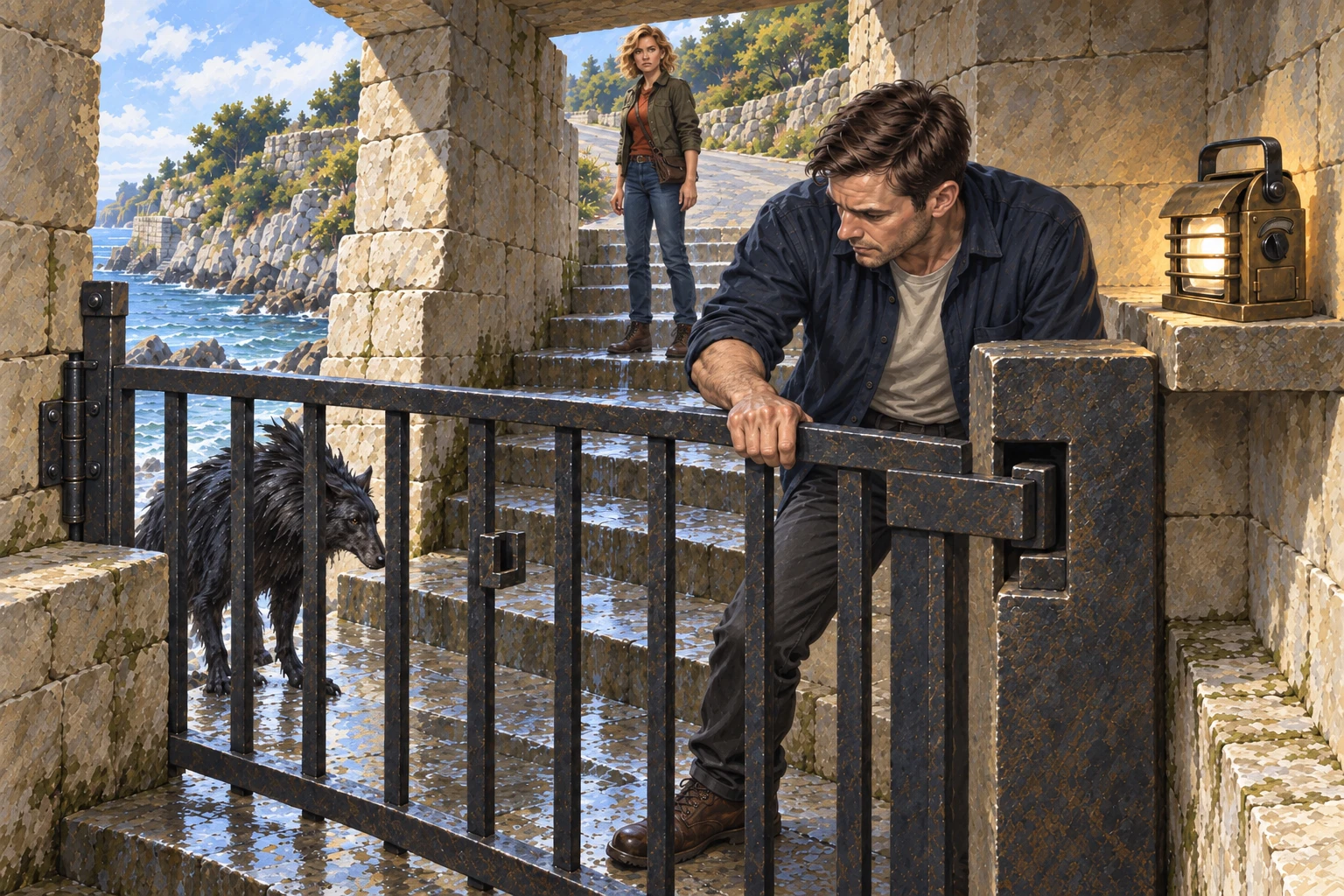
An unlit bronze lamp stood on a shelf beneath the roof. Vic went down the dry upper steps and lifted it by the black bail. Green filled the casing’s corners and the hood was dented, but the handle held firm. He held it out so that its little control faced Kate.
She turned the control, and warm light spilled from under the dented hood. The dent had caught in its guide; Vic eased it free with his thumb and slid the hood back, and the beam fell into her cupped hands.
‘Oh, that’s lovely.’
She spread her hand in the beam, then moved it aside so the light found the hollows worn into the steps. Above the empty shelf, letters had been cut in the stone at the height of someone reaching for the handle. He could make nothing of them.
‘Somebody keeps this here,’ she said. ‘For coming up in the dark.’
The stair continued below the gate and disappeared into green water. Across the harbour, the island’s steps met the same surface.
‘Take a picture of the writing as well,’ Kate said.
He did. Before taking the lamp, he meant to shut the gate; he had seen what could come out of these rocks.
A long bar hung from the gate. Vic drew it shut and dropped the bar into a bracket, and saw at once that it locked nothing. He spent one effort and a minute comparing the bar with the worn stone below, and the answer came up out of the wear like a word on the tip of his tongue: the bracket was only a rest, and the real seat was lower down, packed with grit. He picked it clean. The bar dropped home with a small, complete sound.
‘Vic.’
Kate had gone still at the upper exit. A black muzzle lifted above the wall below the gate.
This animal was bigger than the one at the Arsenal, heavy in the shoulder, with a pale scar running across its nose. It climbed another tread, and the coarse hair along its neck rose in that stiff, feathered ridge. Below it, on the rocks at the water’s edge, a second dark shape lifted its head.
‘Up the steps.’
Kate snatched up the lamp. The scarred animal hit the gate before Vic had turned, thrusting its muzzle between the uprights at the hand he still had on the post. He felt a tooth catch above his knuckles and tore free.
The gate boomed in its frame. The bar jumped in its seat and dropped back. The animal struck again, and again, using its whole weight, and Vic stood two treads above it and watched the bar he had cleaned take every blow and stay where he had put it.
The bar held. Vic saw it seated in the stone as he went up the steps after Kate, keeping his injured hand against his coat. Behind them the scarred one gave up the gate and stood on the tread with its head low, watching him go. It did not rasp. That was worse.
Kate caught his wrist at the top. ‘Show me.’
A torn line ran across the back of his right hand, above the knuckles, where blood was beginning to gather. He closed his fingers when she asked and opened them again while she unwound her scarf. Her hands were not quite steady as she tied it round the cut, and he held his wrist still for her until she had finished.
‘We’re not bringing Owen down there,’ she said.
‘It was waiting,’ Vic said. ‘I think it was waiting for whoever came down for the lamp.’
‘Then we’re not coming back this way either.’
Kate was already following the buttress, and he caught up with her where it concealed a narrow flight of steps. At the top, a passage ran beside a shed and opened into the red-brick court, so suddenly familiar that he stopped at its entrance.
Priya stood in the back door with flour on her apron.
‘Where’s Owen?’
‘At the terminal,’ Vic said. ‘He’s hurt his arm. Tess is looking after him. He sent us to find you.’
She gripped the door, then turned towards the windows opposite.
‘Gordon! He’s at the terminal.’
Gordon pushed a window open. One of its panes was starred where something had hit it in the night, and he was wearing a brown cardigan over a shirt buttoned wrongly beneath it.
‘I’ve got his keys.’
Priya laughed, covering her mouth with her free hand while Gordon struggled with the window catch. Vic had not expected that sound; he had been preparing to explain the arm and the animal, and now she was crossing the court to take his sleeve. She looked from him to Kate, then down at the scarf round his hand.
‘You’re both all right?’
‘We’re all right. It’s Owen who needs to get home.’
Vic told Priya about the animals on the steps. She shut the shed door and wedged it with a brick.
‘I thought I only had to work out what I could feed people,’ she said.
Kate drew Gordon a way to the terminal on the back of the leaflet, one that kept off the shore. Gordon took it down to tell Owen they were coming, and came back by it alone, complaining that she had put in every step.
‘You asked me how many,’ she said.
‘I was hoping you’d say fewer.’
At the terminal, Tess unwrapped the scarf, poured water from a bottle over the cut and looked at it for longer than he liked.
‘Was this a tooth?’
‘It caught me pulling my hand away from the gate.’
‘Then it’s dirty.’ She cleaned it, dressed it and told him to show her if it went red.
They brought Owen home that afternoon. Priya met them with bread and a chair; Gordon put the keys into Owen’s right palm.
Vic followed him up with the lamp, close enough to help if he stopped and not so close that Owen would tell him off. At the top Owen opened his own door and stood looking into the room. His slippers were beside the mat, and a paperback lay face down on the arm of the chair where he had left it. One curtain had caught on the window handle, letting a narrow strip of daylight across the carpet.
‘That’s better,’ he said.
Across the court, Gordon was pulling a covering straight over his broken pane. Owen lifted his good hand. Gordon saw him and lifted his own.
Priya offered Vic and Kate the downstairs floor. They slept there for an hour through the quiet middle of the afternoon while Owen rested upstairs.
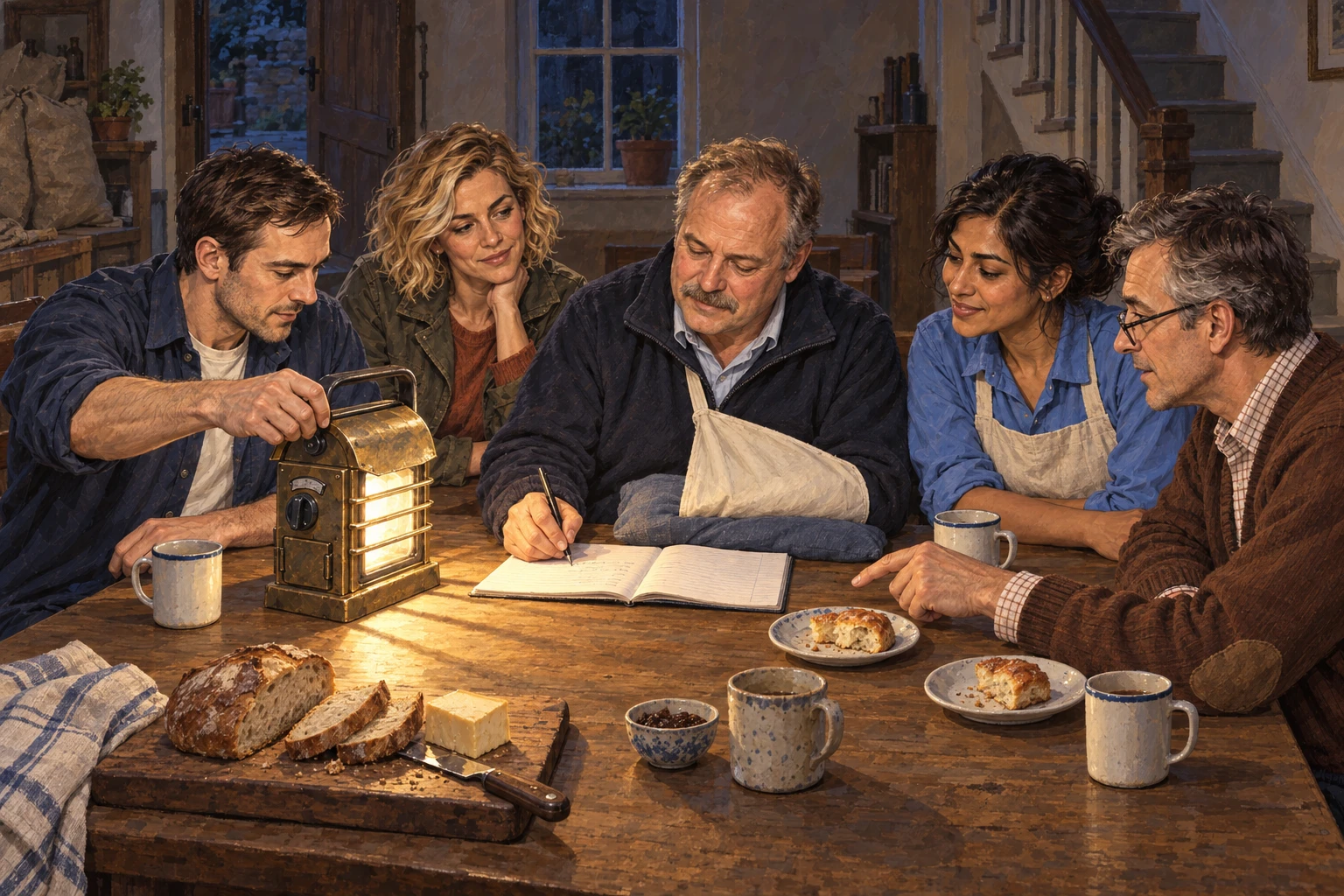
When Priya called them to eat, the pressure behind Vic’s eyes had eased enough for him to notice how hungry he was. He put the lamp on the table and turned it on while she cut cheese beside a loaf. Owen settled his left forearm on a cushion and ate with his good hand while Gordon drew a chair closer to hear him.
Priya kept a small pastry beside her plate as she passed the board.
‘The last one?’ Gordon asked.
‘Mine.’
‘I only asked.’
She cut it in half and pushed a piece towards him. Owen waited until Gordon had taken a bite before asking whether the hero in last week’s film ever got out of the cupboard.
‘It wasn’t a cupboard. I told you, he was hiding.’
‘He’d been in there a long time.’
‘Well, I could have got him out if you’d stopped interrupting.’
Priya asked whether anyone had thought to go to the toilet before getting shut in, and Kate laughed with her head against the wall, the lamp catching the pale streak above her temple. Vic had not realised how much he wanted to hear that sound until she made it.
Kate tipped the lamp’s hood down out of Owen’s eyes without being asked.
‘There are more steps than there used to be,’ Gordon said, easing his knee under the table. ‘I’d like a way out of here I can use without borrowing somebody’s knees.’
He offered to check the Arsenal’s doors in the morning, and Vic gave him the key, with directions that kept him well away from the loading door. The armour could stay covered where it was. It had waited four hundred years for somebody to understand it; it could wait a few days while they found out where they were.
Owen had brought an exercise book down with him. He opened it beside his plate and wrote where they were, then turned a page for the people they wanted to reach.
Gordon leaned in to check the spelling of his sister’s name, then asked Kate to write that he was at home.
‘She’ll think I’ve gone wandering off somewhere.’
‘Shall I put that?’
‘No. She’ll say I always do.’
Kate pulled the book towards her and wrote Martin’s entry herself. Vic could see the name and number, then her hand covering the next line as she hesitated.
‘I should have come on Saturday,’ she said. ‘I wanted to.’
‘Put that.’
She wrote it and passed him the pen.
He entered Helen’s number without checking his phone, surprised by how easily his hand went through the familiar digits. Beneath it he wrote where he was and who was with him, then began the answer he should have sent before leaving the Arsenal: he would like to stay for supper when he came to fix the drawer. He had to remove tomorrow from the sentence. The pen left a dark patch where he had pressed too hard through the word, and he looked at it for a moment before putting the pen down. Kate read the line beside him. Her knee touched his beneath the table and stayed there.
Something in the yard went over with a crash.
Priya was on her feet first. Through the back window Vic saw the shed door hanging open on one hinge and the brick that had wedged it rolling across the cobbles. A dark shape was backing out of the shed with a sack in its jaws, pulling it in short hard jerks, flour pouring white from a tear.
‘That’s my flour,’ Priya said, as if it might listen.
Gordon had the door open before anyone could stop him and stood in it with a broom held like a bat. The animal dropped the sack, and Vic saw the pale scar across its nose. It had followed them. Up the hidden steps, along the passage by the shed, to the one place on this coast that smelled of bread.
It came towards the door, low.
Kate pushed past Vic with the lamp. She did not shout. She ran the hood back to its stop, the way she had learned it would go, and threw the whole beam into the animal’s face.
It flinched. For a moment it stood blinded in the white light, its feathered ridge flat, and then it turned and went up the wall by the shed in two scrabbling leaps and was gone over the top.
Nobody moved. Flour drifted down the yard in a thin cloud and settled on the cobbles.
‘Well,’ Gordon said, lowering the broom. ‘It doesn’t like the light.’
‘It doesn’t like that much light,’ Kate said. Her hand was shaking on the lamp. She drew the hood back down to the angle she wanted and held it there, and Vic saw her steady it on purpose.
Priya went out to the sack and knelt by it.
‘Half,’ she said. ‘It got half. That was a third of what I had.’ She looked up at the wall. ‘And it knows where the bread is now.’
It took the five of them an hour to make the shed fast. Vic took the hinge off and reset it in sound wood, Gordon found a length of chain, and Owen sat on the step with his good hand round a cup and told them where to put things. When they came back in, the bread on the table had gone cold and nobody minded.
‘I want to try that building across the water,’ Kate said. ‘That wall came from somewhere with people in it, and those things came from somewhere too. If anyone knows what they are, or where people end up, it won’t be in the terminal.’
‘What building?’ Owen asked.
Vic showed him the photograph of the island. Owen moved the phone closer with his good hand.
‘Looks like a station. A ferry place, perhaps, with those steps right down to the water.’
‘But we didn’t see anyone,’ Vic said.
‘They keep a lamp on this side. I’d like to knock on a door on the other.’
Owen looked at the photograph again.
‘My dinghy’s on the slip beside the terminal. Cream one, blue round the edge. There are two buoyancy aids in the cupboard with the oars. If the boat’s sound and the water stays quiet, you can borrow her. Keep the coast in sight. If it gets rough, you stay ashore.’
Kate was still looking at the roof. ‘I’d want to try it near the shore first,’ she said. ‘And know how to get back in if I came out.’
‘We’ll try her here first,’ Vic said.
Owen found the cupboard key on his ring and pushed it across the table. Vic closed his hand round it, and the cut across his knuckles pulled.
‘Ask for these as well,’ Gordon said, tapping the book. ‘Not just your own.’
‘We’ll take the book,’ Kate said. ‘Everyone’s in there.’
Kate laid the key in the crease to hold the book open and drew the island facing their names. Owen turned the lamp towards her pencil.
Out in the yard, the new chain shifted against the shed door, once, as if something had tested it. Then it was quiet.
When Vic went to draw the curtain, he saw it. It was sitting on the top of the yard wall above the shed, quite still, its scarred nose towards the lit window, watching them eat.
He drew the curtain. He did not tell the others until Priya had gone to bed.


