Viewpoint: Vic
Vic woke on Priya’s floor on Tuesday morning with Kate’s elbow in his ribs. He lay still while he remembered where they were, listening to somebody moving about beyond the door and trying to withdraw his arm from beneath her coat. The notice became clear as soon as he attended to it, though he had done nothing since last night except sleep.
He propped himself on his free elbow to read it again. Across the room stood the lamp Kate had swung into the animal’s face.
‘It counted the lamp,’ he said.
Kate opened one eye. ‘Did it count me nearly blinding a dog with it?’
‘Apparently not.’
‘Robbed.’
Kate settled back into the coat. Perception had risen on its own; Vic put the free point into Focus, because effort grew with Focus and with every level, and he had a feeling he was going to need it. He could feel the difference before he had decided to look for it: the room was very slightly more legible, every hinge and catch a little closer to hand. Yesterday he had spent hours wishing he could do something useful. This needed neither a tool nor somebody else’s help, and there was no form afterwards. He lay back, enjoying it, until Priya knocked to say that people who wanted breakfast should move off her floor.
Priya wanted to see the water for herself, so Kate drew her a way down that kept well above the shore. They left word at the terminal on the way, where Owen was waiting with his arm in its sling and a weather eye on the sky.
‘Wind’s gone round to the west,’ he said. ‘And it’s springs this week. The water’ll be higher every day till Saturday. Don’t be out in it when it turns.’
At the landing, Vic stayed above the stair and looked over the wall before letting Kate come down beside him. The scarred animal lay in the sun on the lowest dry tread beyond the gate, its coat still dark with water. When his shadow touched the wall it raised its head, watching him without getting up. Lower down, on the wet rocks, two more lay in a loose heap like dogs outside a pub.
‘There’s three of them,’ Kate said.
‘That we can see.’
He could see the bar still seated where he had left it. But green water ran round the foot of the wall to both flights of steps; nothing separated the animals’ side from the open stair except a short swim. The scarred one had not taken its eyes off him.
‘I don’t want to be here,’ Kate said.
‘Come on. We can get to the slip from the road.’
They went back up. Behind them the animal lowered its head to the stone, still watching.
At the slip, Vic found Owen on the harbour wall, and the dinghy already uncovered beside him; he had got someone from the terminal to do it. The little boat was cream with faded blue edging, a plastic bailer beneath the dry wooden seats, ready for another ordinary afternoon on the water.
When Vic tried the oars, one sat awkwardly until he moved it forwards to the bright flat that years of rowing had worn into its rowlock. It pulled smoothly there.
He was about to ask Kate to try the other when he noticed that she had fastened her buoyancy aid but was still standing above the boat.
‘I do want to go,’ she said. ‘I’m just not good with deep water.’
Vic looked up from the oar. She was rubbing her thumb along the buckle.
‘It’s having nothing beside me. No edge I can get to.’
‘It’s only—’
‘I know how far it is.’
Vic stopped. She had drawn the place. She did not need him to tell her the distance.
‘What helps?’
‘One thing at a time. And if I ask you to stop, listen before you explain.’
They fixed a loop for climbing back aboard and tried it from the bottom tread. As soon as she began to climb, the hull rolled towards her. He braced it with his knee and both hands until she could get over the side, then kept hold while she sat and caught her breath.
‘Like that,’ she said. ‘From the start. Every time.’
Priya came down the slip with a loaf under her arm and Kate’s folded directions in her hand. She looked past the boat at the island, and then at the water, for some time.
‘You didn’t tell me it was this big,’ she said.
‘The water?’
‘All of it.’
Owen confirmed the loan, with the same limits on coast and weather. Then he looked along the shore towards the barred stair, which was out of sight round the curve of the harbour wall.
‘Stay off that side,’ he said. ‘Give it room.’
Kate took the painter from his good hand and stepped down into the boat.
‘Ready.’
Beyond the shelter, Kate watched the island over Vic’s shoulder as each wave lifted the bow.
‘A little slower.’
Vic eased the oars and waited while the boat rose beneath them. Kate moved one foot clear of the bag and rested it against the seat support, watching the island until she could point without taking her other hand off the side.
They had given the shore all the room Owen wanted, but the harbour narrowed where the coast curved out, and for a hundred strokes the rocks below the barred stair were nearer than Vic liked. Rowing, he faced back the way they had come, over Kate’s shoulder.
He saw it before she could have. That morning the Assay had sharpened his eyes by a fraction, and the fraction was enough: a line on the water where no line should be, a wake with nothing in front of it, coming off the rocks below the stair. Then the nothing became a dark head, low as an otter, the scarred nose pointed at the dinghy like a finger.
‘Kate. Hold on.’
She twisted round, saw it, and turned back white. ‘Row.’
He dug both oars in and pulled, and the boat leapt.
‘It’s swimming,’ Kate said. ‘It’s coming for us.’
‘Talk to me. Where is it?’
‘Behind. Left. Closer.’
He pulled. The oar he had seated that morning ran sweet in its worn flat and the other bit badly, and he felt the difference in every stroke and could do nothing about it but pull harder on the good side and correct with the bad. The cut on his hand opened under the glove.
‘It’s not stopping,’ Kate said. ‘Vic, it’s not stopping.’
Then it was there. A scrape on the hull, a forefoot hooked over the gunwale behind Kate, the boat heeling hard towards it. Kate threw herself the other way without being told. The head came up over the side, streaming, the jaw open, and Vic saw its eyes for the first time, small and pale and entirely intent.
He shipped the bad oar, stood as far as he dared and drove the blade down into its shoulder.
It held on. Its claws dragged two pale furrows through the cream paint. He hit it again, flat across the head this time, the whole weight of his back behind it, and the forefoot let go and the animal went down into the green water and came up a length away, coughing, rasping.
‘Row,’ Kate said. ‘Row, row, row.’
He rowed. The animal swam a few strokes after them and then turned in a wide slow circle and stopped, its head on the water, watching. Behind it, on the rocks under the barred stair, the other two had come down to the edge.
He did not stop until Kate said he could. When she did, her voice was very quiet.
‘It’s gone back.’
Vic sat with the oars across his knees, his chest heaving. Kate had both hands on the gunwales. She was looking at the water, all of it, deep and green on every side, and he waited for her to ask to go home.
She took her right hand off the side, slowly, as if she had to persuade it.
‘Keep that end of the roof where it is,’ she said. ‘We were turning.’
He corrected without increasing the pace. Kate opened the notebook on her knee and set the roof-end against the harbour wall, adding the rocks beside them. She held the pencil in her fist, waiting between waves to make each mark. He saw that the pencil was shaking and that she made the marks anyway.
He kept the terminal in view until Kate pointed out steps behind a tongue of rock. He took the longer approach she chose, sheltered from the breaking water. A landing opened beneath a doorway.
Kate went ashore with the painter, stayed low to secure it round a stone post, then held the dinghy while he handed up the bags. When Vic joined her, she put both palms flat on the upper step.
‘Very nice stone.’
‘Good texture.’
‘Excellent lack of movement.’
Her laugh came out on a long breath. Then she looked at the two pale furrows in Owen’s paint.
‘He’s going to ask about those.’
‘I’ll fill them,’ Vic said. ‘I’ll tell him first, and then I’ll fill them.’
Between the landing and the station door lay a narrow cut full of water. A short bridge stood folded back beside it, meant to be locked straight by two sliding pins. They swung it down. The first pin slid home. The second stuck, and the middle of the bridge sagged under Kate’s hands.
‘It’s offering me something,’ he said. ‘For reading wear.’
‘Take it before I drop the bridge.’
He accepted Read the Wear and spent two effort units on the second pin’s guide.
The bright mark was a fresh scratch. Beneath it, years of polish ran on past the notch where he had left the pin, and with the skill running he could read it like a path in snow: which way the pin had been pushed, how often, how hard.
‘I’ve put it in the storage notch,’ he said. ‘The track goes on past it.’
He slid the pin along the old polish until it seated as deeply as the first, and when Kate let go, the bridge stayed straight.
‘There. That’s where it belongs.’ He was grinning at a pin.
They checked the span and fitted a handline. Vic crossed first to secure it and take the bags. Kate followed with her hands free, glancing down halfway across before continuing to him.
‘An edge on both sides,’ she said. ‘Entirely different.’
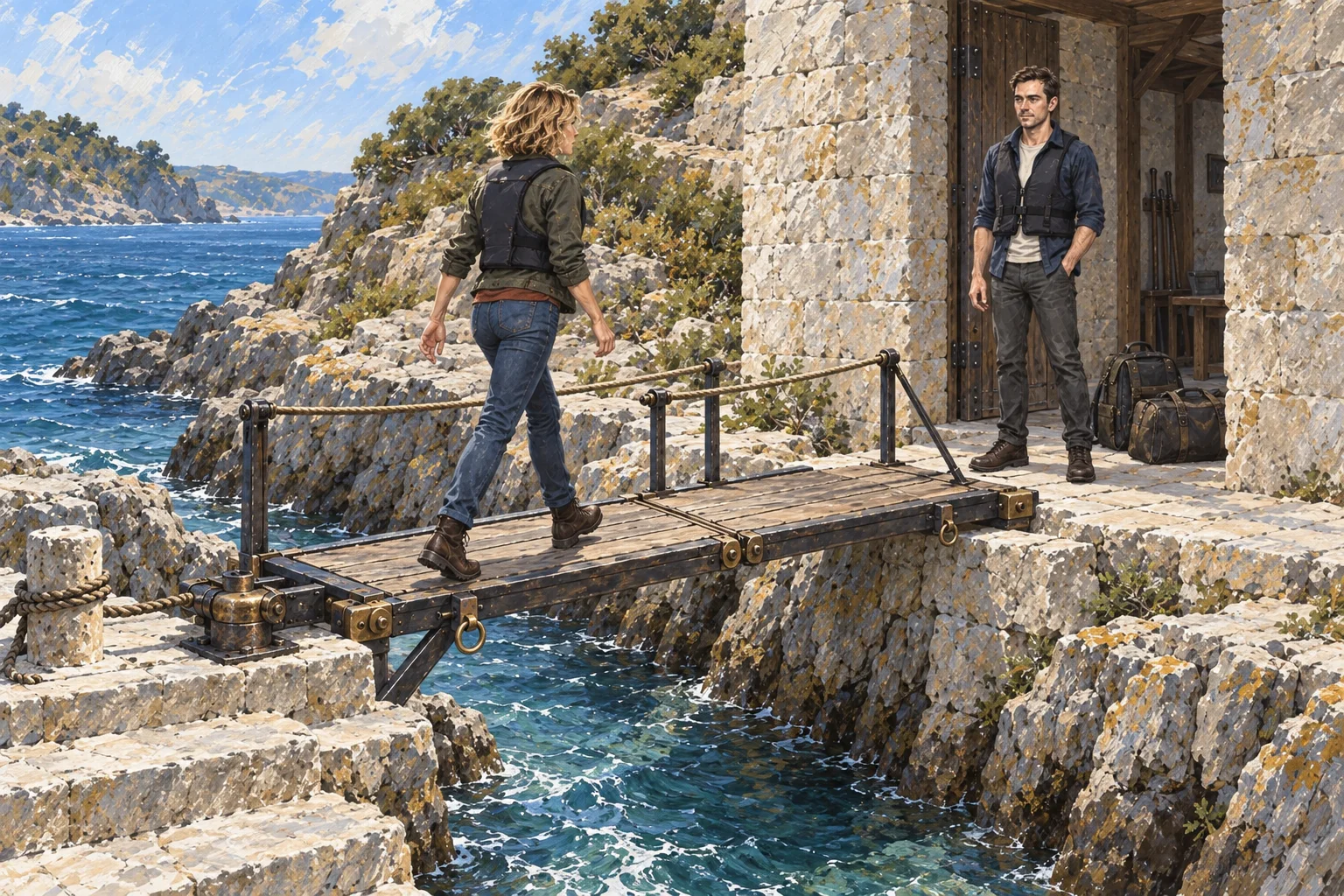
The door caught on a chip from its threshold. Vic eased it clear and called inside. No answer came. He called again as they entered, leaving the way open behind them.
Daylight reached the first table and faded among the timber racks beyond it. Vic lit the lamp, drawing its beam past a stool and a ruled board to loops of cord hanging from a rail. The air had the dry smell of stored leather beneath the damp from the stone. Beneath the table someone had fitted a smooth wedge and tied it to the leg, where it would stay with the furniture when anyone moved it. He touched the knot, smiling.
‘What?’ Kate asked.
‘I like whoever did this. I’ve spent whole mornings looking for bits like that.’
She followed his hand and smiled, then went round the end of the rack.
‘Come here. You’re on the wrong side.’
He brought the lamp round. The room was laid out like a long shop counter: low tables with hinged panels on the visitors’ side, racks of objects behind them for someone to fetch. Vic had started at the racks. Kate had gone to where a visitor would stand.
‘You’d choose here,’ she said. ‘Then collect what you needed over there.’
She lifted a panel. Under it was a map cut into the wood, and a label whose marks matched those on a flat bronze case in the rack behind.
‘That could be a road,’ she said.
They carried the case to the table, where two low supports fitted its stepped spine. Kate spread its padded wrapper beneath it. Vic brushed grit from the hinge and opened it. A thin bronze leaf settled against the wrapper with a soft, beautiful note, and he left his hand above it for a moment, listening.
‘A book,’ Kate said.
When he tilted it towards the lamp, the shallow cuts cast enough shadow to show a road, a wall, and steps going down.
‘That’s where we came down.’
She laid her drawing beside the bronze. Her pencil line met the same corner and turned the same way. She turned the sheet so the harbour sat at the bottom, at six o’clock, the way she had once taught Martin to read maps, and Vic saw the whole coast fall into place: the harbour at six, the island in its mouth, the coast running west to nine.
‘Vic. That’s the approach on the board.’
She held her paper beside the panel, checking the fork as well as the steps. Vic could follow the descent from the bent post to the landing. He had walked that shape yesterday with an animal below it.
The next leaf showed the road going on along the coast to an inlet, and a little recess, and then the drawing turned on its side, as if somebody had sliced the hill open to show what was inside.
A band of ripples crossed above a roofed passage, with the route line running beneath it. Vic followed that line towards the farther end, looking for a place where it emerged above the ripples, but it stayed underwater all the way through. Kate’s finger had stopped at the entrance.
‘That’s underwater.’ She turned towards him. ‘I was hoping you’d tell me I’d got it upside down.’
After her hands on the gunwale, he did not want to offer her a reassuring guess about that roof. Columns of unreadable writing surrounded an enlarged view of the entrance. Beside it was a figure at a ledge, doing something too small for him to make out.
‘We don’t know how they use it,’ he said.
Kate reached for the next leaf.
‘I still want to see where it comes out.’
Beyond the passage, the road rose through bends with retaining walls along their outer edges, then opened into a basin divided by channels. Rows of little round-topped shapes followed the slopes. He tipped the metal towards the light until their fine cuts separated into trees, each crown worked a little differently from the next. Near the upper edge, roofs gathered behind three low arches.
Kate caught his wrist before he could tilt the leaf away.
‘There.’
Paths joined the buildings and continued between the planted rows. A courtyard appeared inside one roof, a stair behind a wall. He could imagine arriving below those arches, showing someone the page and being told where to go. Yesterday he had begun to picture Helen’s kitchen still standing somewhere; here was a place to begin asking about it.
‘There must have been people,’ he said.
‘People who wanted other people to find it.’
But they had called twice through the station door and nobody had answered. He looked at the worn corner of the folio, where many hands had lifted it before his.
‘We don’t know when this was made.’
‘No.’ She kept her finger by the arches. ‘But we know where it says to go.’
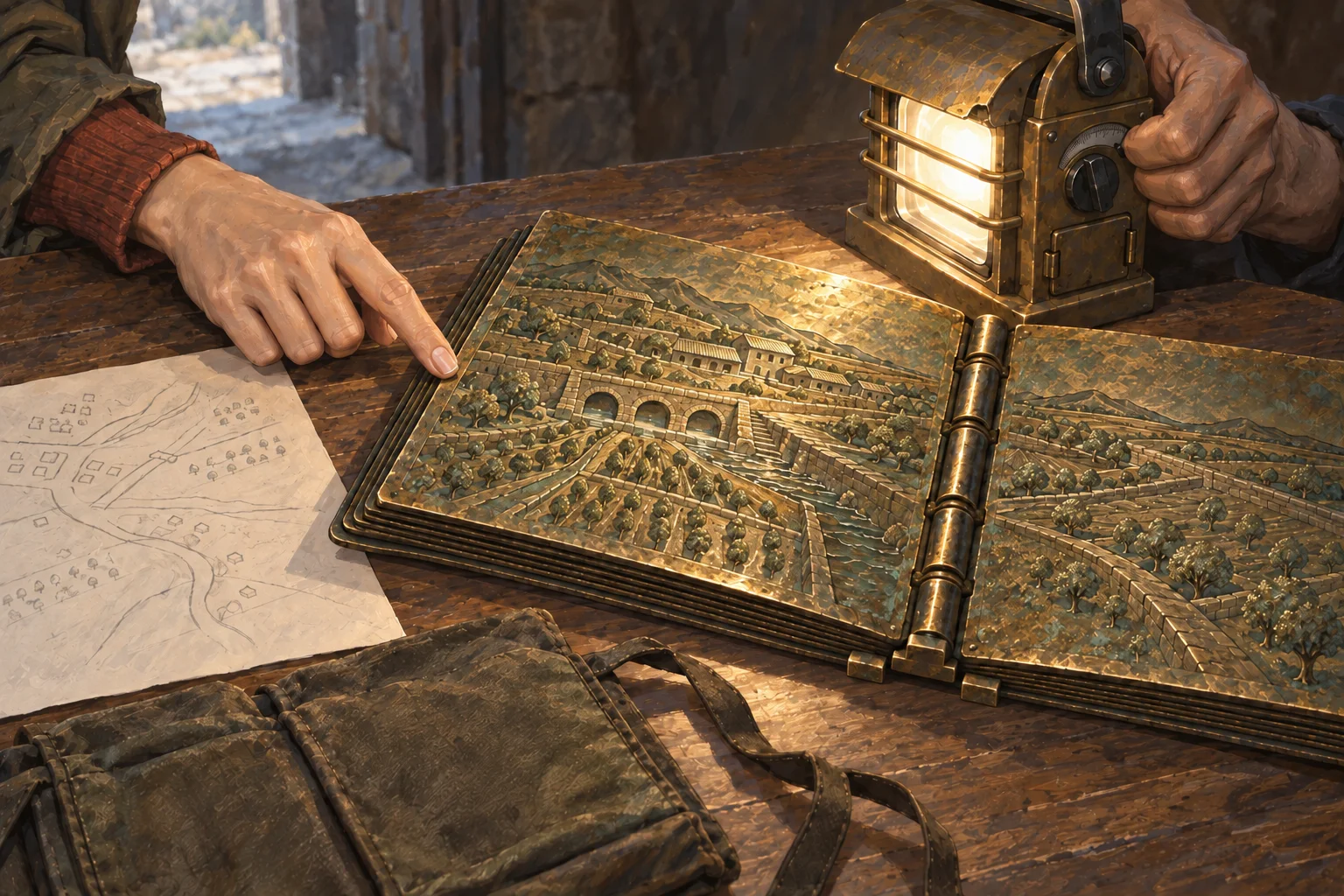
Vic opened Owen’s exercise book beside the bronze leaves. Helen’s number sat above his entry, Gordon’s names a few inches below.
‘We could show them these,’ he said.
Kate drew the book closer. ‘Even if they haven’t seen anyone from home, we can ask how a question travels.’
‘Shall we try the basin, then?’
‘I want to. At least we’d have somewhere to start asking.’
While Kate copied the route, Vic searched the bay beneath the panel. He found a short sheathed hanger, two full cartridges that fitted their lamp, and, in a canvas sleeve, a round pane of smoke-grey glass in a bronze rim that only made the room darker when he looked through it. He called it the station glass. The hanger, with its plain shell guard and a little pitting near the tip, became the Harbour Hanger in his notes, and he buckled it on at once; after the dinghy, he wanted something sharp.
On the table he left a note for whoever came back: a drawing of each thing they had taken, signed with both their names. Kate had left the columns of writing blank on her copy.
‘I don’t want this looking like instructions we understand,’ she said. ‘Let’s go and find that ledge. I want to know how far the flooded passage goes. Whether you can stop, or come back if you can’t finish it.’
‘We can look from the entrance,’ he said. ‘We don’t have to decide about crossing today.’
They wrapped the folio in its canvas and packed it with the other finds, leaving the remaining cases in their racks. Vic put out the lamp.
At the threshold a breeze caught Kate’s page, and she held it flat against her chest.
‘All those people who used this book,’ she said. ‘They went under that roof.’
Vic looked back at the empty stool, the cord tied round the wedge. He wanted, fiercely, to meet one of them.
He was on the landing handing the bags down when Kate stopped with the painter half untied.
‘Vic. Up there.’
She was looking past the tower, out beyond the harbour mouth, where the coast climbed into high grey ground above the sea. He followed her arm and saw only rock and a long shoulder of cloud. Then, near the top of the slope, a fleck of white went dark.
It came back. It went dark twice more, quickly, and stayed white.
‘A window catching the sun?’ he said.
‘The sun hasn’t moved.’
They watched until his eyes ached, and the fleck stayed as it was. Kate took out her pencil and made a small square in the empty margin of her copy, high on the page, with a dash and two short strokes beneath it.
‘One long, two short,’ she said. ‘For when it does it again.’
They went home the long way, out round the far side of the island and back in along the farther shore, a mile from the barred stair. All the way across Kate kept turning to look over her shoulder: at the hill, and at the water behind them.


