Viewpoint: Vic
On Thursday morning Vic nearly told Kate about his new level while she had a mouthful of toothpaste. She held up a finger, leaving him beside the trough in their host’s yard with the dry bag open between his hands. He had already been out to check the vehicle. It was still in the square below the wall, and as soon as they had packed, they were going down to it.
When she finally spat and turned towards him, he had already begun to smile.
‘I’m level three,’ he said. ‘It was there when I woke up.’
She wiped her mouth. ‘You look pleased.’
‘I’ve been waiting for you to finish so I could tell you.’
He had slept until the baskets began moving outside the lean-to, and read the notice twice before leaving the borrowed blankets.
It had counted the boat, the bridge pin and the crossing. It had not counted the chase, or the hound he had hit with the oar. It never counted the fights, he realised: only the things that held. He put the point into Dexterity. Even turning the buckle through the bag’s loop felt easier: he could guide it without catching the corner. He tried once more before noticing Kate watching him. It was a little buckle, hardly something to call her over for, but he was absurdly pleased.
Kate held out her hand for the bag, then stopped.
‘Three here too. The landing, the folio, the crossing. Endurance, and a point I’m putting into Focus.’ She smiled at something he could not see. ‘There’s another one.’
She read it to him.
‘I thought it might have called it Eventually,’ she said.
She put her toothbrush away and offered her hand as though they had just been introduced. He shook it solemnly until she pulled him towards her and kissed his cheek.
‘There. Now help me close this.’
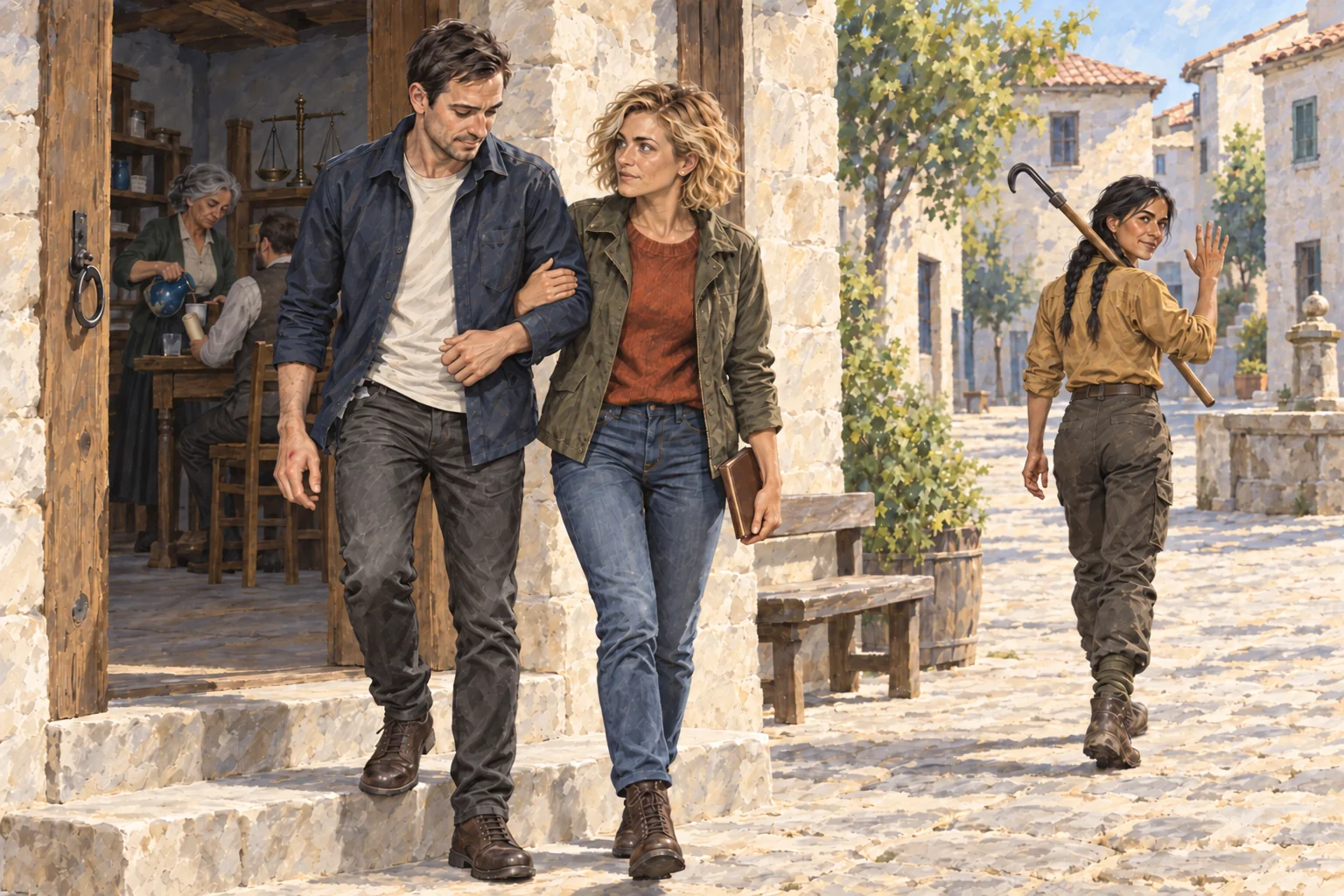
The woman in the blue wrap was spreading fruit on a cloth when they came round to the front of the house.
Kate went over to her. ‘Kate,’ she said, touching her chest, then held out a hand towards the woman.
‘Adela.’
Vic repeated the name, getting the weight in the wrong place. Adela said it again more slowly, smiling when he managed it. Kate wrote it beside the crooked square on her route sheet, then pointed down towards the vehicle. Adela waved them on.
The coach stood at the edge of the square, road dirt along its lower panels. Up close, Vic could see the wet leaves caught beneath its wipers. A man on the open luggage step was repairing a holdall strap as though they had stopped at a service station.
‘Morning,’ the man said.
Vic stopped. He had been ready to open his hands and try the names again.
‘You speak English.’
‘So does Nadia. She’s the driver.’ He pointed towards a woman in a navy jacket coming across the square with a board under her arm. ‘Two more for you.’
‘I’ve got eleven people who all need something said to somebody,’ she said as she reached them. ‘I’m beginning to think I should have brought a bigger coach.’
Her name was Nadia. She had been driving the eleven towards a hotel on Sunday evening when the road changed, the same evening as theirs. Vic looked at the coach again, trying to imagine sitting behind that windscreen and finding this square ahead of him.
‘I keep expecting it to have gone,’ Kate said.
‘It hasn’t gone anywhere. And I’ve no fuel to waste proving it can move. Where have you come from?’
They told her about the coast and the passage. Kate had the exercise book open before Vic had finished.
‘Have you heard of anyone called Martin Mercer? Or Helen Doyle?’
Nadia shook her head. ‘Neither was on my coach. I can ask the others when I see them. I get asked things every day. I’ll add yours.’
Vic thanked her. Someone might have met Helen yesterday and gone on with their day, with no reason to know she belonged in his question.
‘Can you help us ask the people here?’ Kate said.
‘I’ve got about forty words of their language. Enough to get a load to the wrong door. Not enough to get it back. You’ll want Mara for that.’ Nadia looked at her board. ‘I need to finish in the yard first. Come with me.’
Two men were turning timber on a wheeled frame beneath the workyard’s projecting roof. A boy went past them with a cartridge in each hand and told Vic, unasked and in careful English he had clearly learned from Nadia, that he was a Carrier, Measured two, the way another boy might have given his age. Nadia went to check her board with them while Vic waited for the entrance to clear. Behind them, cartridges stood in fitted racks with their gauges facing out. He took out the partly spent one. Adela had sent them to the right place for this too.
A woman in an ochre shirt came out carrying a long hook. Her black hair was tied in two low plaits, and mud had dried up her boots. She turned his partly spent cartridge to inspect its end, then pointed to two matching ones in the rack. He could follow that much.
She shook her head at his words and beckoned to someone beneath the roof. Before the man could reach them, a shout came from the channel behind her. She put Vic’s cartridge into his hand and went towards it, lifting her hook clear of the people in her way.
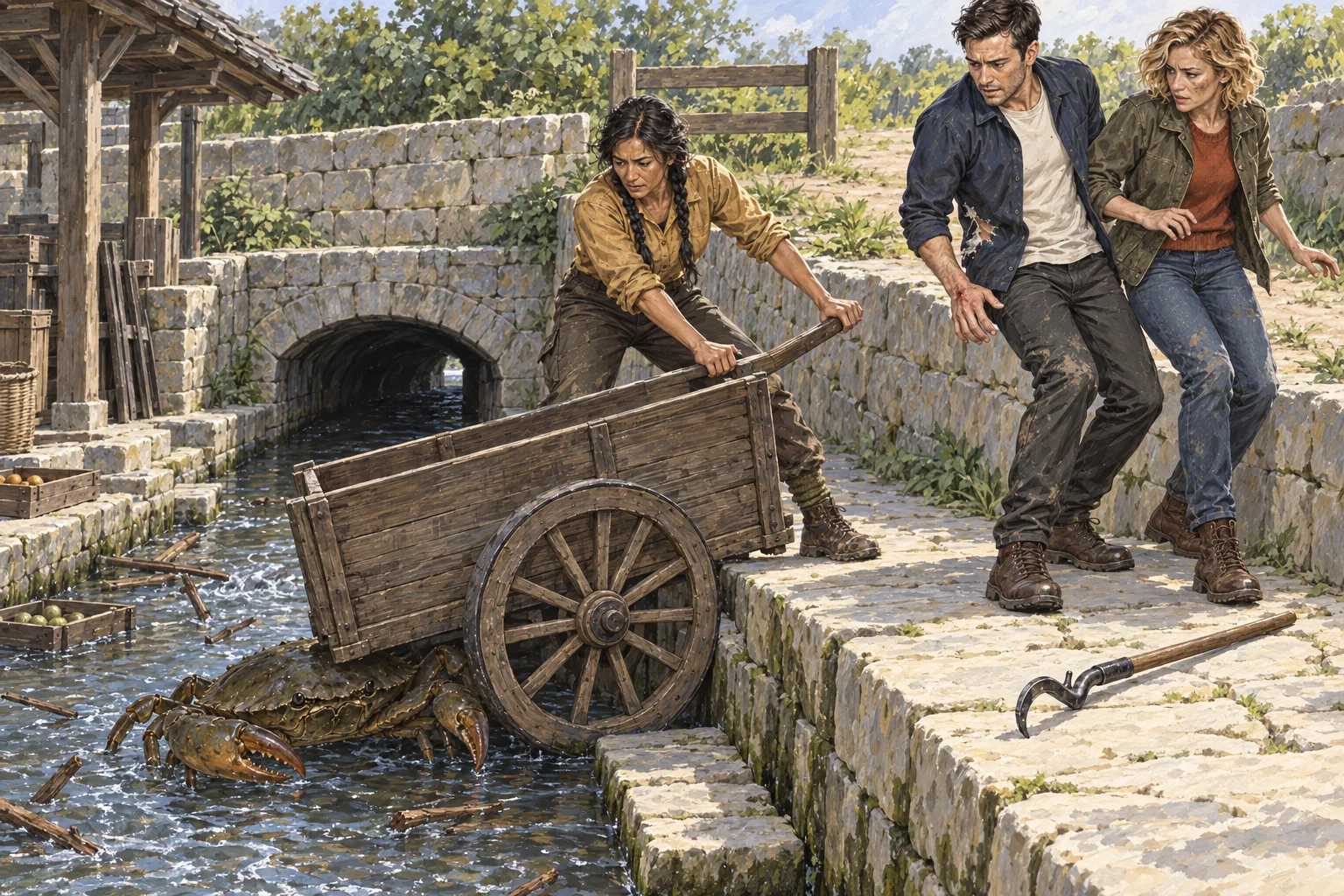
Vic followed her to a low culvert where the channel ran under the path. A mat of twigs had blocked it, and water was spreading across the stones towards a stack of shallow fruit trays. An empty handcart stood beside them. The woman, up on the path, was hooking a tray that had begun to float.
Kate put down her bundle. ‘Those are going in.’
They climbed down onto the narrow stone step beside the channel and began passing trays up to her. Vic had set down his third when she called sharply and pointed her hook at the culvert. The mat of twigs was rising, lifting clear of a broad muddy back.
It came out of the dark on four legs: a shell like an upturned barrow, two small eyes on stalks, and foreclaws each as long as Vic’s forearm. A mud-crab, he thought, though he had never seen one big enough to lift a tray.
Vic turned to climb. Kate grabbed the handcart instead and dragged it across the step between them and the animal.
‘Behind this.’
He crouched beside her. The claw came round the end of the cart, longer than he would have believed, caught his jacket and hauled him out into the open. He drew the hanger and struck; the blade skated off the shell as if he had hit a paving stone. The next pull slammed his right hip against the edge of the step.
Kate caught his sleeve with both hands and hauled. Above them the woman swung the cart’s handle down into the claw. The grip opened, and Kate dragged him back, leaving a strip of jacket behind.
Then the crab shoved the cart. Kate’s boot was caught under a fallen tray, and the cart rolled straight at her foot.
Vic dropped the hanger, grabbed the wheel with both hands and jammed it against a stone. The next shove came through the frame, and the cart stopped dead.
Kate tore her boot free and scrambled up the bank. The woman came down, took the handle and set her weight against it before Vic let go.
With the cart between her and the animal, she reached her hook past its shell and raked the twigs out of the culvert. Water rushed through. The mud-crab backed into the cleared opening with its claws raised and folded them away as it disappeared under the path.
Once the claws were out of sight, Vic retrieved the hanger and sat on the step. His hip hurt whenever he shifted, and Kate knelt beside him before he could attempt standing.
‘I thought the cart covered it,’ she said. ‘You were going up, and I told you to go behind it. I didn’t think it could reach round.’
‘Neither did I.’ Mud streaked one side of her face where her sleeve had passed. He tried to shift towards her, then gave up and kept his weight on his left side. ‘You got me out, Kate. I couldn’t turn while it had the jacket.’
Kate nodded, keeping her hand on his sleeve. The woman extended her hook beyond the cart’s end to where he had stood. Kate followed it all the way round.
‘Yes,’ she said. ‘I see it now.’
The woman held out her hand. ‘Sava.’
Vic gave his and Kate’s names and let Sava help him upright. His leg would bear weight, though bending it hurt. Kate fetched their bags while he tried a few steps; Sava pointed to a bench in the yard, and he understood that invitation well enough to go.
At the bench Vic found a nick near the hanger’s tip, bright steel at the bottom of an ugly crescent. He kept his thumb clear while attending to the offer in his Record. He half expected it to mention the stroke. Instead it named the trolley, the gate bar, and the wheel set against the stone.
It worked on something he held or had set himself, or a guard he wore. It would not mend anything broken, or swing the hanger for him.
‘That would have helped with the cart,’ Kate said. ‘Once you had the wheel against the stone.’
‘The bit I got right. I’d rather have something between us next time than try hitting it again.’
He accepted Brace and turned the hanger’s damaged edge carefully away from his knee.
Sava held out her hook to him: beneath the fresh scrape from the cart lay two bands of older polish. He paid for a minute of Read the Wear and traced the movement for her, a lift and a sideways turn, and she beckoned him to the stair behind the yard.
At the top she hooked a garden door by its low loop and lifted its outer corner clear of the sill to show him. When she let it down, it caught again. Beyond it, laden baskets waited to come out.
‘You’ve been lifting it past there,’ he said. ‘For weeks, by the look of the hook.’
She removed the hook as Nadia called from the yard below.
‘Are you coming? Mara has half an hour before her next customer.’
Nadia checked the last tray against her list and passed the board to the man beneath the roof. She looked at Vic’s torn jacket.
‘Sava says there’s a mark on the hanger. I don’t know which sort. Mara will.’
Sava said something to Nadia, pointing at herself, then at Vic.
‘Orchardist. Measured seven,’ Nadia translated. ‘She’s telling you her work. People do that here.’
‘Collector of Arms,’ he said. ‘Measured three.’
Nadia passed it on. Sava looked at the sheathed hanger and raised an eyebrow.
‘I’m better at the collecting,’ Vic said. ‘You can tell her that, if you know the words.’
The man returned Nadia’s board and said something short, not to them, with a look at the bench where Vic had put his jacket.
‘Service engineer,’ Nadia told them as he went back to the cartridge racks. ‘Forged fourteen. He’d like the wet things off his dry bench, and he’d like it more if I stopped bringing him people.’
‘Forged?’ Kate asked.
‘The tier after Measured. Measured runs to twelve, Forged starts at thirteen, and most people never get there. He’s been at it since before Mara came.’ Nadia looked at Vic’s torn jacket. ‘You’re on three. Don’t let it go to your head.’
Vic folded the wet part of his jacket inwards.
Nadia glanced at his careful stance. ‘Do you need someone to look at that?’
‘It’s a bruise, I think. I can walk if we take it slowly.’
‘I asked whether you need someone to look at it.’
‘No,’ Vic said. ‘Not yet.’
‘Then we can do slowly. Tell me when it becomes yet.’
They followed Nadia and Sava towards the weighing-house. The man on the luggage step raised a hand as they passed the coach again.
Inside, a grey-haired woman was closing a ledger. She listened to Nadia, answered Sava in the local language, then drew a chair out with her foot as she saw how Vic held his weight.
‘Sit down before you fall on something I need,’ she said to Vic. ‘Nadia says you came under the road.’
He sat. ‘Yes. Thank you.’
‘Mara Varga. Weigher, Measured eleven.’
‘You say Measured too,’ Kate said.
‘It says Measured, to anyone who thinks in English. In Vennic it’s a weigher’s word, which is one reason I took to it.’ Mara very nearly smiled. ‘And every English speaker who comes through ends up calling the whole business the Assay. I did, my first winter. So, I gather, did your coach.’
They introduced themselves. When Vic said Collector of Arms, Mara looked at him properly for the first time.
‘Collectors put old sets back together,’ she said. ‘The traders say a set that has been asleep long enough can wake, if the right hands find the rest of it, and then it does something none of its pieces will do alone. The carters have a song about a woman in a woken harness who held a bridge on the river road up all one night while the carts went over it.’ She shrugged. ‘I’ve heard it sung by men who’d swear their grandmothers saw it. I’ve never seen it happen. I weigh things.’
Vic thought of three plates under a cloth at the Arsenal, and the word the Assay had used for them. Dormant.
Kate stood beside the second chair, even after Mara moved a parcel from it. As she laid her route sheet on the table, Mara looked at the drawing.
‘Draw like that for long enough and the Assay will offer you Waymaker,’ she said. ‘Most route-drawers get it in the end. It counts the journeys other people make by what you draw, which is why it already likes you, if your neighbours have been walking your drawings all week. Keep those.’
Kate left the sheet beside the open book.
‘Sava wants me to look at what you’re carrying.’ Mara looked at the marks on the hanger and the cartridge. ‘Station property, both of them. Borrowed, not yours, and you’ll answer for that nick.’ She wrote down his account of the note they had left, kept the two collar cartridges they had half emptied practising, for the engineer, and pushed the hanger back to him. ‘You left a drawing, which puts you ahead of most. Look after it.’
Mara turned their partly spent cartridge in her fingers. ‘Enough charge in these to get you home?’
‘On the crossing we tested, yes.’
Nadia pointed through the back door. ‘There are beds behind here, two nights, and meals. After that you ask again. I’ll show you when you’re ready.’
Mara glanced at the dressing on the back of his hand. ‘That’s a bite.’
‘Something like a dog,’ Vic said. ‘With feathers. The same one came into our yard at home for the flour.’
‘Rook-hound. Not feathers, hackles. Everybody says feathers the first time.’ She did not smile. ‘They come down along the new joins looking for cover, and they stay where there’s food.’
‘Joins?’
‘Where one piece of the world has been set against another. You’ll have seen one. Walls that don’t belong together.’ She watched his face and nodded. ‘Every exchange makes new ones, and new runs for anything that climbs.’
‘Exchange,’ Kate said.
‘That’s what they call it here. Pieces go, pieces come. Nobody I’ve met knows why.’ Mara turned back to the bite. ‘The hounds don’t care why. If one has found your bakery, it will bring the rest of its family. Keep a light burning and your doors shut, and don’t let anyone go out alone after dark.’
Kate looked at Vic. He was thinking of Priya on her knees beside the torn sack.
‘How many people are there where you came from?’ Mara asked.
‘We don’t know,’ Kate said. ‘There are people in the streets round us. We’ve been leaving questions at the terminal.’
‘Good. Keep doing that.’ Mara pulled a sheet from beneath the ledger. ‘I’ve been trying to get Nadia to write down the places her passengers last knew. Some of them would rather sleep.’
‘I’ve got the ones who want to be on it,’ Nadia said. ‘Let the others sleep.’
‘Then I’ll use those.’
Kate opened the exercise book at Helen and Martin’s names. ‘Can you send letters? To people who came here? Or to England?’
Mara’s hand stopped over the sheet.
‘Here, sometimes, if we can find someone going towards the right place. England is a different question.’ Mara left her hand beside the sheet. ‘I’ve tried. I don’t know how to send one there.’
‘But you’ve only had since Sunday,’ Kate said. ‘There might be somebody we haven’t found yet.’
Mara looked from Kate to Vic. ‘I came in 2007.’
Vic went on trying to settle his hip in the low chair. He had heard the year clearly, but could not connect it with the woman across the table.
‘What?’ Kate said.
‘The thirteenth of November. I’ve been here nineteen years, by the dates we’ve compared. Nearly.’
‘You mean nineteen years for you?’
‘For me. I don’t know what happened to the place I left. Nadia’s date was the first recent one I’d had from somebody who could tell me herself.’
Vic looked past her at the shelves, where bundles of letters were tied with cord beside a chipped blue jug and a jar full of buttons. Until a moment ago he had been grateful to find someone who could speak the language. Now he tried to imagine the time she had needed to learn it, sitting at tables like this and asking people to repeat themselves. She had had time to buy a jug and chip it and keep it. He looked back at her hands on the ledger.
Kate sat down.
‘Did any letters get back to you?’ Kate asked. ‘Even if you couldn’t send yours?’
‘From here, yes. Nothing from home.’
Nadia’s name lay on Mara’s sheet beside a date in the local reckoning he could not read. He had been ready to add their own names; now he wanted to know how long each person on the page had been here.
‘But people could be in another town,’ Kate said. ‘Even if we came together, on the same day. We’ve only seen the streets round the bakery.’
‘They could. I don’t know how widely you’ve been scattered, but we can ask farther than that.’ Mara drew the sheet towards her. ‘I can help with the asking. I can’t tell you what happened to your family.’
Mara waited while Kate looked down at the book. Nadia took the chair nearest the door and said nothing, which Vic suspected cost her.
Vic picked up the partly spent cartridge from beside the ledger.
‘The cartridges in the yard,’ he said. ‘Can you fill these again? They had some in the same fitting as ours.’
‘Yes. There’s a charging place by the mill. A whole night each.’
He turned the cartridge in his fingers. It was a question with an answer, and he wanted one of those very badly. Beside him Kate still had her thumb on her brother’s name. He set the cartridge down.
‘Did you have somebody at home?’
‘Yes,’ Mara said.
He waited, but she did not add a name.
‘Do you still think they might come?’
‘When Nadia told me where she was from, I went out to the coach before I’d put my coat on.’ Mara looked towards the open door. ‘I knew it wasn’t sensible. I wanted to look at everyone myself.’
Vic pressed his palms against the edges of the chair, trying to stay still despite the ache in his hip. He had been imagining a search that would end while Helen was still waiting to hear whether she should leave the chest out. Her message was easy to picture, down to the small question mark at the end. Four days had been long enough for him to keep checking it. Across the table Mara had been doing her work here for nineteen years.
‘I’m sorry,’ he said.
‘So am I.’
A man came to the door carrying a rolled sheet. Mara spoke to him in the local language. He answered, looked at the four of them and went to wait on the bench outside.
‘I have a life here,’ she said. ‘Please don’t ask me to account for all of it this afternoon.’
‘No,’ Kate said. ‘I’m sorry.’
Vic took his hands off the cartridge. It left a damp ring on her table. He wiped it with his sleeve.
Mara drew their book towards her, stopping until Kate let it go.
‘Tell me what you want to send.’
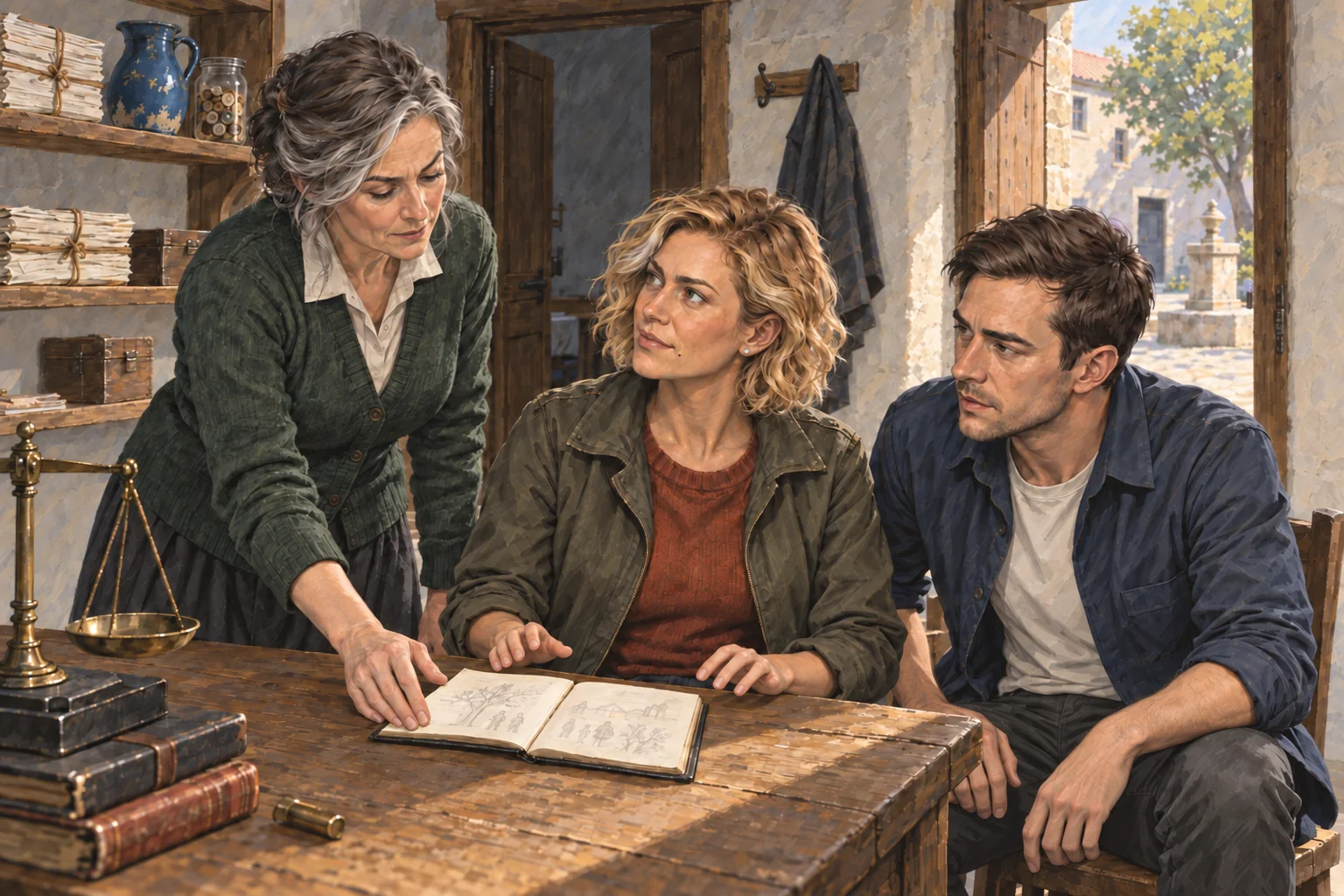
Kate began with Martin’s height, correcting the extra inch he always claimed, then stopped with one hand raised beside her own hair.
‘What if he looks different?’
‘Start with what you know,’ Mara said. ‘We can say when you last saw him.’
Mara wrote Helen Doyle, Vic’s sister, and Martin Mercer, Kate’s brother. Kate remembered the bicycle scar under Martin’s chin. Vic could picture Helen putting her hair behind one ear as she listened, but could not make that useful on a page. He gave her old address instead, watching Mara write Doyle beside a second version in the local script.
‘Vennic,’ she said when he asked. ‘Most of the traders I work with can read this. Leave the English too.’
She read the enquiry back: they were alive, and asked for news of Helen and Martin. Replies could come to her table at the Three Arches weighing-house, or through Owen at the terminal.
‘Don’t say we’re waiting here,’ Kate said. ‘He might try to get here after we’ve gone back. Who’ll take it?’
‘Sava can take it with her orchard tallies to my receiving bench on the upper lane. I’ll ask the traders.’
Sava spoke again, lifting one hand as though it held the hook.
‘Her garden door sticks,’ Mara said. ‘She wants to know if you are any good at doors. I told her you looked like a man who was good at doors.’
‘I am,’ Vic said.
Sava answered. Nadia laughed before Mara translated.
‘She says you should start by learning to put a cart in the right place.’
‘That was me,’ Kate said.
Mara relayed it. Sava answered without smiling this time.
‘Then you should both learn. After breakfast. And she needs it to open with a basket in your hands. An empty door that opens once is no use to her.’
‘We have to be back on Saturday,’ Vic said. His hip was stiffening in the chair. ‘Tomorrow’s our whole day here.’
‘Then you had better be good at doors,’ Mara said. ‘I’ll come up for half an hour before I open, to do the talking.’
Mara called her customer in while Kate laid their copy inside the exercise book, careful of the fresh ink. At the threshold she offered Vic her arm. He eased his hip down the step as Sava crossed the square. Kate called her name and held up the book; Sava raised a hand before turning between the houses.
Behind them a cup clinked against Mara’s table. Vic looked back and saw her pouring for the customer from the chipped jug, her attention already on the rolled sheet he had brought. She knew where everything was without looking.
Kate’s arm tightened beneath his hand.
‘Nineteen years,’ she said.
He had nothing to make the number smaller. They stood on the step until Mara looked up, then moved out of her doorway together.
The square had filled while they were inside. Lamps were being lit along the arcade, and the evening traders had spread out on cloths and barrows: a woman with bolts of blue cloth from somewhere four days up the road, two men with a cart of salt fish from the coast, a boy selling something hot in twists of paper. Kate bought two twists with a coin Nadia lent her. Inside was a knot of fried dough, sour and sweet at once, too hot to hold. Vic heard three languages and understood none of them, and the size of the world opened under him like a step that wasn’t there.
Then the ground spoke.
It came up through the paving into the soles of his boots: not a tremor so much as a hum, low and steady, like a lorry idling in the next street. The cups on the fish men’s cart began to walk. Across the square every conversation stopped at once, in all three languages, and every face turned the same way: north, up past the orchard terraces, to the ridge above the town.
All but one. Under the workyard’s projecting roof the cartridge racks had begun to chatter, forty bronze cylinders rattling in their fitted slots, and the service engineer walked between the two racks without hurrying and put one hand flat on each.
They stopped. Both at once, as if they had been nailed to the ground.
The paving went on humming. Every few seconds the man’s shoulders set by a fraction, the way a man’s shoulders set when he pays for something again, and the racks stood perfectly still under his hands while the ground shook round them. His face did not change at all.
‘That’s Brace,’ Vic said. He knew it the way he would have known his own handwriting on somebody else’s label.
‘Holding work,’ Nadia said, without taking her eyes off the ridge. ‘Two things at once, as long as it takes. He’s had thirty years at it. That’s what fourteen looks like.’
Vic looked where everyone else was looking.
The ridge was doubling. Along a stretch of skyline perhaps half a mile long, the line of the hill had come loose from itself, two outlines lying almost on top of each other and not agreeing, the way a page looks when the eye will not focus. The upper one wavered. Through it, for a moment, he saw stars where there should have been grass.
The hum deepened into a pulse he felt in his teeth. Somewhere up in the orchards a dog began to bark and would not stop. The double line shivered, and something white rolled over the crest and began to pour down the terraces towards them, slow and thick as milk.
‘Mist,’ Nadia said, very quietly, at his elbow. ‘Watch your feet.’
Then the beat stopped, and the two outlines were one again, and the ridge was a different shape.
Where there had been bare grass against the evening sky there was dark ground, peat-dark, rising in a long shoulder, and on its crest stood a row of upright stones that had not been there a minute before, black against the last of the light.
Nobody in the square screamed. That was the thing Vic remembered afterwards. The woman with the blue cloth began, without any hurry at all, to fold it. The fish men pulled a cover over their cart. A door banged, and a voice called a name, and another voice answered it, and then another name, and another, all round the square, like a roll being taken.
Mara had come out onto her step with her ledger in one hand and her pencil in the other. She looked at the ridge, then at the sky, and wrote something down.
‘What was that?’ Kate’s hand had closed on Vic’s arm hard enough to hurt. ‘Mara, what was that?’
‘That,’ Mara said, still writing, ‘was the Exchange. Northern ridge, half a mile, give or take, and I make it twenty past.’ She closed the ledger. ‘The fourth I’ve seen from this step. Somebody, somewhere, has just lost a hill.’
The mist reached the bottom terrace and came on into the square, cold as a cellar and smelling of wet heather, a smell from another country altogether. Lamps became smudges. People became voices. The roll went on round them in the white, names and answers, names and answers.
One name went unanswered. A woman over by the workyard called it again, higher, and then again.
‘That’s the boy,’ Kate said. ‘The Carrier. That’s his mother.’
Vic could not see the workyard. He could not see the far side of the square. But he knew where the culvert was, because he had been dragged across its step by a claw that morning, and he knew what a mist like this would do to the edge of a channel.
Kate was already going. She did not run. She went towards the sound of running water with one hand out in front of her, the way she had gone down the steps under the lintel, and Vic followed the dark shape of her coat as fast as the hip would let him.
The boy was on the culvert step. He was crouched there with a cartridge clutched in each hand, exactly where Vic had stood that morning, staring at the water going past his boots, black and fast. He had come to fetch something and the white had come down round him and he had not been able to see which way was up.
Kate crouched on the bank above him and did not reach for him straight away.
‘Carrier,’ she said. ‘Measured two. Yes?’
The boy looked up. His face crumpled and recovered.
‘Measured two,’ he said, in Nadia’s careful English.
‘Measured three,’ Kate said. ‘Hand.’
He gave her one of the cartridges first, because that was his job, and then his hand. She brought him up the bank and stood him on the path and did not let go, and they walked back into the square along the wall, Kate keeping her free hand on the stones, towards the woman’s voice. When they were close enough the woman came out of the white and took him, and said something to Kate, and then said it again, holding Kate’s sleeve.
Kate stood in the mist with the cartridge still in her hand and looked at it.
‘He gave me this first,’ she said, and laughed, unsteadily. ‘He gave me his work first.’
By the time the mist thinned, the lamps were lit all round the square and the roll had been taken twice. Up on the ridge the standing stones were already a part of the dark.
Nadia found them in the square with the fish men’s news, and she gave it to them the way she would have given them a timetable, as if hills did not move.
‘They say the sea’s up at the inlet. Higher every tide since the weekend, and the wind keeping it in.’ She looked at Kate’s collar. ‘How deep did you say that passage of yours goes?’