Viewpoint: Vic
Vic woke hungry in the room behind the weighing-house and lay for a moment wondering whether someone would call them for breakfast. The room was still unfamiliar until he remembered Mara’s jug and the way she had turned to her waiting customer. Nineteen years was long enough to know who would need a chair and where to set their cup. He had gone to sleep trying to imagine that much of a life here, then slept most of the nine hours they had been in bed.
Kate was already sitting on the other bed with the enquiry across her knees. The sheet had curled a little at one corner, and she was pressing it flat with her thumb.
‘It’s Friday,’ she said. ‘The thirteenth. The day she came.’
He had not put the dates together; yesterday the year had crowded out everything else, and then the hill. Beyond the wall somebody began opening the shutters. Over the roofs the new ridge stood in the grey light with its row of stones along the top, as if it had always been there.
‘Should we say something to her? I was so busy asking yesterday that I hardly thought about the date.’
‘I don’t know what I’d want somebody to say.’ She folded the sheet, then flattened it again. ‘I keep thinking about her letters. I want this to leave today.’ She looked at the window, where the light was grey. ‘And I keep thinking about Nadia’s question.’
So had he, half the night. Three metres at the bend on Wednesday, and the collar good for four. The springs peaked on Saturday.
‘We go back Saturday morning,’ he said. ‘Early, at low water. And we find out where Sava’s shelf goes, in case the passage won’t have us.’
Vic swung his legs out of bed too fast. The bruise at his hip brought him back to the mattress with a noise that made Kate look up from the sheet. She moved a chair beside him so he could sit while he dressed. He accepted it without explaining what he had meant to do.
As they approached the garden stair, Vic heard the scrape of baskets being dragged over stone. A basket had wedged in the garden door’s narrow opening, and when the man behind it pushed, yellow fruit spilled down the steps. Kate caught one against her boot.
Sava looked from his careful stance to the door. She pointed to a low stool beside the wall.
Vic sat with his right leg stretched out while Kate gathered the fallen fruit. Behind the door, rows of laden baskets stood waiting beneath the trees, and every one of them would have to pass through an opening scarcely wider than a person.
Mara came up the steps carrying her own breakfast in a folded cloth.
Kate closed the exercise book. ‘You said the thirteenth. Is that today, for you too?’
Mara stopped on the upper step. ‘Yes.’
‘Would you like company this evening? We don’t have to ask you anything.’
Vic looked up from the stool. Inside the garden another basket scraped towards the door, and the man stopped it before it could catch behind the first.
‘Come to the house for supper, after I’ve shut,’ Mara said. ‘I’d rather sit somewhere I can leave the ledger alone. Nadia can show you the lane.’
‘We’d like that,’ he said.
She sat on the wall and broke off a piece of bread. Sava began speaking, and Mara listened while she ate.
‘They’re sorting the damaged ones again,’ she told them. ‘The carrying trays won’t go through. The people on the upper plots need the empty baskets back, and Sava needs to take these out before she goes up with the accounts.’
‘Can I take the little cover off the bottom fitting?’ Vic asked.
Mara put it to Sava. Sava nodded, then spoke for longer, pointing to the hook and the door’s upper corner.
‘You may work on it. She wants you to understand that she can lift it with the hook, but she cannot carry a tray and do that too. It has to stay usable when you’ve gone.’ Mara listened to Sava a moment longer. ‘And if it opens, she’ll show you where her shelf goes. She says that’s a fair price for a door.’
‘All the way open, without lifting it. Then shut again.’ He mimed the full swing.
Sava nodded at the sweep of his hand before Mara had finished translating. She worked the trapped basket free and pushed it back to the man, then cleared the step for Vic’s stool.
‘When should we come back to you?’ Kate asked Mara. ‘We’ll want to know where it’s gone.’
‘Before I close. I can tell you who has agreed to carry a copy.’
Sava showed Kate the narrow wooden tally case she carried her accounts in. The enquiry would lie flat there without having to be folded again. Kate put it back in the book until Sava was ready to leave, then pointed through the opening to a covered stone passage running along the garden wall beyond the trees. ‘Does that lead towards our side of the water?’
Sava fetched a board hanging inside the door and brought it close enough for them to see: a drawing protected beneath a cloudy sheet, its corners secured with broad tacks. Kate took out the folded copy she had made from the island folio and turned it until the coast lay the same way.
‘The service shelf goes along the lower wall,’ Mara said, while Sava traced it. ‘Dry, most of the way she knew. There’s a fall beyond the next turn, and she hasn’t been past it since the last rain. A footway, not a road for the coach.’
Kate was looking at the top of the board. Above the gardens a line climbed off the edge of the sheet, and beside it someone had drawn a small square crossed by three bars. The same mark stood on a scrap of island in the bottom corner.
‘What are those?’ Kate asked.
Mara turned it into Vennic. Sava touched the island, then the square at the top, and answered briefly.
‘Stations,’ Mara said. ‘Survey houses, for the people who look after the roads. They signal to each other from the towers.’
‘With what?’
Mara put the question to Sava and listened. ‘Shutters, she says. She knows some of what they mean. Not all.’
‘I saw one moving,’ Kate said. ‘High up on the coast, above the sea. Twice.’
Sava looked at her for a moment. Kate unfolded her copy and showed her the little square in the margin, and the dash and strokes beneath it: the order the fleck had gone dark and come back, as near as she had been able to catch it.
Sava went very still. She put one finger on the dash, then on the strokes, and spoke to Mara without taking her eyes off the page.
‘She says that’s the old service code,’ Mara said slowly. ‘Station occupied. And the last part—’ Sava said something else, sharp. ‘The last part is a call for help. She says nobody has sent that on this side in her lifetime.’
Kate looked at Vic. Somebody was up there, on the high coast above the sea, asking for help, and the only people who had seen it were two strangers who could not read the board in front of them.
‘How do we get up there?’ Kate said. ‘Ask her. Please.’
Mara asked. Sava traced the line that climbed off the top of the board, then lifted her hand above its edge, and higher again, and wrapped her arms round herself. Vic did not need that translated.
‘Past the last farms and into the snow,’ Mara said. ‘Days of it. Nobody takes that road in winter without a party and a reason.’ She paused. ‘Somebody asking for help is a reason. It isn’t a party.’
‘Then we find a party.’
‘You’ve been here two days,’ Mara said, not unkindly. ‘You don’t know anyone well enough yet to ask them to walk into snow for you. I’m not sure I do, and I’ve had nineteen years.’
Kate turned to Vic, and he could see she wanted him to argue. He couldn’t. He was thinking of Priya on her knees beside the torn sack, and the scarred head on the yard wall, and five o’clock on Saturday.
‘We promised to be home tomorrow,’ he said. ‘And the passage gets deeper every tide.’
‘So we just go home.’
‘We go home and tell them. And then we come back with—’ He did not know with what.
‘With a way to answer.’ Kate was looking at the little barred square on the island, down in the corner of the board. ‘The island station has a tower. If they talk to each other from towers, then that one talked to this one, once.’ She folded her copy along its crease, hard. ‘Somebody has been asking for help, and nobody has said anything back.’
Sava drew the board away, tapped the garden door and pointed at the baskets.
Mara laughed, though not much. ‘She says this first. Her door won’t wait for the snow either. And her shelf is the price, remember. If your passage won’t have you tomorrow, you may want to know where it goes.’
Kate looked at the door as though it had personally offended her. Then she knelt and began picking up fruit. Their interpreter’s half-hour was over, and Mara went down to her waiting customer while Vic turned to the fitting he had asked to uncover.
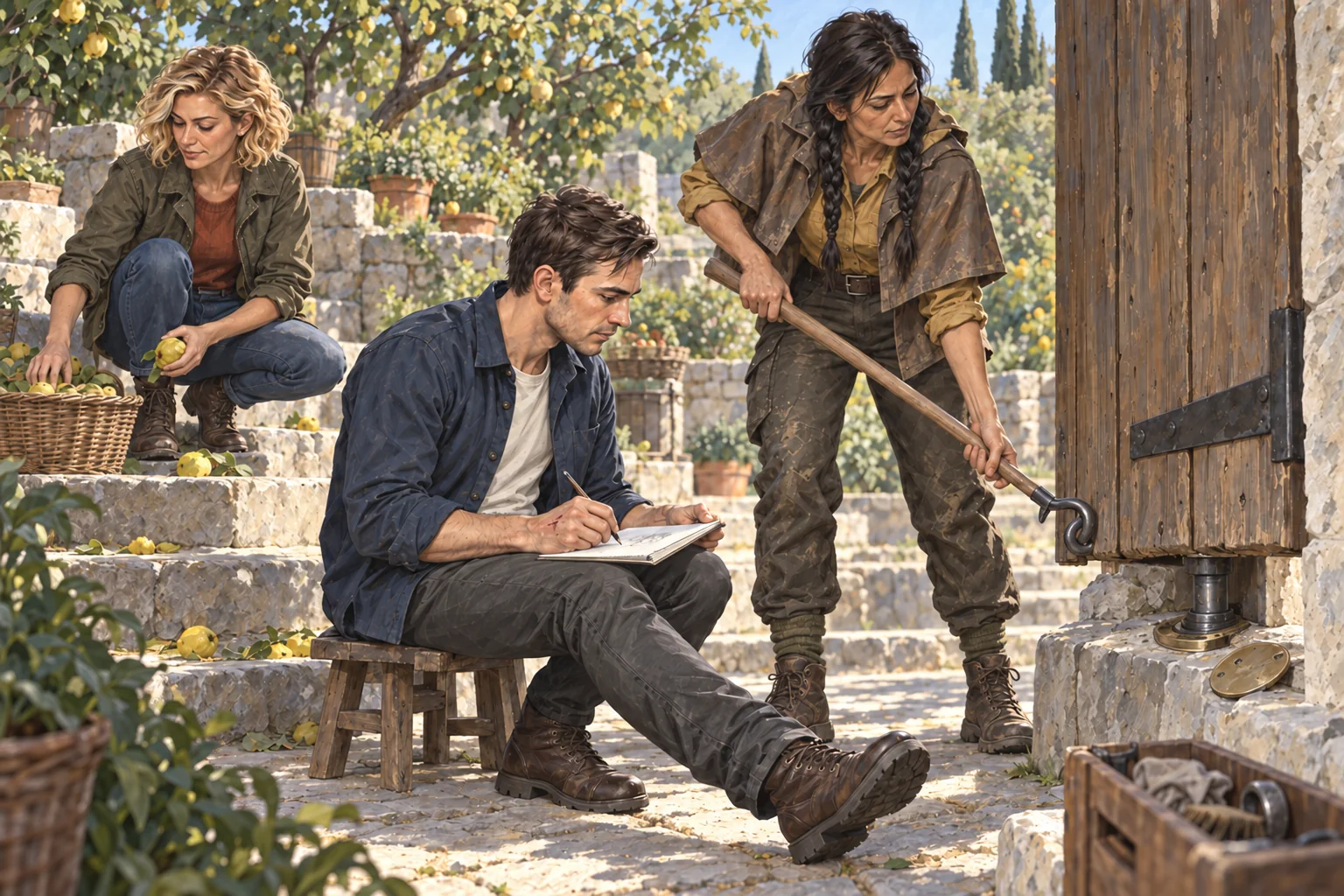
With Sava’s permission, Vic took the cover off the bottom hinge and found the worn hollow that had been dropping the door onto its sill for weeks. He cut a crescent of brass from her offcuts to pack it.
Halfway through its swing the door stuck again. His packing needed to reach farther.
Kate took the file out of his hand. ‘You hold. I’ll do this. I need to do something to something.’
So she filed and he held. For the first few strokes she went at the brass as though it had sent the signal itself. Then, gradually, she slowed, and their sleeves brushed at the end of each stroke, and by the end she was humming under her breath, the tune that came out of her when she was working and had forgotten to be anything else.
‘I’m still angry,’ she said, without looking up.
‘I know.’
‘Not with you. Mostly.’
With the wider piece fitted, the door stayed level throughout its swing. Sava opened and shut it twice. Vic waited for the scrape; it never came. She picked up the wide tray and walked through without turning it sideways, and then she turned round in the doorway and walked back through it again, for the pleasure of it, and Kate laughed in spite of herself.
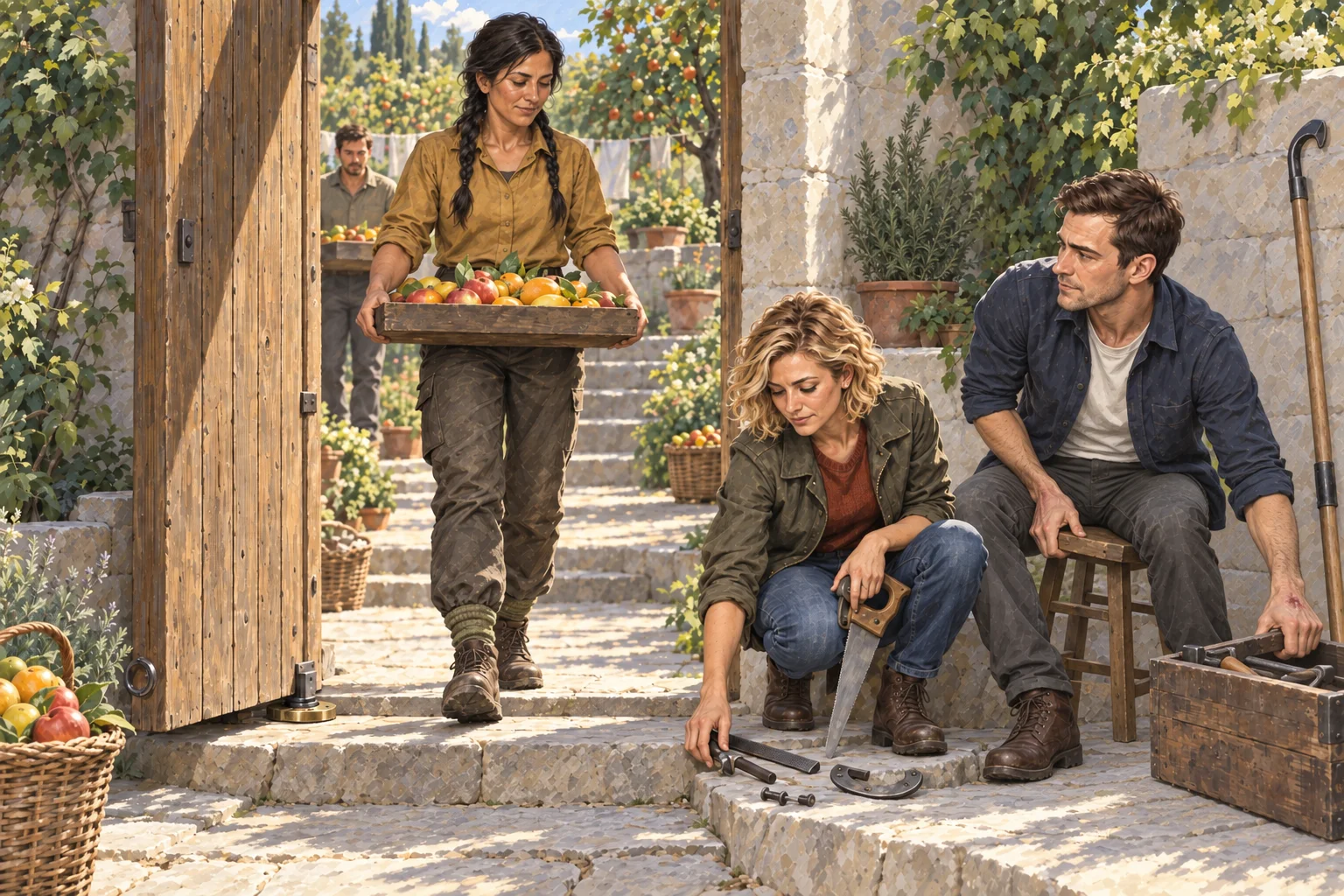
As the man passed with another tray, he laughed at something Sava said and touched two fingers to Vic’s shoulder. Vic could not answer him, but he moved the tool box farther out of the way and watched him carry the fruit down the steps. He was still sitting with the box beside his foot when he became aware of a new entry in his Record.
If he ever took the fitting apart again, it would hold the working alignment in his hands while he put it back.
He accepted Conservator.
A Calling, then, beside the Vocation. The Vocation was the field. The Calling was the hands. Kate was following the next tray into the garden.
‘Kate, come and look at this. I’ve got a Calling.’
He read her the offer as she came back through the doorway.
‘For the door?’ she asked. ‘I was hoping it would count. Would it have helped with that piece?’
‘Once I’d found the position that worked.’ He pointed to the fitting. ‘It wouldn’t have told me to make it wider.’
Kate picked up the failed crescent from the box. ‘Then don’t use this one as the reference. I’m getting quite attached to being able to walk through.’
He laughed as she put it back and squeezed his shoulder, then opened his full Record for the first time. He wanted to see the Calling beside the Vocation he had chosen at the Arsenal.
Kate turned her hands palm upwards; a grey line of brass dust had gathered in each crease.
‘I did some of it too. I hope it noticed the filing.’
‘I noticed. I was getting nowhere holding it on my own.’
He let the Record go and picked the failed crescent out of the box for his notebook. Behind them the door swung shut after another load, clearing the sill with room to spare.
Once the stacked trays were through, Sava beckoned them into the garden. Vic used the frame to ease himself over the shallow step and found room to stand among trees planted in long beds against the hillside. Small yellow fruit crowded the branches, with strips of faded cloth lifting above the newest growth. Through them he could see the upper lane at last, only a short rise beyond the last terrace. Two people were passing baskets over the side of a cart there. The latch clicked behind Kate, and he moved on so she could see too.
Sava set a stool for him beside the path. She put three pieces of fruit on the box of unused metal, kept one for herself and handed out the others. Vic wiped his on his sleeve. The skin broke sharply between his teeth; the flesh was softer than he had expected, with a sourness that made the next bite better.
They ate in the shade while someone in the workyard below dropped something that rang against the paving. The outburst that followed was the same in any language. Sava called down, listened to the answer and rolled her eyes, and Vic smiled with fruit still in his mouth.
When he had finished eating, he joined her at the covered entrance. The service shelf ran along the outside of the stonework, dry and wide enough here for two people to pass, with a low wall between it and the slope. It was easy to imagine following it round the bend until the fallen masonry came into view. Beyond the fall he could see neither the walking surface nor what supported it.
‘Gordon could walk on this bit,’ Kate said. ‘If there’s more like this on the other side of the fall, we could bring him.’ She looked along it towards the sea. ‘And if the water keeps coming up, it might be the only way any of us gets home.’
Vic pictured Gordon’s face if they came back with another route that began by putting his head underwater. ‘Owen too, once he’s able. He could keep his arm dry.’
Stacked trays blocked the straight path across the orchard to the cart on the upper lane. Kate drew Sava a way round by the cistern on a page of her notebook, tore it out and gave it to her.
‘Mara said someone else had to use it,’ she said quietly. ‘I keep wanting to go along and explain.’
They followed Sava back through the door to the yard side. She settled her tally case on a basket and held out her hand to Kate.
Kate took the enquiry from the book but kept hold of it a moment. Helen’s name stood above Mara’s smaller script.
‘It seems very little,’ Kate said.
‘They’ll know it’s us if they see it.’
Kate nodded. She gave Sava the sheet.
Sava laid the enquiry beside her accounts and closed the wooden case. She lifted the basket with the case on top and carried it through the garden doorway without putting it down, then turned onto the terrace path towards the cart. The door swung shut behind her and opened again for the man’s next load.
Vic watched Sava unfold the drawing at the cistern. She looked from the paper to the trees, took the outside row clear of the low branch, and reached the cart without coming back to ask. Beside him Kate raised a hand. He was about to ask whether Sava had seen her when she stopped waving.
‘Vic. It’s here.’
He turned to find her looking past his shoulder with her mouth open. Before he could ask what she meant, she held up a hand for him to wait.
Five seconds’ touch would set a mark she could feel from half a kilometre away, three at a time, until she slept. Vic watched her look from her empty hands to the door beside him.
‘Yes,’ she said. ‘I want that. I accept.’
Vic was smiling before she looked at him.
‘Try one here,’ he said. ‘I want to watch you do it.’
‘You won’t see anything. Stay there, though. I want to try from round the corner.’
Kate put her palm against the garden door and let him count the five seconds with her. Nothing in the timber changed. When she took her hand away, she kept looking at the place she had touched, then went down the steps until the corner hid the door from her. Vic waited above her, wanting to call out before she had even turned.
‘There.’ She pointed through the wall, a little above him. ‘Near.’
Vic looked back along the direction she had pointed. It led through the wall to the place where her palm had rested. She laughed and shut her eyes to try again, then came back up the steps so fast he had to step out of her way. She caught his hand before he could tell her what he had seen.
‘We could go somewhere I haven’t drawn yet.’
He looked past the orchard to the high ground, where the line on Sava’s board had climbed off the edge of the sheet.
‘Up there?’
‘Not tomorrow. I know.’ She was still holding his hand. ‘But I could mark it. For whoever comes after us. For whoever we bring.’
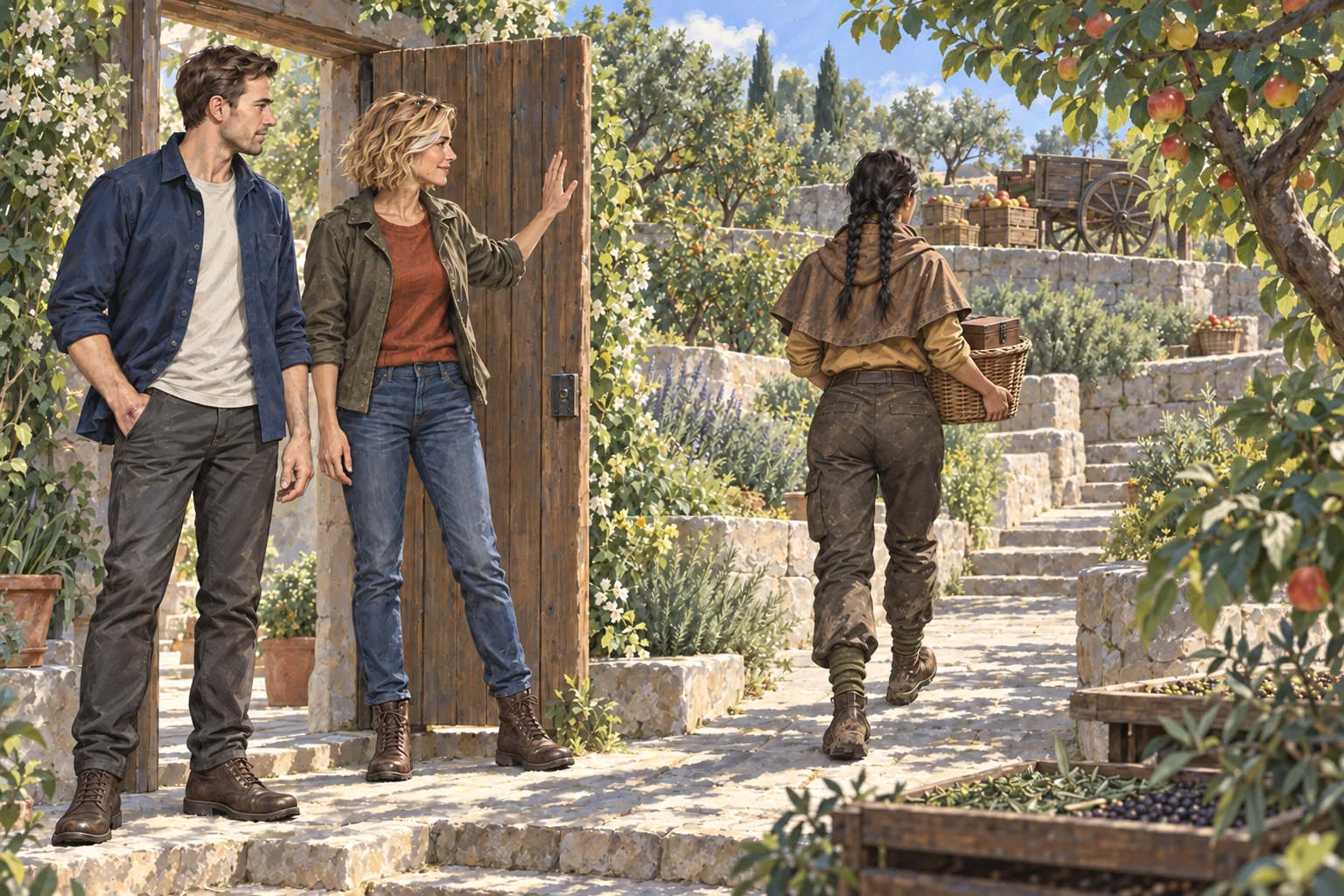
When Sava came back from the cart, she kept her side of the bargain. She took her hook from beside the door and walked them out along the shelf herself, past the covered entrance and round the shoulder of the hill, with the gardens dropping away on one side and the stonework on the other. It was a road made for carrying, wide enough for a basket each side and worn smooth in the middle. Vic limped and did not care.
Ten minutes on, it ended in fallen masonry. A whole face of the wall had come down across the path, a slope of broken stone and earth with the paving buried under it. Beyond it, the shelf went on, clear and level and empty, round the head of the inlet, and far along it, on the other side of the water, Vic could make out a bent post above a road he knew. Home, by the long way round.
‘It goes on,’ Kate said. ‘Look. It just goes on.’
She took out her sketch and began drawing it, fast. Vic leaned on the low wall to rest his hip and looked down.
The slope below the shelf fell steeply to a cleft in the rock, and in the side of the cleft, half hidden by a hanging tangle of roots, was a doorway. Square-cornered. Lintelled. Cut as carefully as the ledge under the water. The ground in front of it was trodden bare, and there were small bones there, and dark coarse hair caught on the roots.
The air coming out of it moved. He felt it on his face before he understood it: a cold draught, sour with animals and stone, that blew out of the doorway for a long breath and then, slowly, drew back in. As if the hill were breathing.
Sava had seen him looking. She came to the wall beside him and her face closed.
‘That’s worked stone,’ Vic said. ‘Kate. That’s somebody’s passage. If it runs under the fall—’
‘Then it comes out on the other side.’ She had seen it at the same moment. ‘Another way round. In case the water won’t have us.’
Sava caught his arm and shook her head, once, hard. Vic understood her perfectly and went anyway. He told himself it was ten metres of slope and one look, and that he would be careful of the hip.
Kate came after him. Sava stayed at the wall with her hook and said something that did not need Mara.
The doorway was taller than it had looked from above. The draught came against his face as he reached the threshold, and the lamp showed a corridor running back into the hill, its floor polished pale down the middle and scored at the edges, the way a step is scored by boots. These were not boot marks. He put the Glass against the jamb and paid for it.
For half a minute the worked stone opened under his hand. The corridor ran five metres in and turned, not down into the hill but along it, parallel to the shelf, towards the sea. Under the fall. The polish went on round the turn.
‘It goes round,’ he said. ‘It’s a road. It’s their road.’
The draught stopped.
For one long moment nothing moved at all, in or out, as though the hill had held its breath. Then, from far inside, came a rasp, and another answering it, and then too many to count, overlapping, rising, coming nearer.
They ran. Vic made it four strides up the scree before the hip went, with a sound he felt rather than heard, and he was down on his hands on the loose stone with his leg folded wrong under him before he knew he had fallen. Then it hurt.
Kate had him under the arm. ‘Up. Up, Vic.’
Below them the first of them came out of the doorway into daylight. Then another. Then four, five, a sixth with grey on its muzzle, hackles standing like black fans, filling the trodden ground in front of the door. They did not climb. They stood across the threshold, rasping up at him, and he understood that this was not a hunt. It was a house, and they were standing in the door of it.
Something hooked his belt from above. Sava had come down as far as the slope allowed, flat on her stomach on the scree, and the hook of her pole was through his belt. Between her and Kate they dragged him up the last of it and over the wall onto the shelf, where he lay with his face against the warm paving and his leg on fire.
Nothing came up after them. When he could look again, the trodden ground was empty, and the hill was breathing.
They went back along the shelf much slower than they had come, Vic with an arm over each of them. Sava did not say a word all the way. At the gardens she put him down on her stool, went to the covered entrance and held her palm across it. Then she pointed back towards the fall, and at his leg, and at him, and shook her head with her whole body.
‘Yes,’ Vic said. ‘I know.’
Kate was still holding her sketch. Beside the fall she had drawn the doorway as a small square with a lintel, three short strokes coming out of it for the breath, and, very small and fierce, a line running behind the fall and out the other side.
‘We go home under the water,’ she said. ‘Not through that.’
‘Not through that,’ Vic agreed. He tried his leg against the stool. It took weight, with a grinding reluctance he did not like. Tomorrow’s crossing was six minutes of swimming.
Nadia took them to a lane behind the square and pointed up a stair before leaving to see her passengers. Vic climbed one step at a time, resting his weight against the rail whenever he had to bring his sore leg up. Mara opened the door before they reached the top and waited while Kate helped him over the last step.
Her house occupied two rooms above the lane. In the upper one a table stood beneath the window, with jars along a shelf where the remaining light caught their contents. Vic went closer while Mara fetched the food. They were full of buttons, sorted by colour into blues and browns and a jar of pale ones through which he could see mother-of-pearl. None seemed to match the clothes she wore.
‘I like them,’ Mara said, seeing him look. ‘That’s all it is. Don’t make it mean something.’
‘I wouldn’t.’ He had once bought a joiner’s plane he had no use for, only because the mouth was so finely cut. ‘I’d have bought that blue jug at the weighing-house for the chip.’
‘I didn’t buy it for the chip. I chipped it.’ She put a pot on the table. ‘Sit down. The stew is what everyone here eats; you’ll have it every day you stay. The bread is from the square. Adela asked after you both.’ She set the loaf down. ‘And Sava came by. She asked me to translate this exactly, so I will. She says you are the two stupidest people who have ever mended her door. She says she has lived under that hill all her life and never seen six of them at one doorway, and she would like to know what you did to them.’
‘We looked,’ Kate said.
‘She thought you might say that.’ Mara sat down. ‘She also says the leg is your own fault, and she’ll bring something for it in the morning. From Sava, that is practically an embrace.’
Vic drew the bowl towards him and let the steam reach his face. Beneath the greens were barley and beans, with a piece of fish that Mara said had come up from the coast that morning. He ate carefully at first, expecting the unfamiliar sharpness of Adela’s drink, then reached for the bread to wipe up what was left of the broth. Mara filled his bowl again without making him ask.
Away from the weighing-house she took her time over questions, letting Kate finish an answer before finding something in it to laugh about. She wanted to know about exhibitions, whether the cases still arrived with the wrong keys, how much a coach cost to hire now, and how they had come across the harbour. Kate told her about the dinghy and the thing in the water, and made it funnier than it had been. When Kate gave her a figure, Mara put down her spoon.
‘Twice what I paid. Well. I ran a tool-hire counter for twelve years. I know what things cost. I knew what things cost.’
‘What did people want most often?’ Vic asked.
‘Mostly they wanted drills. And floor sanders on a Friday, because somebody had told them it was easy.’ She looked at him. ‘You’d have been one of the ones who brought them back clean.’
‘Clean and early. I’d have wanted you to see me bringing it back.’
‘Oh, I’d have known you by the second visit. I always remembered those.’ She looked from him to Kate and back. ‘And how long have you two been—’
‘Friends,’ Kate said. ‘Eight years.’
‘Friends,’ Mara said, in the voice of a woman weighing something, and passed the bread.
Vic was reaching for the bread again when he noticed that Kate had stopped eating. Her spoon rested in the bowl, with one hand still round its handle.
‘Can I ask one thing? You can say no.’
Mara set her spoon down and folded her hands above the plate. Vic recognised the movement from the ledger yesterday, and left the bread where it was.
‘Ask it.’
‘Nineteen years. If Martin came the way you came – if he’s somewhere – could it be years from now? Or years ago? Could he be here already and old?’
The crease came into Mara’s eyebrow.
‘You want me to be the proof of something,’ she said. ‘I know that look; I’ve had it from people who wanted me to be the proof that the road went the other way. I’m not proof. I’m one woman who came on one night.’
Vic looked down at his bowl. He had wanted the same answer, although he had left Kate to ask for it.
‘In nineteen years I’ve been told twice about a person who talked like me,’ Mara said. ‘Once was four days’ road from here, ten years ago. A trader told me, and I wrote, and what came back I couldn’t read as an answer. The other was a story about a story. That’s everything I know, and I’ve had a long time to know it.’
‘I’m sorry,’ Kate said.
‘Don’t be. It’s the right question. I asked it every day for two years.’ She picked her spoon up again but left it above the bowl. ‘I wrote home for two years. The letters are on the shelf at the weighing-house, the ones with the cord round them. Nobody could carry them anywhere that answered. I stopped writing when I stopped believing anyone would carry them. I didn’t stop because I’d stopped minding.’
Vic remembered the bundles behind her chair. He had seen them yesterday without wondering who had written them, taking the cord and the stacked pages for part of her work. His own letter was still in Owen’s book, with the dark patch where he had crossed out tomorrow.
‘What did you do instead?’
‘I learned to say “not that one, the other one” in Vennic. That took a year. Then I learned to say it about weights, and then somebody paid me to say it for them.’
She pushed the bread towards Kate, who took a piece without yet eating it.
‘I’ll tell you the only thing I know that’s worth the price of the stew,’ Mara said. ‘Replies come to tables. The people who found anything were the ones who went along the road with the question and asked it themselves, in the next place, and the one after that. I had nobody to go with, the first years. You’ve got each other, and Sava thinks you’re worth a morning, which from her is a reference.’
Kate looked at Vic.
‘Then we go with the sheet,’ she said. ‘Once we’ve been back, and we know which road to take. I don’t want to spend all our time here waiting for somebody to bring an answer.’
‘You’ll need the words,’ Mara said. ‘I can teach you, though I charge for that. Tonight you’re just having supper.’
‘I’d like to pay you for the words. We needed you for almost everything yesterday.’
Mara nodded, then picked up her spoon and began eating again. Vic followed her, grateful for something warm to do with his hands while Kate finished the bread. After a while Mara asked whether the coach had a radio and what it played, speaking with the curiosity she had brought to the price of hiring one. Kate began to answer and found she needed to explain what had happened before that; she had covered no more than two of the nineteen years when Mara held up a hand.
‘Don’t. I’ve managed this long.’ She was laughing. ‘Tell me one thing. One.’
Kate sat considering the question until Vic began wondering what he would choose. Before he could suggest anything, she went to her bag and brought out the paperback, the bus ticket still marking her place a third of the way through. Vic knew the page. She laid the book beside Mara’s place with the cover turned towards her.
‘That’s the newest thing I’ve got,’ she said. ‘I’m a third of the way in. Somebody’s gone back for the dog, and that’s all I’m telling you.’
Mara put her hand flat on the cover and left it there.
At the door, with her hand on the latch, Mara stopped.
‘One more thing, for the stew. The animals that went after your boat.’ She had listened to that part of Kate’s story without interrupting, which Vic had noticed. ‘Rook-hounds don’t swim for pleasure. If they are crossing water on your side, something has pushed them out of where they used to be. Watch the shore.’
By the time Mara let them out, the lane was fully dark. Light from her doorway reached the upper steps, and Vic kept his hand on the rail as he went down, taking them one at a time. Kate waited at the bottom with her head a little on one side. He thought she was listening for something in the lane until he recognised the way she had stood at the corner below the garden.
‘Still there,’ she said, and pointed up through the dark and the houses, towards a door neither of them could see. ‘Near.’
She turned towards the water and held out her hand again, trying the direction in which they would go in the morning. Vic waited while she felt for something she had not placed there.
‘Nothing,’ she said, and laughed. ‘I haven’t put one there. I just wanted to see if it would tell me anyway.’
Vic looked the same way. Tomorrow they would go back under the water and take their news to Gordon and Owen, if his leg would swim. Kate took his arm for the walk to the weighing-house and did not ask, which meant she was thinking about it too.
Halfway down the lane she said, ‘I told Mara friends.’
‘You did.’
‘I didn’t say only.’ She kept her eyes on the steps. ‘I just want that on the record. Since everything else is.’
He did not trust himself to say anything at all. He held her arm a little tighter, and she let him, and they went on down to the weighing-house in the dark.
At the bottom of the lane the wind came up from the coast, and he could smell the sea in it, much nearer than it ought to have been.
And under the wind, from somewhere up on the dark hill beyond the gardens, far off and then nearer, one long rasp, and then another answering it, and then a third, from somewhere else entirely, as if a house had woken and was counting who was home.


