Viewpoint: Vic
The title was waiting when Vic woke, after another full night in the room behind the weighing-house, as plain as a label on a drawer.
He lay looking at it while Kate dressed, then read it aloud, because he was pleased and saw no reason to pretend otherwise.
‘For the door,’ she said, pulling on a boot. ‘It noticed.’
‘It noticed that it works. It doesn’t care that I nearly got it wrong.’
‘Neither does Sava.’
He sat up carefully. Sava had left a jar on the step at dawn, grey ointment that smelled of pine resin, with a stick figure scratched into the lid lying flat on its back. The hip was a little looser for it. Not much. When he knotted his bootlace the cord went where he wanted it with a little less attention than it should have needed, and he did it twice more for the pleasure of feeling it.
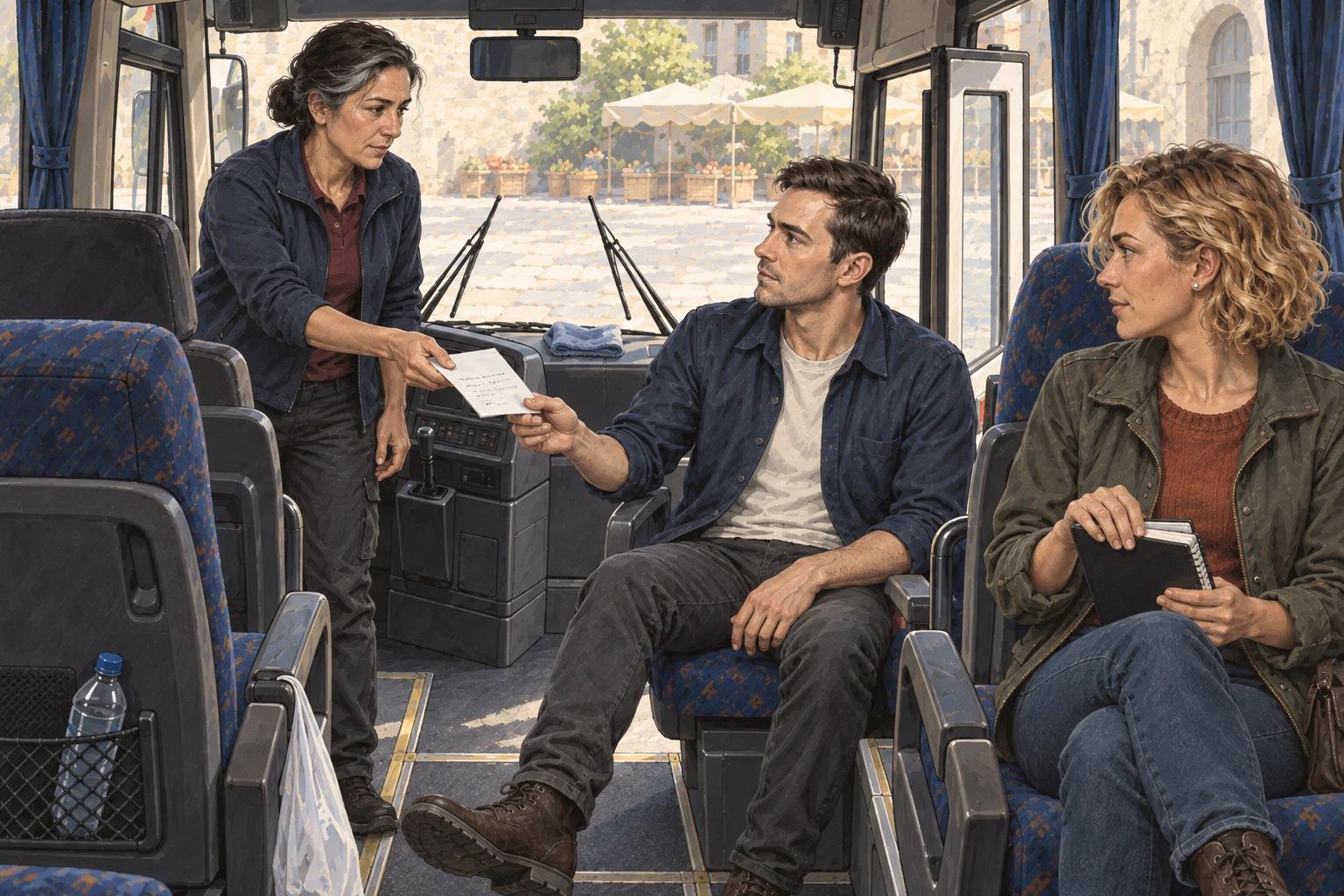
Nadia was cleaning the coach windscreen when Vic came round the corner with the bedding under his arm. Kate was inside, watching a man copy names onto the back of an old itinerary.
Nadia handed Vic a folded page. ‘The ones here who want their names sent, and where they last saw people. I’ve checked it with them. The man at the back doesn’t want to be on it, so he isn’t.’ She sat on the edge of the driver’s seat. ‘And tell them we’ve got beds. I’d like somebody to ask me where I want to go.’
Kate closed the exercise book. ‘Where do you want to go?’
Nadia looked past the windscreen at a child trying to carry two stacked baskets without seeing over them.
‘Home. But this morning I’d settle for a walk without being stopped.’
‘Then walk us to the gate,’ Kate said. ‘It’s a start.’
Sava was coming down the garden steps with a tray as they passed. She looked at the way Vic was standing, said something short that sounded extremely rude, and squeezed his forearm, and carried the tray back through her door, which opened for her without a sound.
The descent began to hurt before they reached the inlet. At the recess Vic sat to change, then packed the folio with its hard corner clear of his bruise. The water stood two steps higher on the stair than it had on Wednesday, and the wind off the sea was pushing small waves in under the lintel and sucking them out again.
‘That’s low water,’ Kate said. ‘That’s supposed to be low water.’
Vic lit the lamp and checked the collars, leaving the breathing switches off while they were still on dry ground. Each still held enough for the three crossings they required before going in. That was the rule, and it said nothing about depth.
‘We could wait for it to drop,’ he said.
‘It won’t drop. Owen said. Every day till Saturday, and it’s Saturday.’ She looked at the water. ‘If we don’t go now, we’re here till the springs are over. And they’re expecting us at five.’
They switched the collars on at the water’s edge and went down together.
Once beneath the lintel, there was less room above his head than there had been, and the surge came in after them: a slow push that lifted his bundle against the roof and let it fall again. Pain caught along the outside of his hip at the first narrow place. He closed his hand, saw Kate acknowledge it and waited while it eased. She stayed where he could see her.
At the projecting stone he turned his left side to the wall, as he had on Wednesday, and his hip locked.
It did not hurt at first. It simply stopped, the leg folded wrong and wedged against the ledge, and when he tried to straighten it the pain came all at once, white and enormous, and his breath went out of him in a rush of bubbles. He hauled on the line. The leg would not move. Above him the surge came in and pressed him down, and the pressure in his ears became a hard knife, and he thought, very clearly, of the four metres printed on the collar’s offer.
The collar was still giving him air. It was giving it grudgingly, a thin hard pull through his teeth, as if it were working at the edge of what it could do.
Kate had gone on. He could see her lamp-shadow ahead on the wall, small, beyond the stone.
He could not signal her. His hand was the only thing holding him to the line.
Then the shadow stopped, and turned, and came back.
She came along the line towards him with her face white behind the bubbles, and he knew what it cost her: there was nothing beside her but water, no edge she could get to, and she was coming back into the deepest part of it. She took one look at his leg. Then she let go of the line with one hand, got her shoulder under his arm, set her feet on the ledge and pushed him upwards and forwards, and his hip came out of the angle it had jammed in with a pain that nearly blacked him out.
She did not let go. She towed him past the projecting stone by his collar strap, one hand on the line and one on him, to the bronze eye where his knot from Wednesday was still holding, and she put his hand on it and closed it there and held it until he could hold on by himself.
Then she gave him the signal, the closed hand, and waited for his answer, and he gave it.
They went on together, slowly. At the bend the water was deeper than it had ever been, and then it was not, and the line rose, and so did they.
On the steps they switched the collars off. The crossing had taken nine minutes.
Vic lay on the stone with his eyes shut and his hip burning and could not, for some time, say anything at all. When he opened his eyes, Kate was sitting beside him with her arms round her knees, shaking so hard her teeth knocked.
‘You came back,’ he said.
‘You stopped.’ Her voice cracked. ‘You stopped for me on Wednesday. I wasn’t going to leave you down there because I’m frightened of water.’
He reached for her hand, and she let him have it.
‘We can’t do that again,’ she said after a while. ‘Not at springs. Not with that leg. Next time it might be deeper than the collars go.’
‘Then we need another way home.’
They both looked up the stair, towards the coast, and the shelf Sava had drawn for them in the air.
With the lamp out, they stayed in the daylight recess until they were warm, eating the rest of Nadia’s bread while water dripped from their folded clothes.
Gordon saw them from the window before they reached the bakery door.
‘Owen! They’re back.’
The covering over Gordon’s broken pane had been replaced by a piece of board. It had new scratches across it, long pale ones, at the height of a large dog standing on its hind legs.
It was well before five, the hour they had promised Priya. Priya wiped her hands and came out into the court, bringing the smell of the bakery with her.
‘Let me see you.’
She looked from his torn jacket to the careful way he was standing, then at Kate.
‘We’re all right,’ Kate said, with her hand on Vic’s shoulder. ‘He’s done something worse to his hip. What happened to Gordon’s window?’
‘Thursday night.’ Priya folded her arms. ‘Two of them came up the hidden steps. One went at the shed and one at Gordon’s board. Gordon put the light on and hit the board with a saucepan until they went.’
‘It was a large saucepan,’ Gordon said from his doorway.
‘And on Friday they got into the kitchen at the terminal.’ Priya’s face changed. ‘Dev was on the door. The man who walks up and down all night. He went in after them with a chair, and one of them had his leg. Tess stitched it on the counter. Eleven stitches.’
‘Is he—’
‘He’s sitting up and complaining. He was lucky.’ She looked at the scratches on Gordon’s board. ‘Next one might not be.’
Owen came down with his left arm still in its support, keeping his good hand on the rail. Vic stood at the foot of the stairs, his hip aching, watching each step until Owen reached the court. They had spent days wondering what they would find on the other side, while Owen had been here taking those same stairs with one hand, with those things at the door.
‘How’s the arm?’
‘Still attached.’
‘We found a town,’ Kate said. ‘There are people living there. Houses, gardens. We stayed with them. There’s a coach, an ordinary coach from England, with eleven passengers and the driver. And on Thursday night we watched a hill change.’
Gordon looked up. ‘Change into what?’
‘Into a different hill.’
‘Could it happen here?’ Priya asked.
Owen looked out of the court, past the roofs, to the slope that had not been there a week ago.
‘It already has,’ he said.
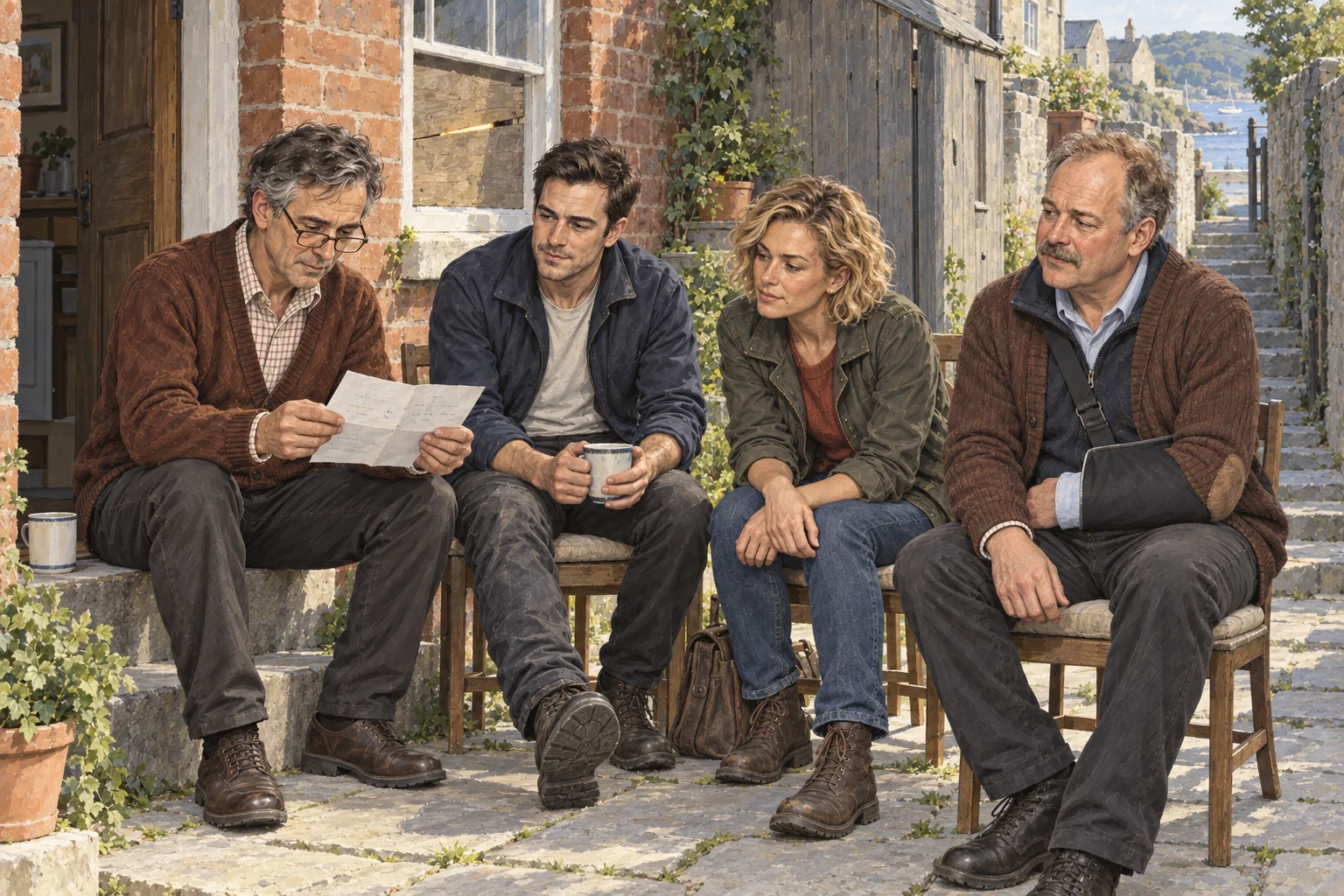
Vic brought out the folded page. Gordon began reading the names at once, moving his finger down the list and stopping wherever a place was familiar.
‘My sister used to go there,’ he said. ‘Before she moved.’ He held the page with both hands and looked back at the names near the top. ‘You spoke to them, then. About anyone else from home.’
‘There’s a woman who speaks both languages,’ Vic said. ‘She helped us write something people there could read. Her name’s Mara.’
‘How long has she lived there?’
Vic put his cup down.
‘She came in 2007. She’s been there nineteen years.’
From the kitchen came the scrape of a tray. Priya turned her head towards it, then stayed where she was.
Gordon folded Nadia’s page, using the crease already in it, very carefully.
‘I’ve been thinking somebody would find the terminal,’ he said to Owen. ‘A ferry. Somebody looking along the coast.’
‘So have I,’ Owen said.
‘Nineteen years.’
‘That’s hers,’ Owen said. ‘We don’t know what happened where she came from.’
‘What’s she like?’ Priya asked.
‘She works in a weighing-house,’ Vic said. ‘Very particular about where you put things. She had us to supper.’
‘Were you polite?’
‘Eventually,’ Kate said.
Priya looked at Kate’s hand, which had found its way back to Vic’s shoulder, and then at Vic, and went to see about the kettle with an expression of enormous innocence.
‘There’s something else,’ Kate said when she came back. She unfolded her copy and showed them the little square, the dash and the strokes. ‘There’s a light up on the high coast, above the sea. It goes dark and comes back, in the same order every time. Sava read it for us. It’s an old signal from the stations. It means somebody is there. And it means help.’
Nobody spoke. Owen turned the paper towards him with his good hand.
‘Has anybody answered it?’
‘No,’ Kate said. ‘That’s the whole point. Nobody has.’
Kate told them what Mara had said about the animals: rook-hounds, a family of them, and that they stayed where there was food. Priya looked at her shed, at the chain on it, and at the scratches on Gordon’s board.
‘So they’re not going anywhere,’ she said.
‘Not while we’re cooking,’ Owen said. ‘So we keep a watch. Since Dev, it’s somebody at the terminal door every night in turns, with a light and something heavy, and two of us after midnight. Gordon’s made a list.’
‘Put us down,’ Kate said.
‘You can have Monday’s first one,’ Owen said. ‘From four, when it gets dark, till ten. Nobody wants it, because people are still arriving.’
Priya had been counting something on her fingers.
‘I’ve been baking for the terminal since Tuesday,’ she said. ‘Forty loaves a day, and people keep turning up. That thing took half a sack. If nobody new comes, I’ve got eleven days of flour.’ She looked at Kate. ‘And then it’s whatever’s in the terminal’s tins, and then it isn’t anything.’
‘Three Arches has a market,’ Kate said. ‘Fruit. Fish from the coast. A woman with cloth from four days up the road.’
‘Then somebody,’ Priya said, ‘had better find me a road to it that doesn’t need a collar.’
Then Kate spread her route drawing on the empty chair, and Gordon held one corner against the breeze.
Kate had drawn it the way she drew everything now, like a clock: the harbour at six, the inlet at nine, Three Arches at eleven. The shelf was a dotted line from Sava’s gardens at eleven round to the bent post at seven, just above the terminal, with a cross on it for Sava’s fall and a question mark on their own side.
‘And the collars only work for you two?’ Owen asked.
‘They’re bound to us,’ Kate said. ‘We can’t pass one over and send you through. Even if you wanted to.’
‘I don’t,’ Gordon said. ‘I want that bit.’
He put his finger beside the line above the water.
‘That’s the shelf we saw from the gardens,’ she said. ‘There’s fallen stone beyond the bend. We haven’t been round it. But Sava’s drawing had it coming out on this side of the inlet.’
‘The passage nearly didn’t let us back,’ Vic said. ‘At springs it’ll be too deep for the collars. If there’s a dry way to Three Arches, we need it, and so does everyone who wants to get a letter there. We thought we could find where it starts here. Kate and I could go tomorrow—’
‘Why can’t I come to that?’
Vic stopped. He had been about to say they would bring back a drawing, exactly as they had brought this one.
‘I’ve been to the terminal every day you’ve been away.’ Gordon shifted on the sill, easing his knee. ‘I know how many steps we’ve got. I’d like to look at something past them.’
Kate turned the paper towards him. ‘Then we’ll see how far you want to go. If you want to come back, we come back with you.’
‘Put the steps on. Properly. Then I’ll decide where I want to stop.’
They settled on the morning, back for lunch. Owen took the exercise book and read the new notes.
‘Leave me this. Take Nadia’s sheet down. And mind the stair.’
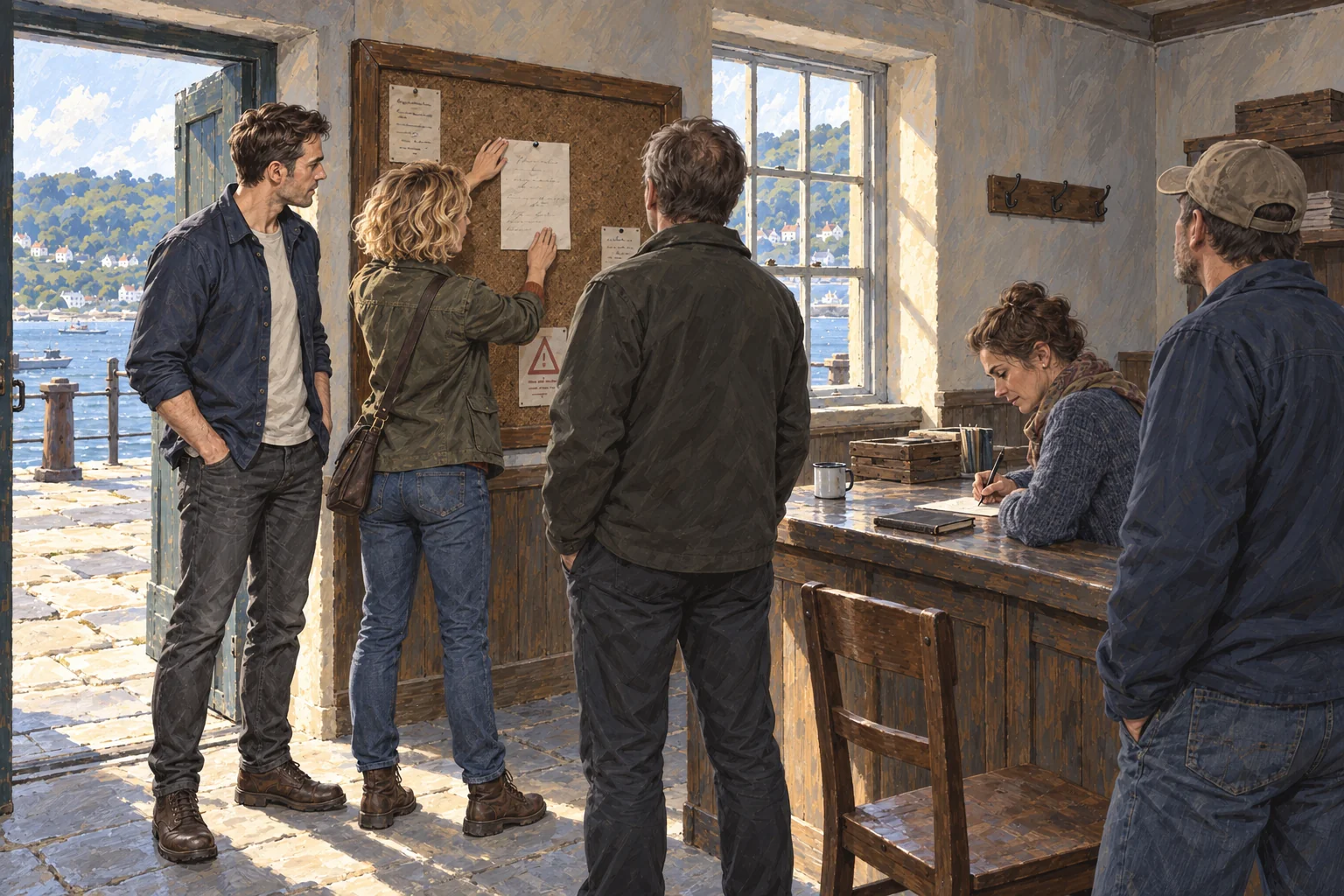
Kate went with Vic to the terminal, with Nadia’s sheet inside his notebook. Inside the terminal, people were talking and a kettle lid rattled near the old counter. The kitchen door had a new bolt, and somebody had propped a cricket bat beside it.
Kate held Nadia’s sheet against the board while Vic found a drawing pin. Before he could press it home there were people round them, reading over each other’s shoulders, asking where it had come from and whether there were children on the coach. A woman from the window fetched a pen.
‘Will you take one back?’
‘Yes,’ Vic said. ‘Put where somebody can find you here.’
She drew a chair to the counter and began writing. By the time she had finished there were three more waiting behind her, and Kate opened the notebook at a clean page for the next.
The terminal had changed in a week. Somebody had chalked a watch rota on the departures board where the sailings used to be. Children were doing homework nobody had set at the café tables. A man Vic half recognised from the first night was ladling soup out of a catering pan into forty cups and telling everyone who would listen that the Assay had offered him Cook on Wednesday, and that it had been very nice about his onions.
‘It said they were exemplary,’ said the woman beside him, who was cutting Priya’s bread.
‘It said they were adequate,’ the Cook said. ‘In a tone.’
Dev was holding court from a row of chairs with his stitched leg up on a cushion, showing three children his eleven stitches as though they were a medal. When he saw Vic limping, he shifted the leg to make room.
‘Sit. You look worse than me, and I’ve been bitten.’
Tess came across before Vic had got down. ‘Vic. I’ll ask you first. What have you done?’
‘Hip. A crab, and then a hillside, and then a passage under the sea.’
Tess looked at him for a long moment. ‘In that order?’
‘Roughly.’
‘Then you’re sitting down, and you’re not getting up till I’ve looked at it, and the rest of this conversation can happen sitting down too.’
He sat. Dev passed him a cup of the Cook’s soup without being asked, and it was, Vic thought, a great deal better than adequate.
The Arsenal was a hundred yards along the apron. Vic had not been inside it for six days, and he found he had been putting it off, the way he had put off ringing Helen.
The label he had written still hung by the loading door. Out in the bay the trolley stood where they had left it, strapped into the gap under the shutter, its padding scored to rags. Inside, the workroom smelled of cold and dust and very faintly of the oil he used on the bench, and the cloth lay over the armour exactly as he had arranged it, with the matching pair together underneath.
‘You’ve been wanting to do this all week,’ Kate said.
‘Since Sunday.’
He did not lift the cloth. He went past the bench into the store, where the rest of Duke Albrekt’s set lay on the racks in its padded boxes, as it had lain all autumn while he worked on the torso: helmet, arms, gauntlets, the long leg pieces, the little articulated feet. He knew every box. One place on the second rack had been empty since before he was born, a gap in the inventory that everybody at the Trust had long ago stopped noticing.
He took down the fauld, the skirt of overlapping steel bands that should hang from the breastplate’s lower edge, and carried it to the bench, and folded the cloth back.
Kate held the torch without being asked.
He spent one effort and began the minute. The top band’s rivets ran along a line, and the line ran up into the breastplate’s lower edge, into the worn rub on its left side that he had always taken for careless storage. It wasn’t. It was the place where the fauld had moved against it, years of moving.
And for the length of the minute he could feel it. Not see it: feel it, the way he had felt the bridge pin’s track. The breastplate and the fauld moving together over a body that breathed, the bands sliding one over another as somebody walked, and turned, and bent to pick something up, the whole of it going with him instead of against him, as if the steel had been waiting a long time for someone to be inside it again.
Then the minute ended, and it was cold metal on a bench.
‘Four,’ Kate said, reading his face.
‘Four.’ He laid his hand flat on the cold steel. ‘It isn’t broken. Not one of them is broken. It’s waiting.’
‘For what?’
He looked through the doorway at the racks, the boxes, the one empty place.
‘For somebody to finish.’
‘Then finish.’ She was smiling in the torchlight. ‘Not tonight. You can hardly stand. But I’ll hold the torch.’
He covered the four pieces together and left them on the bench, where he would see them first next time.
Kate came down the next morning with an expression Vic had last seen on her when a funding bid came through: pleased, and suspicious of being pleased.
‘It gave me one,’ she said, and read it to him over the bread.
‘For the passage,’ Vic said.
‘For dragging you along it.’ She flexed her hands, as if she might feel the extra strength in them. ‘It didn’t count me being terrified the whole way.’
‘It never counts that.’
‘It should.’ She looked at him across the table, and then away. ‘That was the worst thing I’ve ever done, and I’d do it again. I don’t know what to do with that.’
He did not know either. He passed her the butter, which was not an answer, and she took it as though it were.
Gordon was waiting by the bakery door with his coat on and Kate’s drawing spread over his knees. Vic still had bread to finish. He had slept well on the floor upstairs, but every chair seemed to want him to sit on the bruise.
‘You can take that with you,’ Gordon said.
‘I’m nearly finished.’
‘You were nearly finished when she went to get the water.’
Someone had added a small rectangle beside the turns Kate had drawn.
‘What’s that?’
‘Somewhere to sit. The wall past the terminal. I put it in.’
‘We can stop before that if you like.’
‘I meant for you.’
They took the upper road, leaving the descent to the barred stair well below them. Beyond the terminal Gordon stopped where the last strip of tarmac met the pale paving.
‘This is as far as I’ve been.’ He stepped onto the stone. ‘It’s Sunday. I used to go out on Sundays. Anywhere with somewhere open at the end. My sister would say she was coming for the walk, then ask about the cake before we’d parked.’
At Gordon’s rectangle, Vic was glad to sit. Beyond the terminal lay the island, its station windows bright when a cloud shadow cleared the water.
‘That’s where you went in Owen’s boat?’
‘Round the other side,’ Kate said.
‘Doesn’t look very far. I expect it does from the boat.’
‘It did with something swimming after it.’
At the bent post the familiar road went down towards the inlet. Kate stood over her drawing, looking for the shelf, and found only hillside.
‘Does that carry on?’ Gordon asked. He had sat down on a ledge to rest his knee and was pointing at dead stems below the bank.
A low coping continued behind the stems, hidden from the road by the curve of the bank. From Gordon’s seat it was almost at eye level. Kate pushed a stem aside with the edge of her drawing and found a worn tread, then another, turning down behind the wall. Beyond them a strip of paving followed the slope, with a low wall along its outer edge.
‘You could see that from there?’ she asked.
‘I had time to look.’
Gordon used Vic’s arm to get down the first high step, and they followed Kate round the turn.
The path brought them out above the inlet. Far below, the road they knew wound down through trees towards the green water, but their path kept its height, following the slope round towards a much larger ravine.
Vic stopped. Gordon almost walked into him.
Across the ravine stood stone piers, so tall that the trees at their feet looked like scrub. The nearest carried a piece of roadway which ended in the air. Beyond it, on the far face, another piece reached out to meet it. For a moment Vic followed the road across the missing span and over those slender piers to the high ground beyond, where someone must once have been able to walk without thinking about what was underneath.
The middle was gone.
‘Oh,’ Gordon said.
Kate had not moved. She was looking past the far deck, where the line of the road went on climbing towards the high coast above the sea, and her hand had gone to the pocket where she kept her copy.
‘That’s where it was going,’ she said. ‘Up there. Where I saw it move.’
‘Your light,’ Gordon said.
‘Somebody’s light.’ Kate did not take her eyes off the high ground. ‘Somebody up there asking for help, and the road to them has fallen into a ravine.’
Branches hid the bridge as they went on. Under a rock overhang the shelf widened round a stone seat. Gordon swept the leaves off before he sat, and took off his glasses to wipe them.
‘We used to show a film with a railway over a valley like that,’ he said. ‘Every time the train went across, I’d look for the join in the picture. I was running the projector, so I saw that train rather a lot.’
This was the question mark. It was just past the next bend. A narrow gully cut down through the hillside, carrying a thread of water into the trees below. The shelf ended on either side of it, a few paces of nothing between.
Vic crouched on the sound ground behind the broken edge while Kate held his shoulder. Below, two squared recesses faced matching ones across the gully, where a crossing had once sat. Fragments of timber lay caught among the rocks farther down, and something else, which he took at first for a heap of old sacking until it lifted its head.
‘Kate.’
There were two of them on the rocks at the bottom, where the thread of water ran. The nearer one had grey on its muzzle.
Vic knew it. He had last seen it two days ago, standing in the trodden ground below Sava’s fall, rasping up at him across a hillside on the far side of the inlet. Now it was here, on this side, looking up at him as if it had been expecting him.
It did not climb. It looked at him for a long moment, and then it turned and crossed the bottom of the gully to its far wall, and the other went with it, to a black square in the rock that Vic had taken for shadow. A doorway. Square-cornered, lintelled, cut, the twin of the one below Sava’s fall. The two animals went into it one after the other, and the dark took them.
‘It’s going home,’ Kate whispered.
‘Its home goes under the hill. All the way.’
He felt the hum before he heard it.
It came up through the paving into his knees, low and steady, exactly as it had come up through the square at Three Arches. A pebble on the broken edge began to walk.
‘Vic.’ Gordon had stood up from the seat behind them. His voice was odd. ‘The other side. Look at the other side.’
The far end of the shelf, across the gully, had gone double. Two edges lay almost on top of each other and did not agree, the paving and a ghost of it a hand’s breadth higher, wavering like heat. Under Vic’s hands, grit began to run off the near edge in a thin, steady hiss.
‘Back. Off the edge. Everybody back.’
They went back. The hum went with them. It was in the hillside now, in the rock over their heads, and when Vic looked up he saw why Gordon’s voice had changed. A crack had opened across the underside of the overhang, above the stone seat, and a slab of it the size of a door was leaning slowly out of the rock, over the seat and the path, and Gordon, whose knee would not let him move fast, was standing under it.
There was a broken piece of the low wall on the paving. Vic got his hands under it and heaved it up on end under the leaning rock and set his shoulder to it, and the slab tore the last of the way out of the overhang and dropped onto his prop with a jolt that should have broken his shoulder. He paid before he had thought about it, the way he would have caught a falling plate.
Brace
Effect: holding doubled for 10 seconds.
The weight came down through the stone into his shoulder and stopped there, as if the prop had roots. He felt the doubled hold as a strange, solid patience in the joint between stone and stone and his own body, and he knew to the second when it would end.
‘Gordon. Out. Kate—’
Kate already had him. She took Gordon by both arms and hauled him along the path, his bad knee folding, his glasses falling, Kate not stopping for them. Six seconds. Seven. Grit poured past Vic’s face.
‘Clear!’ Kate shouted.
Vic let go and threw himself sideways onto the path.
The ten seconds ended. The prop went over, and the slab came out of the overhang and down onto the stone seat with a sound like a door slammed in a cathedral, and broke in three, and lay there in its own dust.
The hum stopped.
Across the gully the far edge was single again, sharp and ordinary in the sun. It was a hand’s breadth higher than it had been, and the gap between the two ends of the shelf was wider.
Nobody said anything for a while. Gordon sat on the path where Kate had dropped him, looking at the broken stone on the place where he had been sitting. Kate found his glasses and put them into his hand, and he held them without putting them on.
‘I had time to look,’ he said at last, not quite steadily. ‘Apparently I shall have to look up as well.’
Vic could not stop looking at the doorway across the gully. Somebody had cut that, as carefully as the ledge under the water, and it went into the hill, under the high ground, towards the coast where Kate had seen the light.
‘That one was at Sava’s on Friday,’ Kate said. ‘On the other side of the inlet. The old one.’ She looked at Vic. ‘Mara said if one found our bakery it would bring the rest of its family.’
‘It has,’ Vic said. ‘It’s bringing them by the back way.’
Kate was looking at the gully, at the far edge that had moved while they watched. ‘And their road is inside the hill. When the hill moves, it doesn’t care. Ours is on the outside.’
‘I’d like to go back now,’ Gordon said.
Nobody argued. Further back, where the path was sound, Kate added the crossing to her larger sketch, and the gully, and two small marks for the doorway. Beneath them she wrote that the far edge was still moving, and that the shelf was a road for more than people.
Gordon kept the drawing on the way back. At the little steps he checked the two branches against it and chose the one they had come by. At the high step he took Vic’s forearm without telling him where to stand.
The wind caught them again at the bent post. Vic picked out the station windows across the water, and the square tower at the end of its roof.
‘There were other route panels in that room,’ he said. ‘We only followed the one down to the water.’
‘If there’s one for this shelf, it might show what’s between the two ends.’ Kate was looking at the tower too. ‘And if the station’s one of Sava’s, that tower might be how they talk.’
‘You want to try it.’
‘I want to see what it can see.’
On the coast road the terminal roof grew larger at each turn.
By the time they reached the bakery court, Priya was setting bowls beside a covered pot. Owen moved his chair to make room, his splinted arm clear of the table.
‘How far did you get?’
Gordon sat before answering.
‘Past where they’d been.’ He spread the drawing between the bowls and took Owen along the line himself, from the turning to the seat, then on to the missing crossing and the gully. ‘You can’t get through. The hounds have a door down there. And the far side moved while we were looking at it.’ He nodded at Vic. ‘Then a piece of the hill came down on my seat, and he held it up. With his shoulder.’
‘For ten seconds,’ Vic said. ‘Kate got you out.’
‘She did,’ Gordon said. ‘You have left out the part where I very nearly sat back down.’
Owen looked at Vic’s shoulder and said nothing, which from Owen was a great deal.
Vic let them have the drawing for a while before he spoke.
‘We’d like the boat again tomorrow,’ he said. ‘For the island.’
Owen looked from him to Kate. ‘The drawings, or the signalling?’
‘Both,’ Kate said. ‘The crossing needs somebody from Three Arches who knows that shelf, and they’ll want a better drawing than mine. And if that tower can see the high coast, I want to know who’s been moving things up there.’
‘Same terms. Coast in sight, quiet water. Keep well off the stair.’ Owen tapped the edge of the table with his good hand. ‘And you’re on the door at four.’
‘Then we’ll be back before four,’ Kate said.
Gordon kept his hand on the drawing. ‘Then copy this one for Sava. I know what mine means.’
Late that night, after the others had gone up, Vic went to draw the kitchen curtain. On the wall above the shed, where he had seen it on the first night, the scarred one sat in the dark with its nose towards the lit window.
It was not looking at the shed, or the flour. It was watching the door, and who went in and out of it, the way Owen watched a shore.
He drew the curtain, and this time he went upstairs and told Kate straight away.


