Viewpoint: Vic
The water was higher than it had been on Tuesday. Vic saw it before Kate did, while he was still easing the dinghy in towards the island landing: the lowest step had gone, and the stone post they had tied to stood with green water round its foot.
‘Is that the same place?’ Kate asked.
‘Same place. More sea.’
She took the painter ashore and made it fast. A full night on Priya’s floor had done little for his hip, which had been sore all the way across, and his shoulder still remembered the slab. Not from the rowing: from sitting braced between strokes, with one eye on the water behind them.
Kate stood on the upper step and looked past the station roof at the high coast. Morning haze lay along it, thick enough to hide the line of the land against the sky.
‘Can you see anything?’
‘Not from here.’ She lifted the bag onto her shoulder. ‘Panels first. Then the tower.’
They had told Owen they would be back before four. He had looked at the sky, then at Vic’s leg, and said that four meant four.
The bridge was still down where they had left it, both pins home. Inside, the dry smell of stored leather met them at the door, and Kate went straight to the low tables while Vic opened the shutters on the landward side. In daylight the room looked more used than he remembered: the stool pushed back at an angle, a smear of old grease on the rail where somebody had hung a wet cord to dry.
Kate lifted panels one after another, holding each up to the window before letting it fall. Vic stood beside her and tried not to point.
‘This one goes past the arches,’ she said at the fourth.
The line on the board climbed from a cluster of roofs he recognised, then went on up, much farther than the first folio had taken them. Small squares stood along it at intervals, each crossed by three bars. Near the edge of the panel, where the line turned towards the sea, there was another.
‘Sava’s mark,’ Vic said.
‘All the way up.’ Kate touched the last square without quite touching the wood. ‘That’s the one. That’s where it was moving.’
Its label matched none of the cases on the racks. Beside it, a little drawing showed a stair going down to a rack with one case on it, and a wavy line drawn across the top of the room.
‘It’s underneath us,’ Kate said.
At the far end of the bay a hatch stood open in the floor. Beside it rose a tall cabinet he had walked past on Tuesday without a second look: two shut doors with no handle and no keyhole, only a narrow slot in the frame between them, with an offset shoulder at one side and two unequal notches cut into its edges. He ran a fingertip along it and found no wear at all. Nobody had opened it in a very long time.
Vic had taken the hatch on Tuesday for a store. Now he could see why it smelled of the sea. Stone steps went down six treads into water so clear that he could follow the treads below the surface, and then a passage that ran on under the floor, with a pale line fixed along its wall.
He crouched, carefully, and put his hand flat on the top step. It was wet. Through the clear water he could see a crust of old salt on the wall where the sea usually stood, a long way below the surface now.
‘On Tuesday this would have been half empty,’ he said.
‘Can we wait for it to go down?’
‘Not if we’re going to be back before four.’
Kate looked at the water, then at him, then at the collar sticking out of the top of his bag.
‘How far is it?’
By the scale on the panel it was twelve metres to the rack, and nowhere much deeper than his own height and half again.
‘Two minutes there,’ he said. ‘Two back. I’ve got enough in this cartridge for that and the rule besides.’
‘Then I’m not coming.’ She said it before he could ask. ‘There’s no point both of us being down there for one case. I’ll hold the line and the light.’
‘I wasn’t going to argue.’
‘You were going to offer.’
He had been.
They went up to the tower first, because Kate wanted to see the coast before she stood at the top of a stair holding a rope.
The stair climbed from the upper floor through a hatch into a square room with windows on three sides. Vic took the last steps slowly and stood for a moment with his hand on the rail. On the seaward side two bronze tubes rested in cradles, each pointed through its own small opening. Below the windows ran a long bench, and above the bench a row of wooden handles hung from cords that went up through the ceiling.
Kate went to the nearer tube and put her eye to it.
‘Haze,’ she said. ‘It’s all haze.’
Vic looked up at the cords. They ran over pulleys and out through the wall to a frame of slats outside the glass, grey wood with black paint at the edges, all of them closed.
He tried the nearest handle. It went a finger’s width and stopped.
‘Don’t break it,’ Kate said, without taking her eye from the tube.
‘I’m looking.’
At the end of the bench a locking bar held all the cords fast, the way you would lock shutters before a storm. He drew it out and tried the handle again. The cord ran. Outside the glass a bank of slats turned, showing white, then black again as he let it back.
Kate came away from the tube.
‘Do that again.’
He did, and then the others. One cord had jumped its pulley; he climbed onto the bench, slowly, and lifted it back.
‘That’s all of them,’ he said. ‘I don’t know what any of it means.’
‘We know one word of it.’ Kate went back to the tube. ‘That’s one more than they know we know.’
The haze had not moved. She looked at her phone, then out at the sky above it.
‘We’ll have to wait for it to clear.’
‘So we wait.’
‘We wait.’ She put the phone away. ‘You could go down now.’
Kate set the lamp at the top of the flooded stair and turned the hood until the beam lay along the passage under the water. Vic checked his collar and read the gauge to her: enough for both legs and the margin, with some to spare.
Two iron rings were set in the wall above the top tread, a hand’s width apart. The old guide line was tied to the left one. The right one was empty. Both were brown with rust, but the left had a crust round its foot where the stone met the iron, and a hairline running away from it into the mortar.
Kate had the end of their own line ready to tie. She looked at the rings, then at him.
‘Which?’
He looked before he touched. The crust round the left ring’s foot, the hairline running off into the mortar: he had seen that pattern a hundred times on wall fixings at the Arsenal, where water had got in behind iron and rusted it loose from the inside. The right ring was rusty too, but its seat was clean and tight.
‘The right,’ he said. ‘The left’s been rotting in its seat for years. Look at the crack.’
He put his fingers round the left ring where it went into the stone, to be sure, and the Assay gave him something he had not asked for.
‘What is it?’ Kate asked. She had seen his face change.
‘It noticed I was right.’ He read it to her. It would answer one question about one joint, within a hand’s span of where he touched it, and nothing about the rest. He would have to tap it himself and listen.
‘Will it tell you if the whole line’s safe?’
‘No. Only one joint at a time.’
He accepted, and did not spend it. He did not need it for the ring. Somewhere at the other end of the line there would be a joint he could not see.
Kate tied their line to the right ring and tested it with her weight. Then she untied the old guide line from the left ring as well and made it off beside theirs.
‘That’s the bit you know about,’ she said. ‘What about the other end?’
‘I’ll find out.’
‘Two minutes. At two minutes I pull once, and you start back, whatever you’ve found. If I feel three pulls from you, I pull you in.’
‘One pull, I turn round,’ he agreed.
He sat on the top tread, then the second, letting the cold climb his legs. The collar’s switch was under his thumb. Kate’s hand rested on his shoulder until he nodded, and then she took it away and held the line.
He breathed in the cramped way he had learned, and went under.
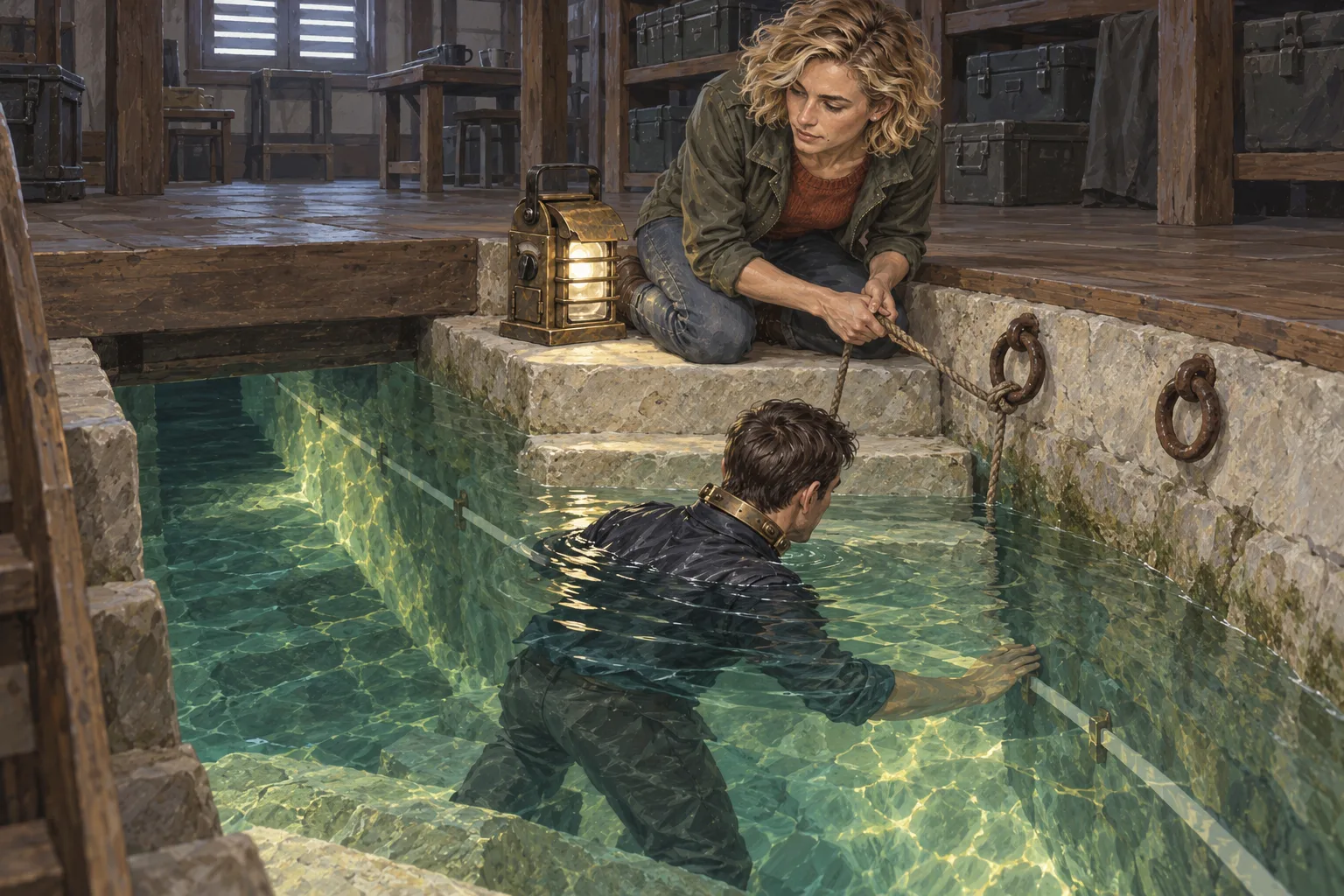
The beam lay along the passage ahead of him, broken into shaking pieces on the floor. He pulled himself along the guide line hand over hand, keeping his legs down, and the hip complained at every reach. The walls were close enough to touch on both sides, furred with something soft that came away green on his knuckles. The air at his mouth tasted of metal again. Twelve metres had sounded like nothing in the room above. Here it went on, and the light behind him grew thinner with every pull.
The line ended at a bronze eye beside the rack. It held when he pulled on it, which was all he could learn of it, and all he needed. The rack was where the drawing had put it: a shelf of stone a little past the end of the passage, with a bronze catch across its front and one case behind the catch.
The catch moved a finger’s width and stopped.
He tried again. Nothing. In the thin end of the beam he could see why: a white crust of the sea’s making had grown along the catch where it met the stone at the right-hand end, years of it, binding catch and rack into one piece. The case sat behind it like a book behind a locked glass door.
He worked at it with his fingernails. The crust was hard as old mortar. The collar gave him its small cramped breaths and the cold came into his hands, and he thought he had perhaps a minute left before Kate’s count ran out.
If he struck the wrong end he would crack the rack, or the case behind it. He put his fingers on the catch where it met the stone, and paid.
He tapped the left end with his knuckle, then the right. The left answered with one note, close and whole: the catch was free there, only resting. The right answered dull and doubled, a little behind the tap, the way a loose plate sounded on its rivet. That was where the sea had grown it shut. Ten seconds, and then only the ordinary feel of cold bronze.
The line jerked against his wrist. Once.
Two minutes. Turn round, whatever you’ve found.
He had the eye in one hand and the catch in the other. Behind him was the light, and Kate, and the rule they had made together and had not yet broken. In front of him, a finger’s width away, was the only thing on the island that might show them the road to the light on the coast.
He set the heel of his hand against the right-hand end of the catch and struck it, hard, the way he would never in his life have struck an object he cared about. The crust starred. He struck again, and a piece of it broke away in a white cloud that hung in the beam, and the catch came up.
He drew the case out, slow as he could, and felt its weight change in the water as it came free. He clipped it to the loop at his chest, as he had practised on the step with his notebook, and read the gauge on the collar by the last of the beam.
The rule said eighteen for the way home: three crossings’ worth, so that nobody ever had to count. The gauge said fifteen. Enough to get home, and enough to come back and try again if the line failed, but not the third time the rule was there for. He had spent the third time on the catch.
He turned on the line and came home towards the light.
Kate had the line in both hands when his head came clear. She did not pull. She let him find the step himself, then took the strap from his chest while he switched off the collar and sat with the water running off him.
‘Six minutes,’ she said. Her voice was very level. ‘I pulled at two.’
‘I felt it.’
‘You felt it and you stayed.’ She held up the gauge for him to read, as if he had not already. ‘That’s under the rule, Vic. That’s under the rule we made so that neither of us would ever have to sit at the top of one of these and count.’
‘The catch had grown shut. If I’d come back, we’d have had to go down again, both of us, on less.’
‘Then you should have come back and told me that, and let me say no.’ She put the gauge down. Her hands were shaking. ‘I was going to give you an extra minute. I counted it out, and then it ran out too.’
He had no answer that was better than the truth.
‘I’m sorry,’ he said.
‘I know you are.’ She fetched the towel and dropped it over his head, not gently, and then, through the towel, her hand came to rest on the top of his skull for a moment and stayed there. ‘Don’t do it again.’
He unclipped the case and laid it on the floor between them. Water came out of the wrapper in a long thin stream. He wiped his face on the towel before he touched anything else, then dried his hands, then the wrapper’s edge.
‘Aren’t you going to look?’
‘Not here.’ He wanted to open it more than anything in the room. ‘It’s been wet for a long time. It can be wet a bit longer, and then it can dry properly.’
‘You broke our rule for it and now you won’t even look?’
‘Especially now.’
She made a face, and he saw that she had wanted to look too, and that she had forgiven him about a quarter of the way, which was further than he deserved.
By the time they had eaten, the haze had drawn back from the high coast. Kate went up first. Vic followed with the second folio wrapped in his dry jumper, because he did not want to leave it on the floor of a room he did not own.
Through the tube the far station came up small and sharp: a pale block on the slope above the sea, with the line of an old road running below it. On the front of the block, a frame of slats stood in the light.
‘It’s the same,’ Kate said. ‘It’s exactly the same shape as ours.’
He took a turn at the tube while she wrote. Nothing moved. Then the white went dark.
‘Kate.’
She was beside him in a moment, phone in one hand and pencil in the other. He gave her the tube. She counted under her breath and wrote, and he watched the sea instead of her, so that he would not distract her.
‘Same as before,’ she said, when the frame had gone still. ‘Same order, and the long white at the end, the way it stopped when we watched from the landing.’ She looked at the phone. ‘I want to know how often.’
They waited. He sat on the bench with the case on his knees and his leg straight, and listened to the cords tick against their pulleys in the draught. From up here the harbour looked like something he could have held in his hands: the terminal’s flat roof, the slip, the dinghy’s cream cover, a fleck on the harbour wall where they had folded it that morning. The town he had known was a strip along the edge of it. Everything behind was hills he had never seen, folded one behind another into the haze, and he found he could look at them for a long time without wanting to put them anywhere. Kate stood at the tube. At last she said, ‘There,’ and wrote again, and checked the phone.
‘Forty minutes. It’s on a clock.’ She came away from the tube and stretched her neck. ‘Either somebody’s doing it every forty minutes, or something is.’
That was the question, and Vic had no way to answer it from where he sat. A weight could run a frame like that. So could a person with a watch.
‘If we send it back,’ he said, ‘and it’s a machine, it’ll just carry on.’
‘If we send it back exactly, it could be the sun on our glass. Anyone could think that.’ Kate tapped the page. ‘So we send theirs, and then one more dark at the end. Something that isn’t theirs. If somebody’s there and they see it, they’ll have to do something different. I want them to know somebody’s listening.’
‘And if they don’t?’
‘Then they didn’t see it, or there’s nobody.’ She glanced at the window. ‘We’ve got time for one try before we have to go.’
She showed him the order on the page, and he put his hands on the handles and said it back to her. Then they waited for the forty minutes to come round, and the far frame ran through its order again, and when it was still Kate said, ‘Now,’ and he worked the handles while she read him the pattern one stroke at a time. At the end he gave the extra dark, held it, and let it go.
Kate went back to the tube.
The far frame stood still. The sun lay on it. Out on the water, a bird went down and came up with something silver.
‘Next round,’ Kate said. ‘It’ll be the next round. They won’t just stop what they’re doing.’
When the next round came, it was the same as all the others. She wrote it, every stroke, and then leaned back from the eyepiece.
Vic looked at the sky. If they left now, they would be at the slip a little before four, as Owen had said.
‘That’s our try,’ he said.
‘I know.’ Kate did not move from the tube. ‘But they might look only every so often. Maybe they send on the clock and look between. We could have done it when nobody was looking.’
‘We could.’
‘One more. One more round and we go, whatever it does.’ She turned round. ‘And hold the last one longer this time, so they can’t take it for a slip. We’ll be late. I know we’ll be late.’
He thought of Owen on the harbour wall with his arm across his chest, and of Gordon’s list on the terminal board with their names in Kate’s writing. He thought of the frame on the far slope, and whoever had first set it running.
‘One more,’ he said. ‘And then we go.’
They sent it again, the same pattern and the same extra dark, and he held the last one for as long as Kate had asked. Kate stayed at the tube. He sat with the cords in his fingers and did not ask her anything.
The far frame moved before the forty minutes were up.
‘Vic.’ Her voice was strange. ‘Vic, it’s early.’
He was at the second tube before he knew he had stood up. The white went dark, came back, went dark. It was their order. He knew it from his own hands. At the end of it came one more dark, held long, and then let go.
Then the frame did something else. It ran fast, faster than anything they had seen it do, a pattern he could not follow and could not have said back, and stopped.
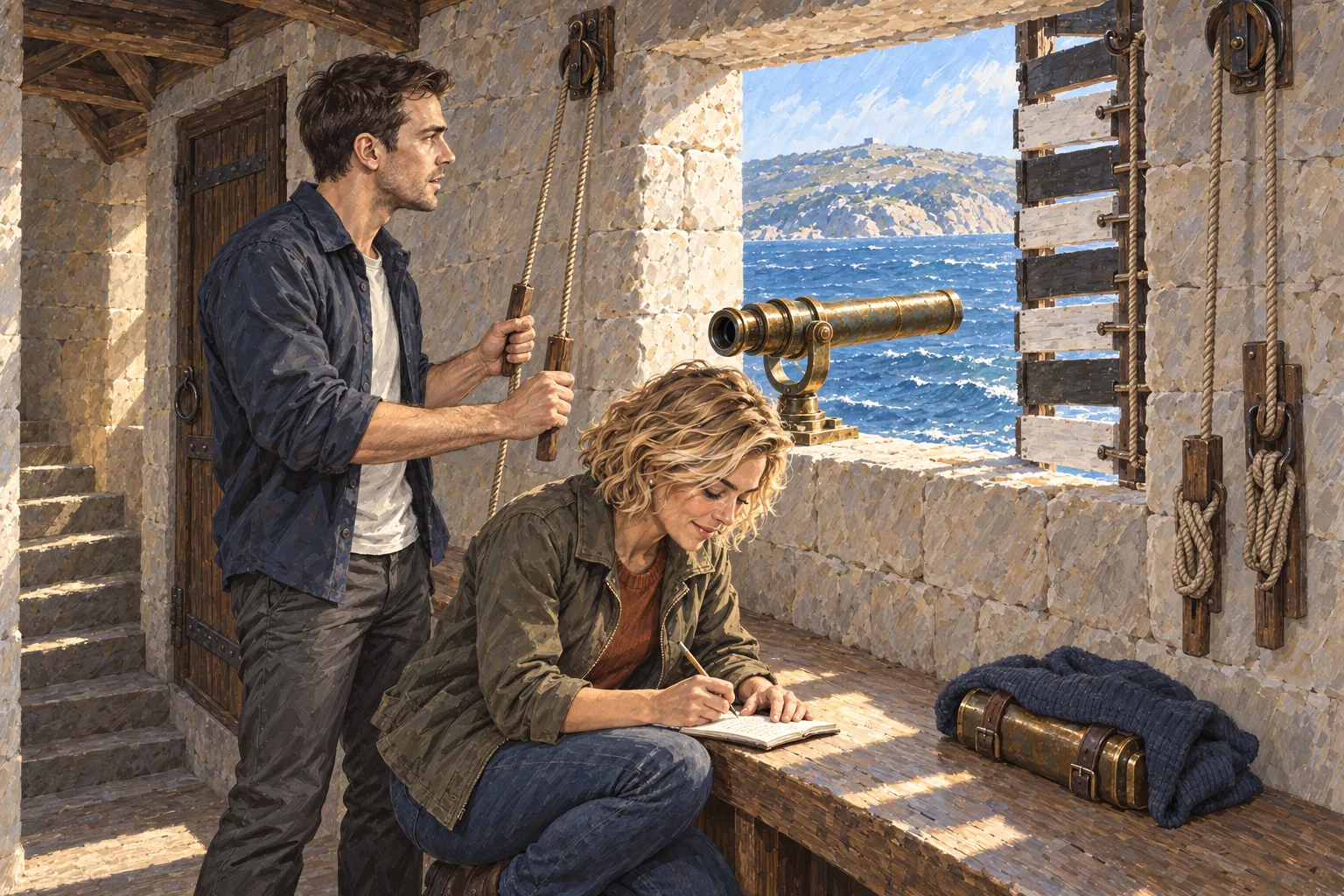
He came away from the eyepiece. Kate had not left hers; she was writing on her knee without looking down, so quickly that the pencil tore the paper at the end of a stroke.
‘Did you get it?’
‘I got some of it.’ She did not look up. ‘The first part’s ours. They sent ours back. With the extra one.’
‘Somebody saw it.’
‘Somebody’s there.’ She looked up then, and her eyes were wet. She laughed at herself and wiped them with the back of her pencil hand. ‘They saw it. They want us to know they saw.’
He looked through his tube once more. The far frame stood still in the sun, white, waiting. He had no idea what to send.
‘We’ll get it wrong if we try anything else,’ Kate said. ‘We don’t know what we’d be saying.’
‘No.’
She closed the notebook over the pencil, carefully, so the torn page would not come loose.
‘Now we go.’
The light was going when they came round the end of the harbour wall, and the sea had come up again while they were in the tower. It slopped over the lowest stones of the slip, where that morning there had been a yard of dry weed. Vic rowed with his back to the town and Kate watched it over his shoulder, and when she said, ‘He’s there,’ he did not need to ask who.
Owen was standing at the top of the slip with his good hand on the rail.
He waited until the dinghy grounded and Kate had the painter. He was looking at the water on the slip as much as at them.
‘It’s been coming up all day,’ he said. ‘Springs were Saturday. It should be dropping by now. It’s this wind, holding it in, and I don’t know how long it’ll blow.’ He nodded at the top of the slip, where the apron ran along to the terminal. ‘Another foot and it’s over the apron. Two and it’s in the terminal, with forty people sleeping on the floor.’
Kate had gone still on the step.
‘The passage,’ she said. ‘Vic. On Saturday it was nearly too deep for the collars at the bend.’
‘And it’s higher now than Saturday,’ Owen said.
Vic did the sum without wanting to. Four metres was printed on the collar’s offer. On Saturday, at the bend, he had felt the collar working at the very edge of it. Since then the sea had come up the slip by the height of his hand, and more.
‘Then it’s closed,’ he said. ‘Until this wind drops.’
‘And the shelf’s broken on both sides, and the gap at the gully’s wider than it was yesterday.’ Kate looked across the harbour, west, to where the inlet ran in under the dark hills. ‘So we can’t get to Three Arches. Not to Mara, not to Sava, not to the market. Not with the flour, not with anything.’
Nobody said anything. The water slopped over another stone of the slip.
‘Then we’d better find out how long the wind’s going to blow,’ Owen said at last, ‘and you’d better find a third way.’ Then he came down two steps, which was as far as the wet stone let him, and looked at both of them, and at the oars, and at the wrapped case on Vic’s knees.
‘Four,’ he said.
‘I know,’ Kate said. ‘I’m sorry. It was me.’
‘It was both of us,’ Vic said.
‘It was me asking.’ Kate made the painter fast and straightened. ‘We stayed for one more go. Somebody answered.’
Owen looked at her for a long moment.
‘Gordon’s on the door,’ he said. ‘He’s been on it since four, doing yours. He said he didn’t mind. His knee minds. And he’s down for his own watch at two.’
Kate drew a breath. ‘Then I’ll do his two o’clock.’
‘Two till six.’
Vic had seen it on the list: the dead of the night, with only Gordon’s name beside it, because nobody else would put theirs.
‘Then I’ll do two till six.’
‘I’ll sit with you,’ Vic said.
‘You’ll sleep,’ Kate said. ‘You can hardly get out of a chair. It was my extra round, and I’ll do it.’
Owen nodded, as though that settled something for him as well.
‘You said somebody answered.’
‘They sent our signal back,’ Kate said. ‘And then something of their own. We don’t know what it means yet.’
‘Then don’t tell Gordon it means anything,’ Owen said. ‘He’ll have them round for tea by Friday.’
He let Vic hand him the oars one at a time, and carried them under his good arm to the cupboard, and did not say anything more about four.
Priya cleared the end of the table for the case without being asked. Vic washed the wrapper with fresh water from the jug, slowly, and let it drip into a basin while Gordon’s chair stood empty at the other end. Then he opened the strap.
The case inside was bronze, darker than the first folio and stained along one edge where the water had sat longest. Its leaves were the same size as the first. He did not turn them yet. He dried the cover, and the hinge, and the narrow fitting that stood out from the spine, a little tongue of metal with an offset shoulder and two unequal notches cut into its sides. It had been made to go into something, the way a key was.
He knew what. He had run his finger along it that morning: the slot in the frame of the cabinet by the archive hatch, with its offset shoulder and its two unequal notches.
He sat very still with the folio in his hands, and did not say anything yet, because Kate was drawing, and because he wanted to be sure. He was sure. They would have to go back.
Then he opened the first leaf.
The road was there, the one the panel had shown, climbing past the arches and on. The station squares stood along it. On the third leaf the road went high, among shapes he did not know, and on the fifth the last square stood above the sea, with a little frame drawn on its face.
Kate leaned over his shoulder.
‘That’s them,’ she said.
She had her notebook open beside the folio. She drew the far station’s pattern down a clean page as she had written it at the tube, then their own pattern below it, and then the answer: their order coming back, the one long dark, and after it the fast part, the strokes she had caught and the gaps where she had not.
‘Sava will know some of this,’ she said. ‘She said she knew some of what they mean.’
‘And Mara can ask her the rest.’
‘We’ll have to take it to them.’ She looked at the gaps. ‘I don’t want to guess at it. If I guess, I’ll make it say what I want.’
Owen had come in behind them. He looked at the page for a while, and at the folio, and at the clock on Priya’s wall.
‘Go and sleep,’ he said to Kate. ‘You’re on at two.’
She went.
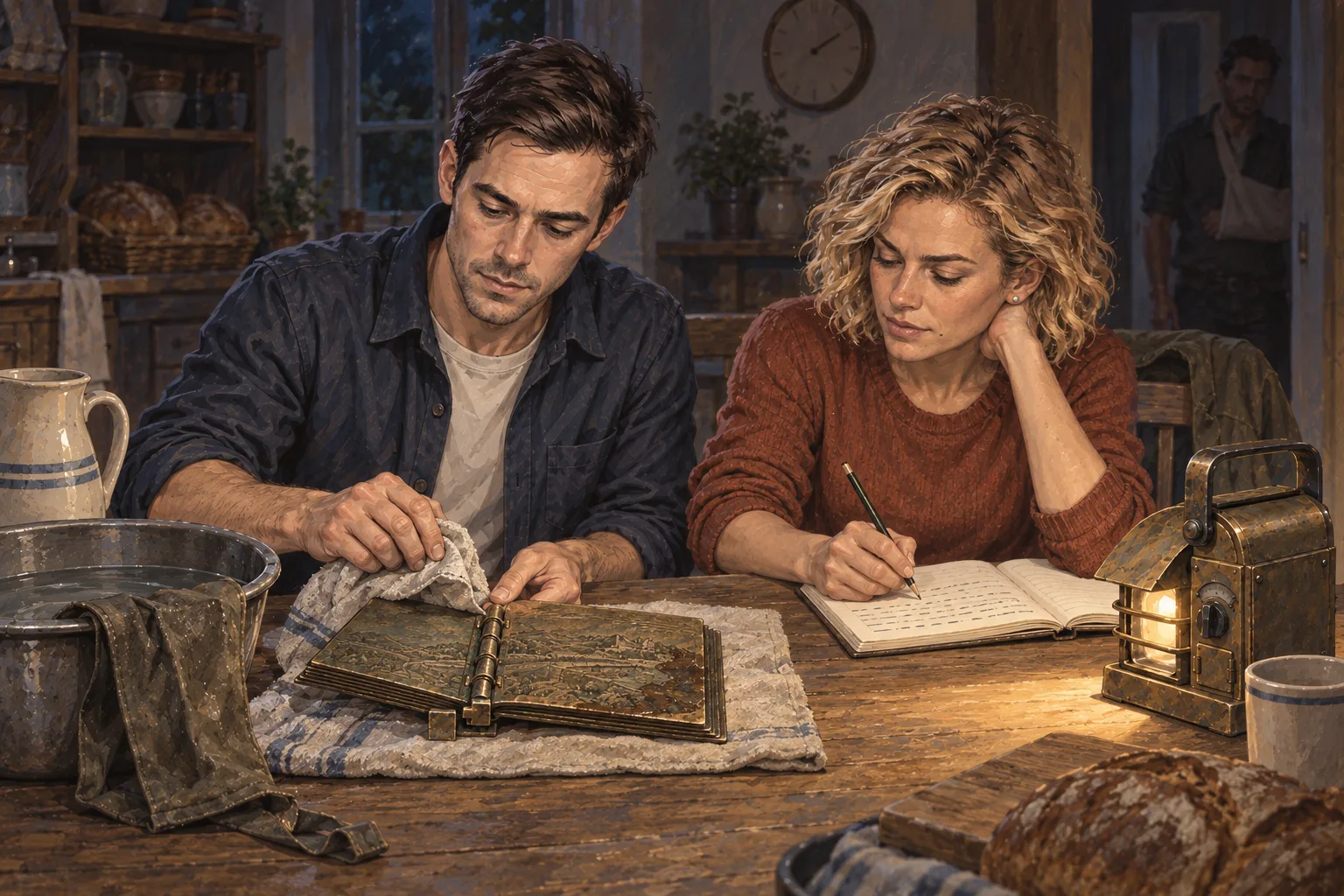
Vic stayed at the table with the folio open and the lamp turned low, and looked at the last square on the fifth leaf, and at the gaps in Kate’s line, until he was too tired to see either.
He did not sleep. At a quarter to two he heard Kate on the stairs, and he was at the back door with his coat on before she reached it.
‘You’re supposed to be asleep.’
‘I tried. Owen says pairs after dark.’
‘Owen says that about Gordon.’ But she waited while he took the lamp, and they went down Gordon’s route together, close enough that their sleeves touched, Vic watching every wall top they passed.
The terminal was dark except for one lamp by the door. Dev, the man who walked all night, was on the watch before them, sitting with his stitched leg up on a chair. He gave Kate the cricket bat with obvious relief, showed them the bench they had dragged across inside the glass door, and limped off to lie down among the chairs. Kate sat on the step with the bat across her knees. Vic sat beside her and turned the lamp low.
For an hour there was nothing but the sea, closer than it should have been, sucking at the stones of the apron.
Then, a little after three, something outside tried the door.
Not hard. A push, a scrape of claws at the bottom of the glass, a breath that misted it. Kate’s hand closed on the bat. Vic slid the lamp’s hood back to its stop and put the full beam against the door, and in the white of it he saw the scarred nose, close, and the pale eyes, and the stiff dark hackles lifting.
It did not run from the light this time. It looked away from it, as if it had learned to, and behind it, at the edge of the beam, two more came up the apron out of the dark.
‘Vic,’ Kate said.
The scarred one hit the door.
The whole frame jumped. The bench they had wedged against it skidded a hand’s width on the tiles, and one of the long glass panes cracked from corner to corner with a sound like ice. The second animal hit the door beside it. Somewhere among the chairs a child woke and began to cry.
He had fourteen effort left; the catch had cost him one. Vic got to the bench before he had thought about it and put his back against it and his good leg against the step, the way he had held the slab on the shelf. He was holding it. That was all the skill asked.
Brace
Effect: holding doubled for 10 seconds.
The next blow came through the door and the bench and into his spine and stopped there. The door held. The cracked pane bowed and held.
Ten seconds, one blow. Then it was only a bench and his back again, and the next blow was already coming.
He paid again.
He had never paid for anything that way before: not once, carefully, after thinking, but over and over, as fast as the blows came, the way he would have fed coins into a meter in the rain. Each one stopped a blow dead. Each one cost him. He could feel the reserve going down inside him like water out of a cistern, and some calm part of his mind, the part that counted rivets, kept the tally. Thirteen. Twelve. Eleven. Ten.
‘How many have you got?’ Kate said.
‘Enough.’ Nine. ‘Not for ever.’
Kate did not waste them. She went to the side window, the one with no bench behind it, and when the third animal’s head came round the frame towards the gap at its hinge she was there with the bat, and she hit it on the nose as hard as she had ever hit anything, and it went back off the step with a scream that set every hound on the apron rasping.
Dev was up, with his chair held legs-out. The Cook had a fire extinguisher in one hand and his ladle in the other. Someone had turned on every torch in the room and pointed it at the glass.
Seven. Six. The scarred one did not tire. Five. Four. A pressure was building behind Vic’s eyes, and when he paid the next one his hands, flat against the bench, began to shake with a fine tremor that had nothing to do with fear. Three. That was the Assay telling him the cistern was nearly dry.
Two.
Two more blows, perhaps, and after that it would be his back and his good leg and whatever the bench was worth.
And then the scarred one stepped back. It stood on the apron in the crossed beams of a dozen phone torches and the full white of the lamp, and looked at the door, and at the window where Kate stood with the bat, and at Vic. Then it turned and went down the apron, and the others went with it, and the dark took them.
Nobody spoke. The child was still crying. Somebody went to it.
Kate came back to the step and sat down beside Vic very suddenly, as if her legs had decided for her. The bat lay across her knees. Her hands were shaking so hard he put his own over them to stop it, though his were shaking too, for a different reason, and after a while she leaned against him, and her head came down on his shoulder, and stayed.
‘It learned,’ she said. ‘It looked away from the light. It learned that.’
‘So did we,’ Vic said.
They sat for a long time with the lamp on the door. Vic was about to turn it down again when Kate took hold of his wrist.
‘Vic. Look.’
She was not looking at the door. Through the long front windows of the terminal, out across the black harbour and the blacker sea beyond it, high on the coast, where in a week of walking those windows Dev had never once seen a light, a single small light was burning.
It went dark.
It came back. One long, two short, and the long white. Then their own extra dark, long, and then the fast part, the part neither of them could read, over and over in the night, as if whoever was up there had been sending it since the sun went down and did not mean to stop.
Kate had her notebook out before he could speak. She wrote with the pencil pressed so hard he heard it, and when the light ran through the fast part again she caught three more strokes than she had caught in the tower, and then four.
‘They’re not just answering,’ she said. ‘They’re still asking. Help. Over and over.’
Vic watched the light go dark and come back, and thought of a stair with its lowest step under the sea, and a road that ended in the air, and someone on a high slope with a frame of slats and a lamp, sending the same thing again and again into the dark because they did not know whether anyone was still listening.
‘Then we answer,’ he said.
Kate did not look away from the window. ‘We don’t know what we’d be saying yes to.’
‘No,’ he said. ‘Not yet.’


